








On 23 June 2016, Wales voted to leave the EU by a margin of 52.5% to 47.5%.
The referendum started the first phase of Brexit - a complex legislative process to extract a Member State from the EU for the first time. The second phase turned to what came next – setting up a new UK-EU relationship that is still in its infancy.
While these two key phases were playing out at a UK-EU level, the UK put new domestic arrangements in place for its internal market, intergovernmental relations and for the EU law that remained on the statute books.
To mark ten years since that day, our interactive tool explains the referendum result in Wales and constitutional developments in the decade since. Click on the boxes for more information on what was put in place between the UK and the EU (dark green), or domestically in the UK (light green).
Select a category:
Withdrawal Agreement
The Withdrawal Agreement is an international law treaty between the UK and EU. It deals only with the separation of the UK from the EU and Euratom.
The Withdrawal Agreement set out that the UK would enter a transition period when it left the EU while the terms of the UK-EU relationship beyond Brexit were negotiated. This would last from 1 February 2020 – 31 December 2020.
The Withdrawal Agreement includes the Northern Ireland Protocol. It protects the rights of UK and EU citizens living in the territory of the other and set out the UK’s financial obligations to the EU. It established governance arrangements to oversee its implementation. The Welsh and Scottish governments do not attend these meetings.
International treaties are subject to a scrutiny process in the UK Parliament but this was disapplied for the Withdrawal Agreement by section 32 of the EU (Withdrawal Agreement) Act 2020.
No Senedd vote on consent took place.
The Withdrawal Agreement entered into force on 1 February 2020.
Back to topNorthern Ireland Protocol
The Withdrawal Agreement includes the Northern Ireland Protocol. It set up new arrangements for the UK-EU land border between Northern Ireland and Ireland, an EU Member State.
Parts of the Protocol were changed by the Windsor Framework in February 2023. Although the Protocol still exists, both agreements are often referred to together as the Windsor Framework.
Back to topBrexit transition period
During the transition period, arrangements stayed mostly the same. For example, the UK stayed in the EU’s Single Market and customs union, contributed to the EU’s budget and continued to apply the EU’s laws and rules. However, the UK was no longer represented in EU institutions and it had no voting rights. The UK’s 73 MEPs, including four from Wales, vacated their seats on 31 January 2020.
The transition period started a countdown for the UK and EU to agree the terms of their post-Brexit relationship, which would start from 1 January 2021.
Negotiations continued throughout 2020 on what would later become the Trade and Cooperation Agreement, announced on 24 December 2020.
Back to topTrade & Cooperation Agreement
The TCA is an international treaty between the UK and EU. It deals only with their cooperation after Brexit.
It was agreed on 24 December 2020 and signed on 30 December 2020. It applied provisionally from 1 January 2021 and entered fully into force on 1 May 2021, after approval from the European Parliament and European Council. Agreements on nuclear cooperation and the security of classified information were agreed alongside the TCA.
International treaties are subject to a scrutiny process in the UK Parliament but this was disapplied for the TCA by section 36 of the EU (Future Relationship) Act 2020.
No Senedd vote on consent took place.
The TCA applied provisionally from 1 January 2021 before entering fully into force on 1 May 2021.
Back to topWindsor Framework
The Windsor Framework changed parts of the Northern Ireland Protocol in relation to trade, the UK’s internal market, and Northern Ireland’s say in decision-making.
The UK Government agreed not to proceed with the Northern Ireland Protocol Bill. The EU agreed:
- not to proceed with seven infringement proceedings it had against the UK; and
- to proceed with granting the UK access to the EU’s science and research programmes, including the €96 billion Horizon programme.
No Senedd vote on consent took place.
The Framework is credited with improving UK-EU relations and was generally welcomed by the Welsh Government despite it not having been consulted on the changes. The Welsh Government would later consent to UK regulations to implement the Framework.
Learn more in our article, Wales and the Windsor Framework.
The Windsor Framework took effect from 1 October 2023. Some arrangements were later phased in, including for medicines supply, trade and for parcel movements.
Back to topCommon Understanding
On 19 May, the UK and EU announced their latest agreement, Common Understanding. It paves the way for new arrangements in the five following areas:
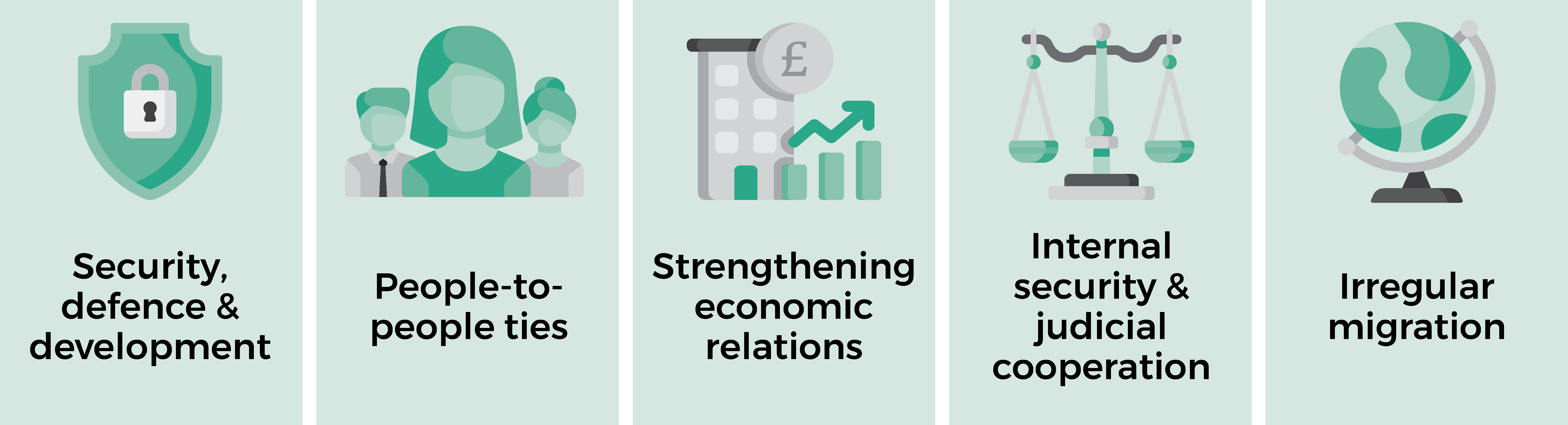
As with every main UK-EU agreement, Common Understanding covers areas of devolved responsibility which the Welsh Government, the Senedd and others will need to put into place.
Among other things, the agreement includes plans for UK participation in Erasmus+ and the EU’s Single Electricity Market, a UK-EU Sanitary and Phytosanitary (SPS) trade agreement, and the linking of UK and EU emissions trading systems.
The UK also committed to following EU rules in three areas: SPS, emissions trading and electricity. For the first two, the UK agreed to make a “financial contribution” to do so. The UK Government intends to implement these arrangements via the EU Partnership Bill.
More information is available in our article, What could the latest UK-EU agreement mean for Wales?
Back to topBrexit referendum
On 23 June 2016, UK voters were asked:
Should the United Kingdom remain a member of the European Union or leave the European Union?
In Wales, 854,572 voted to leave and 772,347 voted to remain – a 52.5% / 47.5% split in favour of leaving. Blaenau Gwent had the highest leave vote (62.0%) while Cardiff had the lowest leave vote (40.0%).
Turnout in Wales was 71.7% compared to 72.2% in the UK as a whole. Turnout was highest in Monmouthshire (77.8%) and lowest in Merthyr Tydfil (67.4%).
Back to topCommon Frameworks
In 2018, the governments of the UK agreed to establish Common frameworks. Common frameworks are agreements between the four governments of the UK on how to manage divergence between the four nations in areas previously governed or coordinated at EU level.
Changes proposed to legislation by any of the four nations in one should be discussed by the intergovernmental groups established by the relevant framework before a government introduces it to their legislature. There are 26 common frameworks in areas devolved to Wales.
Originally intended to be in place by January 2021, many of the frameworks have yet to be finalised. As of May 2026, only 4 of the 26 that related to devolved areas in Wales have been finalised.
Back to topEU (Withdrawal) Act 2018
The EU (Withdrawal) Act 2018 (EUWA18) has three main functions. It:
- repealed the European Communities Act 1972, through which EU law automatically applied in the UK;
- converted EU law to UK law on the day of the UK’s exit (11pm, 31 January 2020) and created a new category of UK law, retained EU law; and
- gave UK and Welsh Ministers temporary powers to deal with deficiencies so that the law functioned effectively.
EUWA18 amended the Government of Wales Act 2006 accordingly, including to remove the requirement for an Act of the Senedd to be compatible with EU law.
The Welsh Government originally recommended the Senedd withhold consent to the EU (Withdrawal) Bill. Following amendments and an intergovernmental agreement with the UK Government, the Welsh Government recommended the Senedd consent to the Bill.
A Senedd vote on consent took place and consent was granted on 15 May 2018.
Vote result: For 46, Against 9, Abstain 0.
The Act received Royal Assent on 26 June 2018.
Back to topEU Settlement Scheme
EU citizens who lived in Wales before Brexit must have applied to the EU Settlement Scheme (EUSS) to stay. EU, EEA-EFTA and Swiss nationals and their family members are eligible for the EU Settlement Scheme. Irish nationals are exempt.
The EUSS remains open to receive late applications beyond its original deadline of 30 June 2021. Successful applicants from Wales had surpassed 116,000 by the end of March 2026.
The Sixth Senedd’s Equality and Social Justice Committee monitored applications to the EUSS in Wales and published a final report in November 2025, Settled but not safe? EU citizens who stayed after Brexit. The report drew four conclusions warning of a second Windrush, a lack of awareness and understanding, the complexity of the system and issues around Wales-specific data. The Committee called for continued scrutiny in the Seventh Senedd.
More information is available in our article, How many EU citizens stayed in Wales after Brexit?
Back to topEU (Withdrawal Agreement) Act 2020
The EU (Withdrawal Agreement) Act:
- gives effect to the Withdrawal Agreement in domestic law; and
- dealt with other separation issues, like how EU law would apply in the UK during and after the transition period. One important example is that a new body of law, called retained EU law (REUL), would be created at the end of the transition period.
The Welsh Government recommended the Senedd withhold consent to the EU (Withdrawal Agreement) Bill.
A Senedd vote on consent took place and consent was withheld on 21 January 2020.
Vote result: For 15, Against 35, Abstain 0.
The Act received Royal Assent two days later on 23 January 2020.
Back to topUK leaves the EU
The UK left the EU at 11pm GMT on 31 January 2020 when the Withdrawal Agreement entered into force at midnight CET. This started the Brexit transition period which would end on 31 December 2020.
Back to topUK Internal Market Act 2020
The UK Internal Market Act (UKIMA):
- establishes the presumption that (in general) goods, services and professional qualifications that can be sold or recognised in one part of the UK should be able to be sold or recognised in any other part, even if the law there is different;
- introduces “market access principles” for goods and services. These mean that, even if the Senedd passes a law to ban or regulate a particular product or service, it can only be enforced on something produced in Wales or imported directly into Wales from outside the UK or apply to a service provider from Wales. Anything that comes into Wales from another part of the UK, or can be legally provided in another part of the UK, doesn’t have to comply with this law if it falls within the scope of the Act, unless it is specifically excluded;
- establishes an Office for the Internal Market which can investigate the impact of legislation proposed or made by any of the four legislatures of the UK on the operation of the UK Internal Market; and
- places duties on Welsh Ministers in respect of the Northern Ireland Protocol and Northern Ireland’s place in the UK internal market.
UKIMA doesn’t affect the Senedd’s legislative competence but it does impact the practical effect of its laws once they are in force.
The Welsh Government recommended the Senedd withhold consent to the Bill.
A Senedd vote on consent took place and consent was withheld on 8 December 2020.
Vote result: For 15, Against 36, Abstain 0.
The Act received Royal Assent on 17 December 2020.
A key amendment was agreed during the Bill’s passage through the House of Lords which enables areas governed by a common framework to be excluded from the scope of the Act. However, only UK Government Ministers can add exclusions to the Act.
So far, there have been three exclusions agreed through Common Frameworks: single-use plastic products, glue traps for capturing animals and deposit return scheme for drinks containers.
In 2025, the UK Government carried out a review of Parts 1, 2 and 4 of the Act and also considered the process for considering exclusions from the market access principles. It published its response to the review in July 2025. The Welsh Government published its response on 17 July 2025.
Back to topEU (Future Relationship) Act 2020
The Act:
- implements the TCA, the Civil Nuclear Agreement and the Security of Information Agreement, in domestic law;
- gives Welsh Ministers powers to implement the TCA in devolved areas;
- set procedures for the exercise of Welsh Ministerial powers at the Senedd; and
- made further provision relating to the UK-EU future relationship, including requiring all domestic legislation to be read in accordance with the TCA retrospectively.
No Senedd vote on consent took place.The Senedd was recalled from Christmas recess on 30 December 2020 to debate the end of the Brexit transition period. A vote was held on a motion noting that the Senedd was not in a position to determine consent.
Motion vote result: For 28, Against 24, Abstain 0.
The Act received Royal Assent the next day, on 31 December 2020.
Back to topNew UK intergovernmental structure
In 2018, the UK and devolved governments commissioned a review of intergovernmental relations to “ensure they are fit for purpose in light of the UK’s exit from the EU”. In January 2022, the governments reached agreement.
The review established a three-tier structure for formal intergovernmental relations:
- interministerial groups at portfolio or departmental level;
- an Interministerial Standing Committee to consider cross-cutting issues, and a Finance Interministerial Standing Committee; and
- a Prime Minister and Heads of Devolved Governments Council to provide oversight of “the system of multi-level governance created by devolution”.
Included among the interministerial groups is a group on UK-EU Relations.
More information is available in our article, The Review of Intergovernmental Relations: a “significant constitutional step forward”?
Back to topRetained EU Law (Revocation & Reform) Act 2022
To minimise disruption when exiting the EU, the UK converted EU law to domestic law and called it retained EU law (REUL). This meant that pre-Brexit laws stayed in place with the aim of avoiding gaps in important areas like product standards, animal welfare and employment law. REUL became a distinct body of law but there are different views on what should be done with it.
The Act puts some of the UK Government plans for REUL into place and grants powers to UK and Welsh Ministers to make future changes.
The Welsh Government recommended the Senedd withhold consent to the Bill in all five of its Legislative Consent Memorandums (LCMs). LCMS are laid in the Senedd when a UK Bill covers policy areas devolved to Wales. Members then vote on whether or not the Senedd should give consent for the UK Parliament to legislate on its behalf.
The Act:
- revoked some REUL so it expired on 31 December 2023. This is the 587 items of REUL listed on Schedule 1, EU-derived rights, the principle of supremacy and general principles of EU law;
- renamed remaining REUL “assimilated law” from 1 January 2024;
- grants UK and Welsh Ministers powers to amend, repeal and replace REUL and assimilated law more easily;
- grants UK and Welsh Ministers powers to recreate the effect of REUL supremacy to a limited extent in relation to specific instruments;
- provides domestic courts with greater discretion to depart from REUL case law; and
- repealed the Business Impact Target as part of other regulatory reforms.
There is no requirement on the UK Government to obtain consent from the Welsh Ministers, nor the Senedd, when making changes in devolved areas.
The UK Government’s programme of REUL/assimilated law reform is ongoing and an informal consent arrangement is in place whereby the Welsh Government’s consent is sought, regardless. The Welsh Ministers have informally granted consent on this basis to UK regulations making changes in devolved areas, like the environment. To date, single statutory instruments have been used to revoke up to 93 pieces of REUL at a time.
Two Senedd votes on consent took place and consent was withheld on 28 March 2023 and 6 June 2023.
Result of first vote: For 13, Against 38, Abstain 0.
Result of second vote: For 17, Against 36, Abstain 0.
The Act received Royal Assent on 29 June 2023.
Back to topSafeguarding the Union
The Northern Ireland Executive was sworn into office for the first time in two years on 3 February 2024. This followed publication of the Safeguarding the Union Command Paper by the UK Government on 31 January and new regulations passed on 1 February. These make changes to address the Democratic Unionist Party’s (DUP) concerns about the Windsor Framework.
Safeguarding the Union:
- established new NI-GB governance structures;
- changed trade rules to incentivise and boost NI-GB trade; and
- provided over £3 billion to the Northern Ireland Executive to address public sector pay pressures and provide an updated Barnett formula for Northern Ireland.
One regulation extended the UK Internal Market Act (UKIMA) 2020’s market access principles to goods from NI. It requires UK Ministers to issue guidance on how to comply with the duty in section 46 of UKIMA to have special regard to NI’s place in the UK internal market and customs territory. Devolved ministers must now have regard to this guidance when carrying out relevant functions.
No Senedd vote on consent took place.
Learn more in our article, Wales and Safeguarding the Union.
Back to topBorder Target Operating Model
The Border Target Operating Model (BTOM) is the UK’s post-Brexit trade border model.
It sets out how imports entering Great Britain will be handled. The UK, Welsh, and Scottish governments and officials from Northern Ireland, developed the BTOM. It will apply to all imports, including to EU imports for the first time since Brexit.
New trade and customs controls will be carried out at Welsh ports. Welsh Ministers are responsible for biosecurity, food safety and sanitary and phytosanitary (SPS) controls which protect animal, plant and public health.
The regime has been subject to several delays and not all controls have been introduced. It was originally due to be phased in from January 2024, with a second phase in April 2024 and a third in October 2024. A different timetable applied to goods arriving from the island of Ireland – it had two phases; January 2024 and October 2024. This is particularly important to Wales, whose ports form part of the UK landbridge with Irish ports.
Three new Border Control Posts (BCPs) were planned for Wales at Holyhead, Fishguard and Pembroke Dock to process imports after Brexit.
Construction was underway at Holyhead when further BCP development was paused across Great Britain in anticipation of a UK-EU SPS agreement. This could reduce or even eliminate the need for trade controls.
More information is available in our articles, Wales and the UK’s new trade border model and Why does Wales need Border Control Posts?
Back to topProduct Regulation & Metrology Act 2025
The Act empowers UK Ministers to unilaterally recognise certain EU product requirements. The consent of Welsh Ministers is needed when making regulations in devolved areas.
The UK Government says this would maintain high product standards, prevent additional costs for businesses and provide regulatory stability.
The Sixth Senedd’s trade committee report on the Bill detailed several concerns, including shifting responsibility onto businesses to keep up with regulatory changes. It concluded:
…the implications for Wales-EU trade are unknown. The Bill would empower the Secretary of State to choose to recognise an indeterminate number of current or future EU regulations, or none at all.
The Welsh Government initially said there’d be positive impacts for Wales-EU trade but later clarified this as a “potential” benefit for importers and a “limited benefit” to exporters.
A Senedd vote took place on 3 June 2025 and consent was granted.
Vote result: For 39, Against 10, Abstain 0.
The Act received Royal Assent on 21 July 2025.
Back to topEuropean Partnership Bill (UK)
The UK Government’s European Partnership Bill is intended to facilitate the “implementation of new deals agreed with the EU now and in the future”.
The UK-EU Common Understanding agreement paves the way for the UK to follow EU rules in “electricity, emissions trading, and food and drink”.
More information is available in our article, Why could Wales follow EU rules?
Back to topEuropean Alignment Act (Wales)
The new Welsh Government’s election manifesto includes plans for a Wales-only European Alignment Act. The intention is to:
Bring forward a new European Strategy, underpinned by a European Alignment Act – to enable us to keep pace with Europe’s world-leading standards in areas including environmental protection, public health and food standards.
Before the election in March 2026, the First Minister said that he believed “firmly that the benefits far outweigh the negatives of close alignment”. Also in its manifesto was the party’s long-standing call for the UK to rejoin the EU’s Single Market and customs union.
In January 2025, the party said that the new law “would undo botched Brexit damage”. The spokesperson for Justice and European Affairs, Adam Price MS, said the legislation would:
enable Welsh law to be aligned as closely and quickly as possible with essential European standards when it is in Wales’ best interests.
He added that it:
would restore powers we should never have given up and would enable Welsh law to be aligned as closely and quickly as possible with essential European standards when it is in Wales’ best interests.Wales needs to stick as close as we can to our European friends and allies and remain alive to changes in European politics and policy to protect our communities in an ever more insecure and uncertain world.
On 13 May 2026, Adam Price MS was appointed Cabinet Minister with responsibility for coordinating matters relating to UK-EU trade.
More information is available in our article, Why could Wales follow EU rules?
Back to topUnderstanding Wales-EU trade in goods since Brexit
Article by Sara Moran, Sam Jones, Adam Cooke and Josh Hayman Senedd Research, Welsh Parliament