








|
Note: This article uses the term “EU citizens” to describe EU, EEA-EFTA (Iceland, Norway and Liechtenstein) and Swiss nationals and their family members who are eligible for the EU Settlement Scheme. Irish nationals are exempt. |
EU citizens who lived in Wales before Brexit must have applied to stay to the EU Settlement Scheme (EUSS) by 30 June 2021, even if they’ve lived here for decades. Although the deadline was five years ago, the EUSS remains open for late applications.
Separation agreements between the UK, the EU and other European states required them to take steps to allow each other’s citizens to stay living in their countries after Brexit. Each country could decide how to put their duties into action. The EUSS is the UK’s first digital-only visa system. The Welsh Government and the Senedd are responsible for upholding EU citizens’ rights in devolved areas.
The separation agreements guarantee the rights of children of EUSS status holders, making the issue both long-term and intergenerational. Failure to obtain status can lead to the loss of rights to work, housing, education and benefits, and even to deportation.
A combination of low awareness, complexity, narrowing criteria and poor data led to stark warnings of a second Windrush from the Sixth Senedd’s Equality and Social Justice Committee (“the Committee”).
This article summarises the latest statistics up to 31 March 2026 and the Committee’s key findings in the Sixth Senedd.
EUSS status explained
EUSS applicants receive one of many possible outcomes.
To stay, successful applicants are granted either a permanent ‘settled’ status (for those who can prove they’ve lived here for five years in a row) or a temporary ‘pre-settled’ status (for those who can’t).
There have been changes to pre-settled status in the past. It’s now a five year status that is automatically extended by an additional five years as its expiry approaches. When pre-settled citizens have proof of residency, they can apply to be upgraded to settled status or may be upgraded automatically.
Both groups can live, work and access healthcare but there are important differences. For example, pre-settled citizens may not be able to access benefits and their family members can’t join them.
Unsuccessful applications are categorised as ‘refused’, ‘withdrawn or void’ or ‘invalid’.
Over 116,000 EU citizens can stay in Wales
Nobody knows how many EU citizens lived in the UK before Brexit, so we don’t know how many applications to expect.
Since its launch in 2019, there have been 8.9 million applications against estimates of approximately 4 million. Over 2.8 million applications were received after the June 2021 deadline.
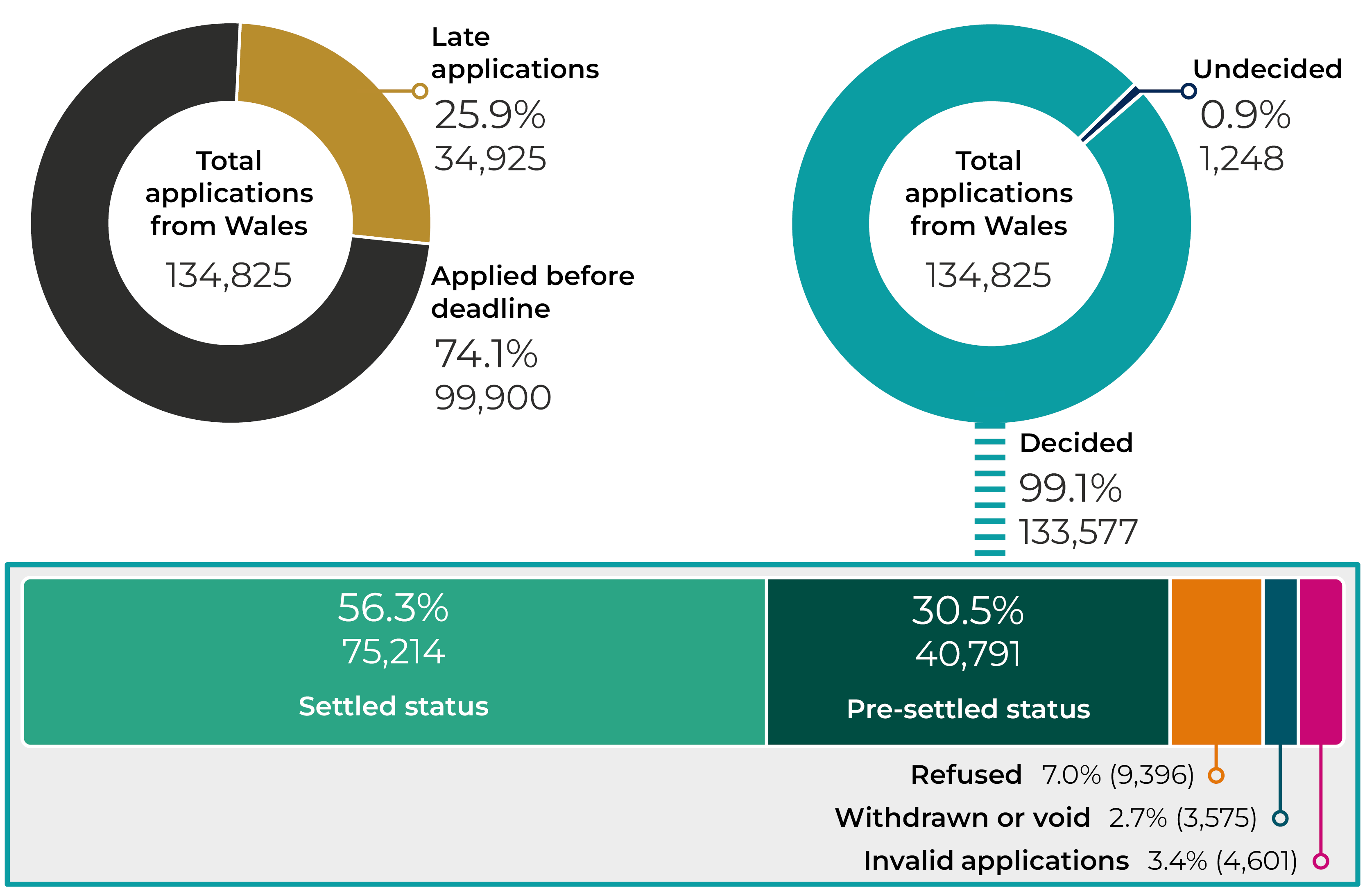
134,825 applications have been received from people in Wales.
116,005 (86%) applicants were successful and can stay either permanently or temporarily. 75,214 were granted settled status and 40,791 pre-settled status. This means that initial estimates for Wales of 95,000 eligible citizens have been surpassed by over 21,000 so far. The Home Office was still receiving hundreds of late applications from Wales every month when it stopped reporting this statistic (the total by June 2025 was 31,207).
17,572 (13.2%) applications were unsuccessful.
EUSS applications from Wales by date, decided applications and outcomes by percentage and number
Source: UK Government Immigration system statistics data tables: EU Settlement Scheme, March 2026
Applications by local authority
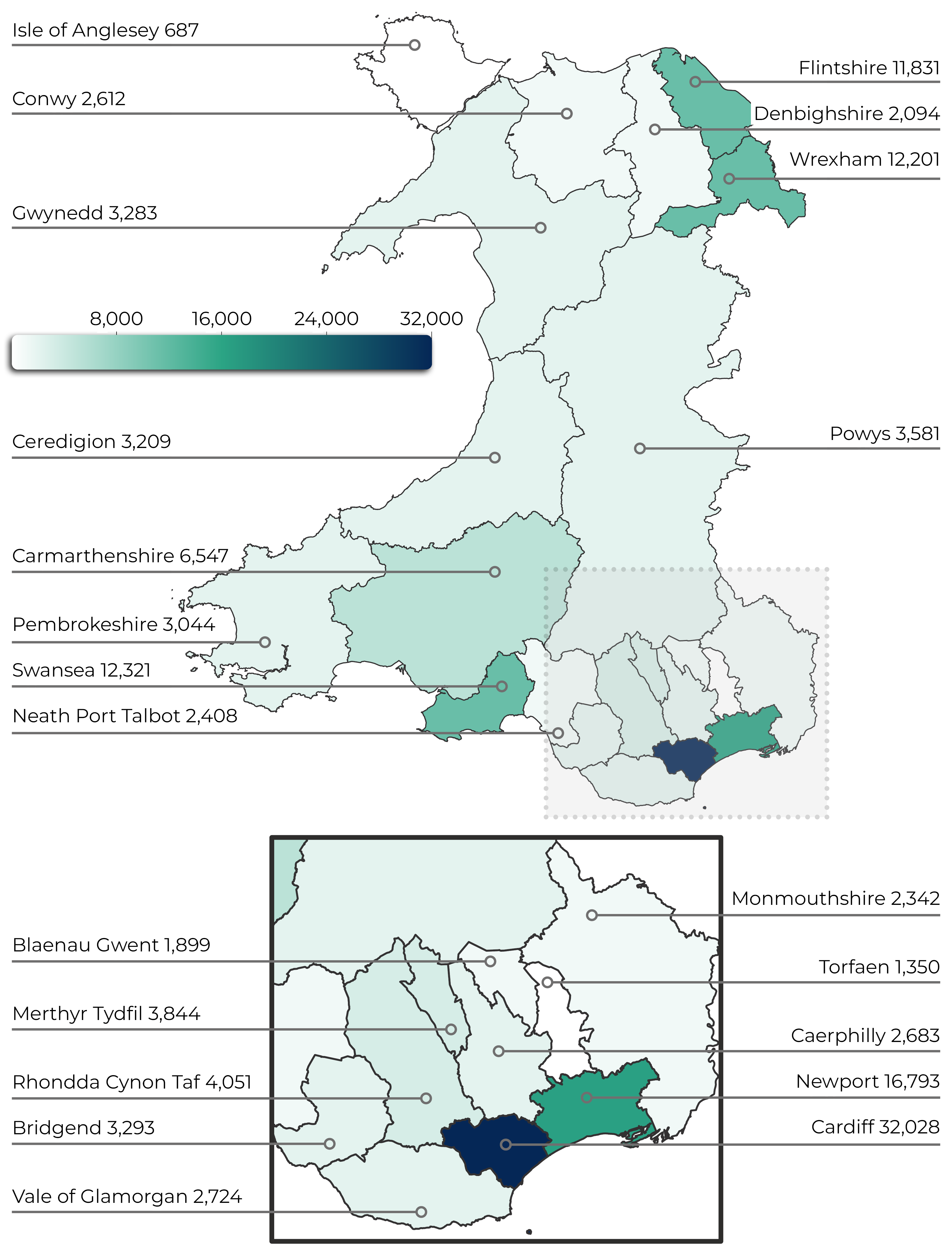
The map below shows the total number of EUSS applications by local authority. Cardiff has the most (32,028) and the Isle of Anglesey has the least (687).
Source: UK Government Immigration system statistics data tables: EU Settlement Scheme, March 2026
Wales statistics removed from Home Office reporting
Wales-level EUSS data was considered inadequate by both the previous Welsh Government and the Sixth Senedd’s Committee. This was detailed in its 2025 report, Settled but not safe? EU citizens who stayed after Brexit, which also documents how statistical requests made by the Welsh Government were “ignored” by the Home Office.
Quarterly statistics were previously published for the UK, devolved nations and local authorities. Fewer statistics were available for the devolved nations than for the UK. However, recent changes have removed devolved-level statistics, leaving UK and local authority levels only. This means that, for example:
- where a Wales-level total was previously provided, it now must be calculated by adding up local authority data individually. This covers all of the main categories, such as application outcomes and applications by type (age, European nation etc.);
- it is no longer possible to see, nor to calculate, monthly late applications by devolved nation. This was a key concern in the Sixth Senedd because hundreds of applicants from Wales faced increasingly narrowed criteria as more time passed after the deadline; and
- comparisons between the four nations are no longer readily available.
“Complete statistics would be of universal benefit”, says Sixth Senedd committee
The Committee’s report concluded that statistics available at the time didn’t “provide a complete picture for Wales”. It said:
We see no reason why the UK Government should not publish Wales-level breakdowns and routinely share data with the Welsh Government as a necessary part of EUSS delivery.
Complete statistics would be of universal benefit to the EUSS’ operation in Wales. Without it, the Welsh Government will never fully understand this group of more than 113,000 citizens who make up 3.6% of the Welsh population, and for whom it has important responsibilities.
It urged the UK Government to:
- share all available Wales-related statistics with the Welsh Government; and
- review its published statistics with the aim of improving the availability of information in the public domain on the devolved nations.
EUSS and the Seventh Senedd
The Committee wanted the EUSS’ long-term nature to be recognised and to become central to UK- and Wales-level planning. It said that a future Welsh Government should target support towards vulnerable groups and those who are likely to be unaware of the need to apply, and to work with stakeholders to share expertise and maintain compliance with the UK’s international obligations resulting from Brexit. It also called for a future Senedd committee to continue its work in the Seventh Senedd.
|
If you have been affected by the issues raised in this article, Settled offers free, accredited advice on the EUSS in a wide variety of European languages. You can contact Settled via their online referral form, email or helpline: 0330 223 5336. |
Why could Wales follow EU rules?
Understanding Wales-EU trade in goods since Brexit
Article by Sara Moran, Senedd Research, Welsh Parliament