The Senedd and Pierhead buildings will be closed to the public on Thursday 15 October. Read information about the closure.









A level results 2026: how did students do and what happens next?
Published 13/08/2026 | Last Updated 13/08/2026
Today, thousands of learners across Wales have received their exam results. We look at how they compare with previous years and those across the UK. We also look at what comes next both for learners and the education system itself.
What do this year’s results look like?
|
A note on data
The 2026 results data presented in this article is provisional. The data, which is published by the Joint Council for Qualifications (JCQ), reflects the position at the time results are issued and may be revised following further checks. The data covers qualification entries by learners of all ages. Qualifications Wales also publishes on-the-day information on results in Wales, with more detailed analysis published later in the autumn.
What detail do we have?
Data published by the Joint Council for Qualifications shows that:
- Mathematics continued to be the most popular subject at both A level and AS level.
- At A level, the largest increases in A level entries in Wales were in mathematics (+202, +5.3%), health and social care (single award) (+148, +22.7%), and chemistry (+131, +5.6%). The largest decreases were in computing (-71, -14.5%), geography (-50, -4.7%), and law (-47, -6.6%).
- At AS level, the largest increases in entries in Wales were in psychology (+380, +13.4%), mathematics (+277, +5.8%), and sociology (+260, +16.3%). The largest decreases were in chemistry (-87, -2.5%), health and social care (single award) (-69, -6.8%), and English literature and English language and literature, which were tied at -51 each (-3.0% and -5.9% respectively).
- There was an increase of around 42% in entries to Welsh First Language at A level, from 185 in 2025 to 262 in 2026.
- At A level, there was a small gap in the overall pass rate for males and females, with males achieving 97.0% and females achieving 98.2% at A* to E. Continuing the trend of previous years, females outperformed males at all grade points apart from A*, where males outperformed females by 1.8 percentage points (pp). Since 2019, males have generally outperformed females at A*, with 2021 being the exception, when grades were centre-determined.
- At AS level, females outperformed males by 2.2pp at A-E and 5.4pp at A-C. However, males outperformed females at A grade by 0.2pp, representing a break from the trend.
Today’s results provide only part of the picture. More detailed data on differences between groups of learners, including breakdowns by ethnicity, ALN status and local authority, will be published later in the year. A level data for learners eligible for free school meals (eFSM) is not routinely published, unlike at GCSE level, where attainment gaps are well documented.
How do this year’s results compare to previous years?
This year’s results are broadly in line with those of 2025, 2024, and the pre-pandemic levels of 2019.
- A level results at grades A* to E were 97.7%, 0.2 percentage points (pp) higher than in 2025, 0.3pp higher than 2024, and 0.1pp higher than 2019.
- AS level results at grades A to E were 90.7%, 0.2pp lower than in 2025, 0.5pp higher than 2024, and 0.6pp higher than 2019.
- AdvSBW results at grades A* to E were 97.4%, 1.4pp higher than in 2025. This is the second summer that the qualification has been awarded. Awards at each grade point were higher than 2025.
A level results: 2018-2026
Figure 1. A level results in Wales, 2018 to 2026 (percentage of all grades awarded). All candidates.
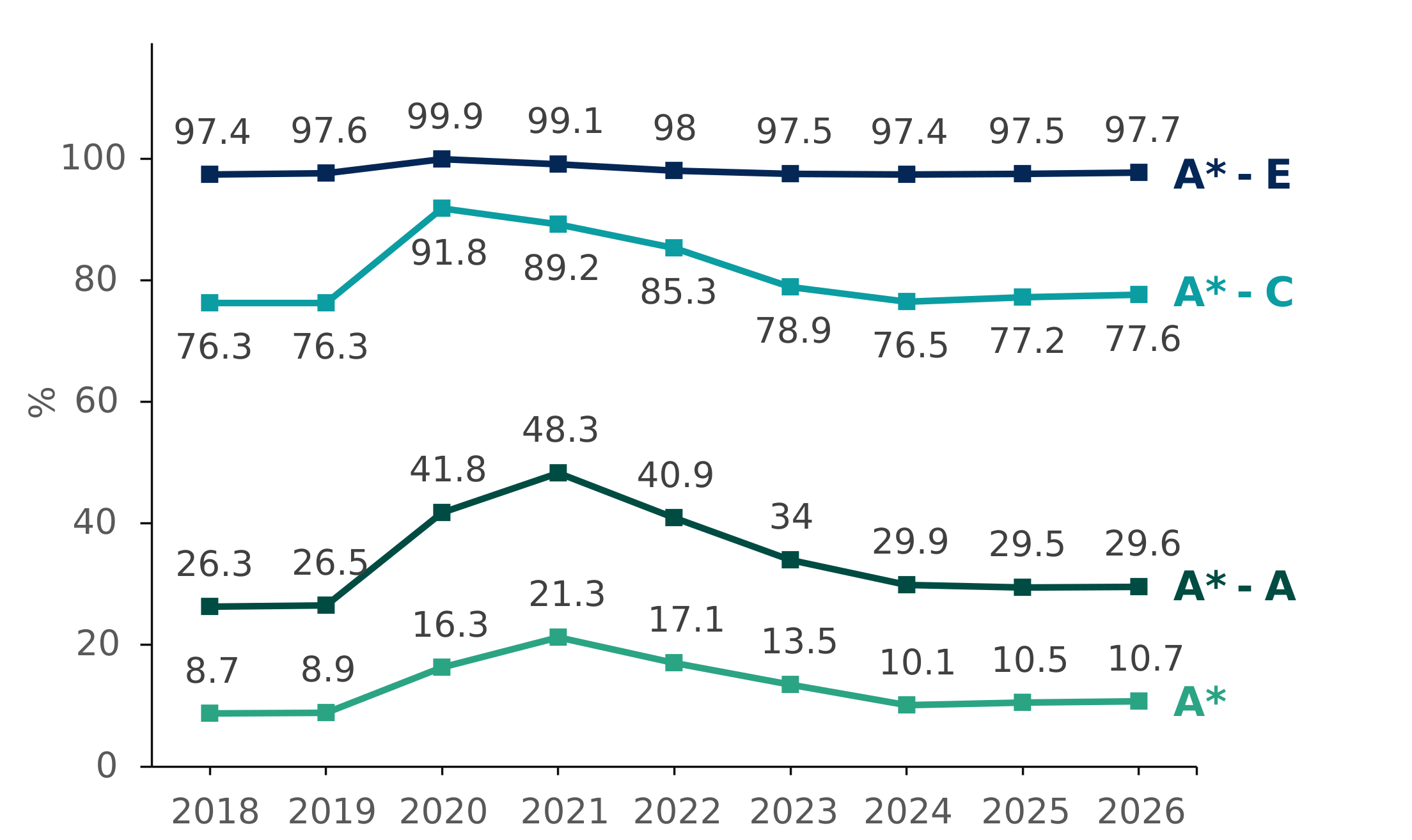
Source: JCQ. Caution is needed when comparing results with 2020 (centre-awarded grades), 2021 (centre-determined grades), and 2022 and 2023 (transition years).
AS level results: 2018-2026
Figure 2. AS level results in Wales, 2018 to 2026 (percentage of all grades awarded). All candidates.
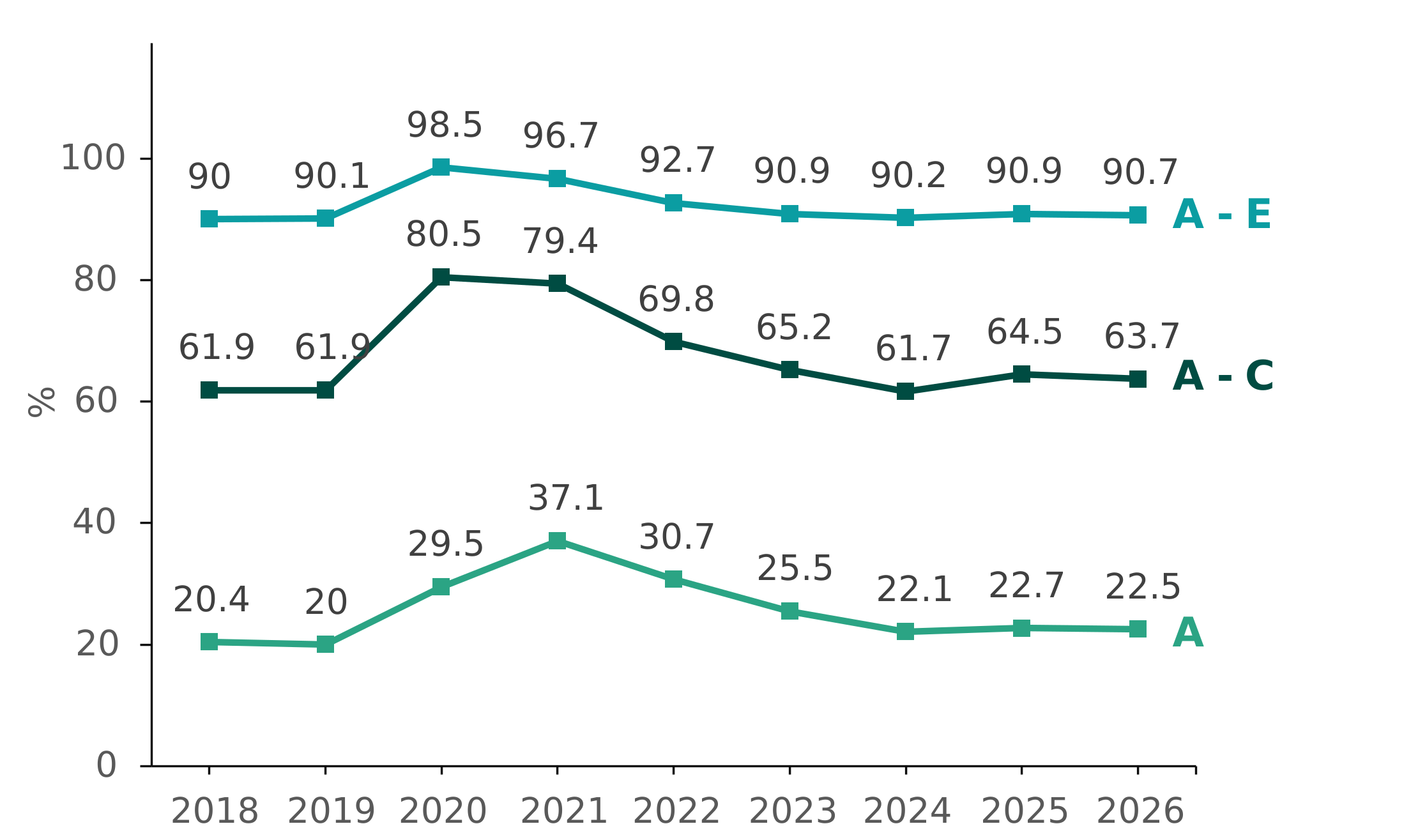
Source: JCQ. Caution is needed when comparing results with 2020 (centre-awarded grades), 2021 (centre-determined grades), and 2022 and 2023 (transition years). A* grades are not awarded at AS level.
Comparison with pandemic years
When interpreting the data above, comparisons with results from 2020 to 2023 should be treated with caution. Qualifications awarded during these years were subject to alternative and transitional assessment arrangements as a result of the COVID-19 pandemic. As a result, outcomes in those years are not directly comparable with results awarded under current assessment arrangements.
The infographic below summarises changes to assessment arrangements between 2020 and 2024.
Timeline of assessment arrangements from 2020 – 2024
Timeline of assessment arrangements from 2020 – 2024 by Senedd Research
Can this year’s results be compared with England and Northern Ireland?
Caution is needed when making comparisons, but the headline A level and AS level figures published by the JCQ allow broad comparisons across Wales, England and Northern Ireland.
The table below shows headline A level results for Wales, England and Northern Ireland in 2026, with 2025 figures shown in brackets. Qualifications are regulated separately in each nation and some assessment arrangements differ. For example, AS levels contribute to the final A level grade in Wales but not in England. Scotland is not included because its qualifications system is not directly comparable.
Table 1. Provisional A level results in Wales, England and Northern Ireland, 2026 (2025 figures shown in brackets). Source: JCQ.
|
A level results |
A* to A (%) |
A* to C (%) |
A* to E (%) |
|
Wales |
29.6 (29.5) |
77.6 (77.2) |
97.7 (97.5) |
|
England |
28.3 (28.2) |
78.1 (77.0) |
97.5 (97.4) |
|
Northern Ireland |
30.7 (30.4) |
86.9 (85.8) |
98.9 (98.7) |
New for this year, JCQ has published results on an interactive dashboard.
What’s next for learners?
Results day remains a personal milestone for learners as they make decisions about university places, apprenticeships and employment.
Support and guidance for learners is available from a variety of sources:
- The Welsh Government’s Young Person’s Guarantee aims to ensure that all 16 to 24-year-olds in Wales can access education, training, employment or self-employment opportunities. Working Wales acts as the main gateway for support.
- UCAS clearing provides opportunities for learners applying to higher education that have not secured a place at their preferred institution, changed their plans, or received different results than expected.
- Student Finance Wales provides information on the funding available to eligible learners entering further and higher education. We have also published a range of student funding guides providing information on the financial support available to Welsh learners.
- Careers Wales has information for young people, parents or carers. There are a number of ways to get in touchwith them to discuss options upon leaving school or college including face-to-face appointments or online chats.
Learners who believe there may have been an error in the marking or administration of their results should speak to their school or college. Schools and colleges can request a review of results through the awarding body where appropriate.
What’s next for policymakers?
A level results are one indicator of how Wales’s education system is supporting learners’ progression, alongside issues such as attendance, behaviour and wellbeing. Policymakers are likely to monitor learner destinations, including progression to further or higher education, apprenticeships, employment and training.
Despite previous Welsh Governments having a long-standing aim to encourage participation in post-16 education and training through initiatives such as the Young Person's Guarantee, data shows 17% of people aged 16 to 24 in Wales were not in education, employment or training (NEET) in the year ending December 2025. An ongoing UK-wide review described the rates of young people who are NEET as a “generational challenge”.
What happens on results day is also likely to inform ongoing debates about the significant challenges facing post-16 education and qualifications policy in Wales. These include the financial pressures facing universities and student loans. This year’s results will contribute to the evidence base used to assess participation, progression and attainment across Wales.
We will publish an article on GCSE results when they are published on Thursday 20 August 2026.
Article by Dr Nyle Bevan-Clark, Senedd Research, Welsh Parliament