








The number of young people who are not in education, employment or training (NEET) has been high on the political agenda over recent months. Each number represents a young person’s life and future.
Young people face a range of complex and interconnected barriers to accessing education and entering the workplace. Ahead of Wednesday’s Plenary debate on young people and employment, this article explores these challenges, the support available from governments to address them, and the changes needed to improve outcomes for young people.
Young people and the Welsh labour market
There are three main sources of data published on young people who are NEET. The statistical first release (SFR), the annual population survey (APS), and pupil destinations from schools. According to the Welsh Government, the SFR is the “definitive statistical source” for estimates of NEETs; this is published annually. The APS is a rolling year annual estimate; which is published twice a year. Careers Wales carries out an annual survey of school leavers in the October; this data is used to calculate the proportion of young people who are NEET. It’s not advised to draw comparisons between the different data sources.
Annual Population Survey (APS) statistics estimate that the proportion of young people aged 16-24 in Wales who were NEET was 17% in the year ending December 2025; an increase of 5.5 percentage points over the previous year. Note, there is increased uncertainty around estimates from the APS.
The graph below shows the Statistical First Release (SFR) data on the proportion of young people who were NEET and whether they were unemployed (actively looking for work and available to start work) or were economically inactive (not looking for work and not available to start work).
Using the SFR measure, in 2024, the proportion of young people aged 16-24 who were NEET was 13.7%, which is 47,100 young people. Of those who were NEET, 14,300 were unemployed and 32,800 were economically inactive. Over recent years, young people in Wales who are NEET have been considerably more likely to be economically inactive than unemployed.
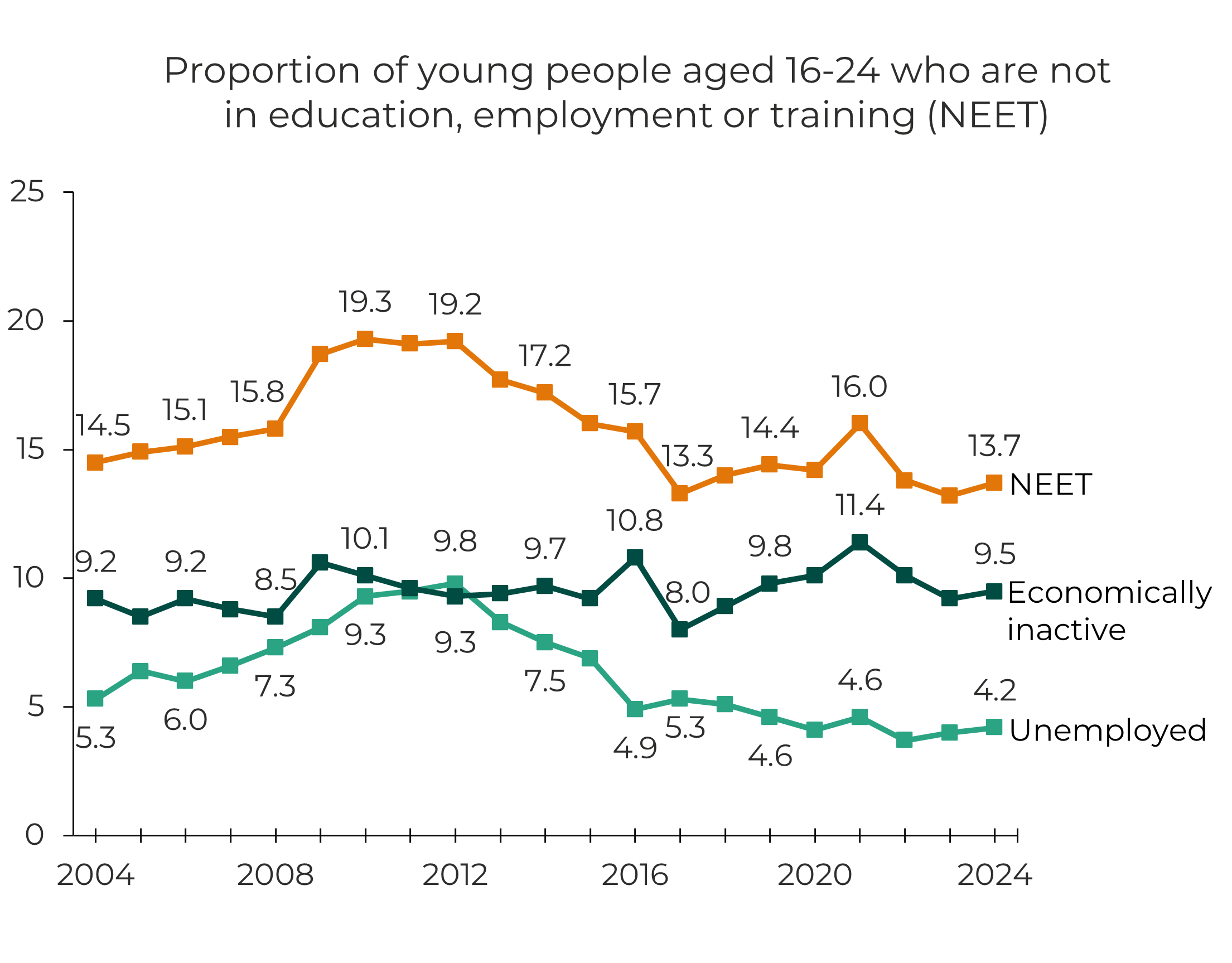
Source: StatsWales, Estimated 16 to 24 year olds not in education, employment or training in Wales by economic activity and age group
Being NEET, particularly for a long time, can have permanent ‘scarring effects’ on a young person. Recent research from academics at University College London found that, in midlife, someone persistently out of employment, education or training as a young person is:
- Six times as likely to be out of work than someone who was never out of employment, education or training as a young person; and
- Three times as likely to report being in poor health than someone who was never out of employment, education or training as a young person.
The challenges young people face in Wales are similar to those across the UK. The interim report to the UK Government on young people and work by Alan Milburn (the Milburn review) highlights young people across the UK who are NEET are becoming detached from the labour market, and are not looking for work.
The big change identified by the Milburn review is the considerable increase over the past decade in the proportion of people who are NEET due to a work-limiting health condition. Over the same period, the percentage of young people in the UK who are NEET has gone from being around the European average to being higher than all EU Member States except Romania.
The Milburn Review also highlights that some groups of young people are particularly likely to be NEET – care leavers, carers, young mothers, and youth offenders. It finds that these groups are failed at transition points by the services which are supposed to support them into the labour market.
Support available to help young people into employment
Both the UK and Welsh governments provide support for young people who are NEET. The UK Government provides support through job centres, and has also developed a range of initiatives that operate in Wales:
- The Youth Jobs Grant offers employers a grant of £3,000 to hire an eligible young person aged 18-24 for 16 weeks or more.
- The Connect to Work service supports disabled people, as well as those who have health or complex non-health related barriers to work.
- The Department for Work and Pensions has funded the Welsh Government and local authorities to deliver Economic Inactivity Trailblazers, which operate in Blaenau Gwent, Denbighshire and Neath Port Talbot.
- The UK Government’s Jobs Guarantee will fully fund six month paid jobs for 18-24 year olds who have been on Universal Credit and looking for work for 18 months. Phase 1 of the guarantee is operating in south-east and south-west Wales, and the guarantee will be fully rolled out across Great Britain later this year.
The previous Welsh Government launched the Young Person’s Guarantee (YPG) to provide everyone aged 16 to 24, living in Wales, with support to gain a place in education or training or help to get into work or self-employment. It aims to prevent young people from becoming NEET. The YPG covers a number of support packages including:
- Jobs Growth Wales+ aims to help young people aged 16-19 to gain skills, qualifications and experience to get a job or further training;
- ReAct+ funding is available for people aged 20 or over who have recently been made redundant or are at risk of being made redundant; and
- Communities for Work+ provides specialist employment support to young people who are NEET and have a complex barrier to employment or those who are not eligible for other programmes.
In February, the then Minister for Culture, Skills and Social Partnership said that, while he felt the YPG had been successful, it was set up during the COVID pandemic, when the Welsh Government expected to focus more on youth unemployment than economic inactivity. Last year, an evaluation of the YPG found that new strategies are needed to reach and engage young people who “have become more and more disengaged from education, work, and training and the support available”.
Responding to the challenge
The First Minister said last month that “we should all be very, very worried at the high level of NEETs that we are seeing”. The Welsh Government will convene a future skills summit to develop a skills strategy that “doesn't accept NEETs as just an inevitable part of the landscape”. The First Minister also said the Welsh Government is increasing training and employment opportunities through investing in apprenticeships and exploring the expansion of junior apprenticeships.
The UK Government has committed to devolving non-Job Centre Plus employment support funding to Wales. It has started this process by transferring funding to the Welsh Government for the Economic Inactivity Trailblazer pilots.
Further funding will be transferred for the design and delivery of a new Employability Support Programme. The Programme was designed by the previous Welsh Government to replace existing support from March 2027, and the procurement process is ongoing. The initial focus will be on young people aged 16-24 who are NEET.
The Milburn review warns that “we are at risk of a lost generation”, with the social contract that each generation is able to do better than the last being broken. How the Welsh and UK governments respond to this will be critical in shaping the opportunities and futures of young people.
Article by Gareth Thomas and Lucy Yarham, Senedd Research, Welsh Parliament