








Schools have moved beyond the immediate COVID‑19 recovery phase, but more pupils are missing school and more often than pre‑pandemic. Pupil behaviour is increasingly seen as a barrier to the already significant challenge of improving educational outcomes and is exacerbating existing concerns about learners’ well‑being.
School attendance and wellbeing remain lower than before the pandemic, persistent absence is higher, exclusions are at their highest recorded level, and teachers and pupils report worsening behaviour. These trends are most pronounced in secondary schools. While the pandemic intensified these issues, some reflect longer-term patterns. Pupils facing socio-economic disadvantage, which for many years has been measured as those eligible for free school meals (eFSM), are experiencing a slower and more uneven recovery.
|
Following the rollout of universal free school meals in primary schools, eligibility for free school meals on a means-tested basis continues to be used as the main indicator of socio-economic disadvantage (SED) – for now. The previous Welsh Government was reconsidering how SED is measured amongst learners and is undertaking a ‘Beyond eFSM’ research project. |
Is attendance improving or has it just “plateaued”?
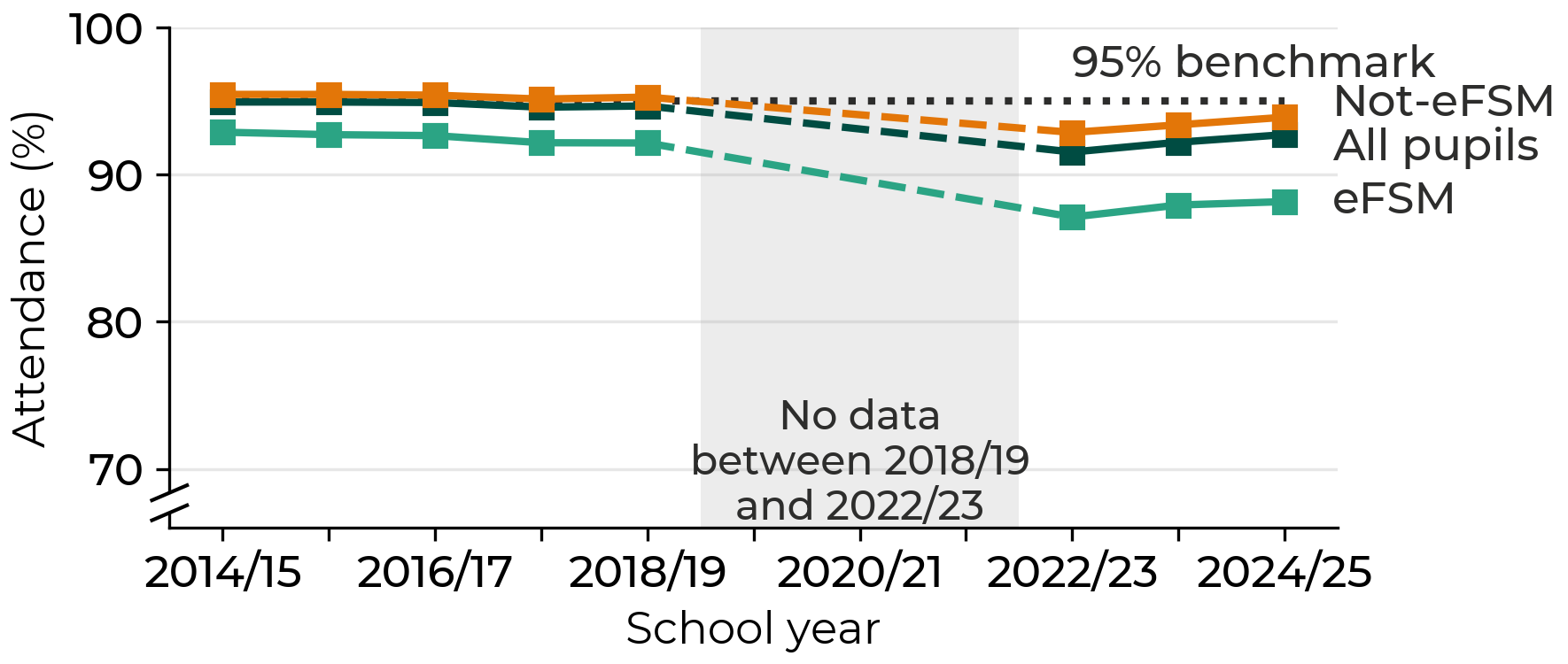
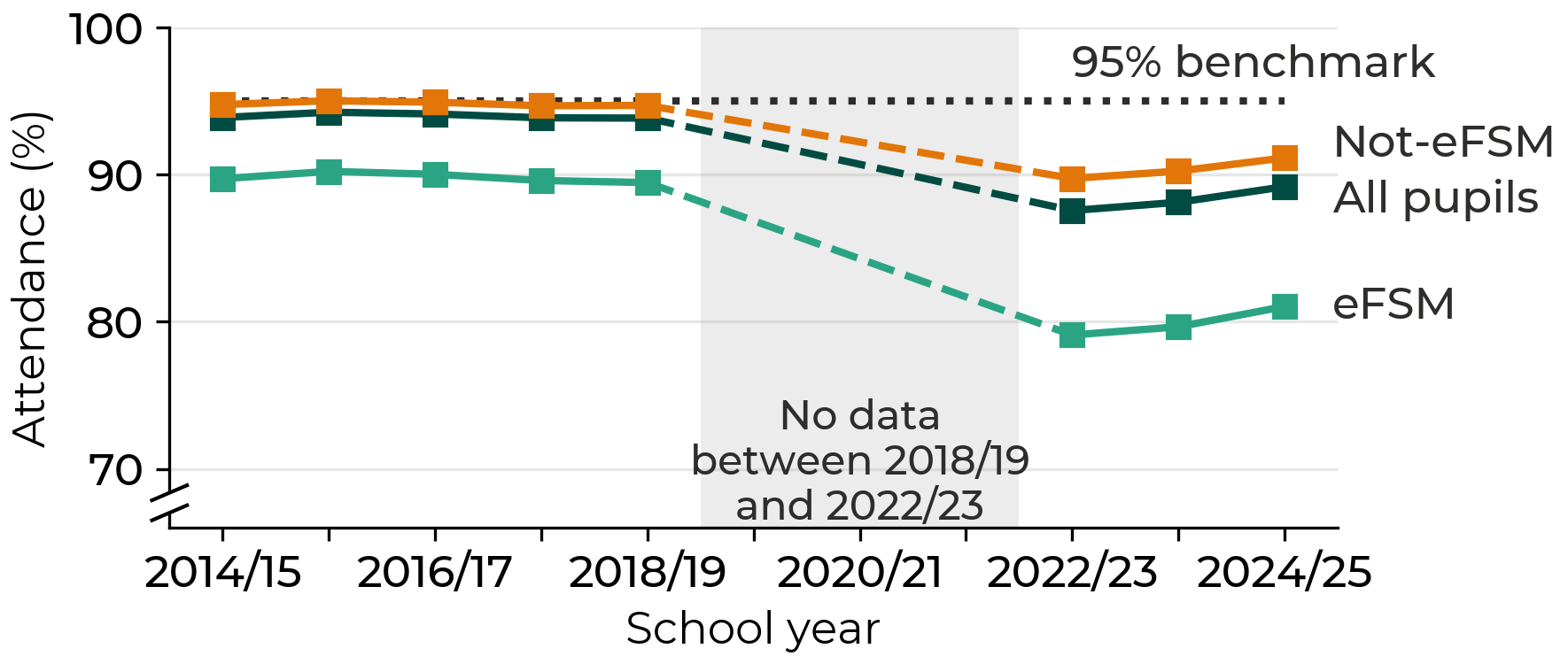
Put simply, if learners are not at school, it directly affects their educational outcomes. Attendance declined sharply following the pandemic and has been slow to recover (Figures 1 and 2). In 2024/25, attendance in all state-funded schools was 91.1%, notably below the pre-pandemic figure of 94.3% in 2018/19 and the Welsh Government’s "good attendance” benchmark of 95%.
The attendance gap between pupils eFSM and those not-eFSM has widened markedly across all settings, but is clearest in secondary schools. For secondary school learners, attendance in 2024/25 for learners eFSM was 81.2%, compared to 91.1% for those not eFSM – a gap of just under 10 percentage points. This represents a significant rise from the pre-pandemic gap of 5.2 percentage points in 2018/19.
The education inspectorate, Estyn, has said progress has “plateaued” in secondary schools. It noted particular concern regarding learners eFSM, some of whom were missing substantial proportions of the school year. Estyn’s thematic report on attendance highlighted transport difficulties and inconsistent local-authority approaches to addressing the issue. Parents have identified persistent barriers to attendance, as outlined in a 2023 report by the charity Parentkind, such as health conditions, school refusal and unmet needs (e.g. additional learning needs) – all of which were described as worsening since the pandemic.
Improving attendance was one of the then Cabinet Secretary for Education's stated priorities. The former Welsh Government sought to take a multilayered approach to improving school attendance, centred on prevention, wellbeing, and a ‘whole school approach’ to mental health. It published updated national guidance on attendance – which set out clearer statutory definitions of attendance and persistent absence – and allocated £8.8m over two years from December 2024 to fund, train, and retain additional Family Engagement Officers.
Figure 1: Percentage of half-day sessions attended by all pupils, pupils eFSM, and pupils not-eFSM: primary school
Source: Welsh Government, Attendance and absence from primary schools: September 2024 to August 2025, Table 1 and Table 3, 27 November 2025
Figure 2: Percentage of half-day sessions attended by all pupils, pupils eFSM, and pupils not-eFSM: secondary school
Source: Welsh Government, Attendance and absence from secondary schools: September 2024 to August 2025, Table 1 and Table 3, 30 September 2025
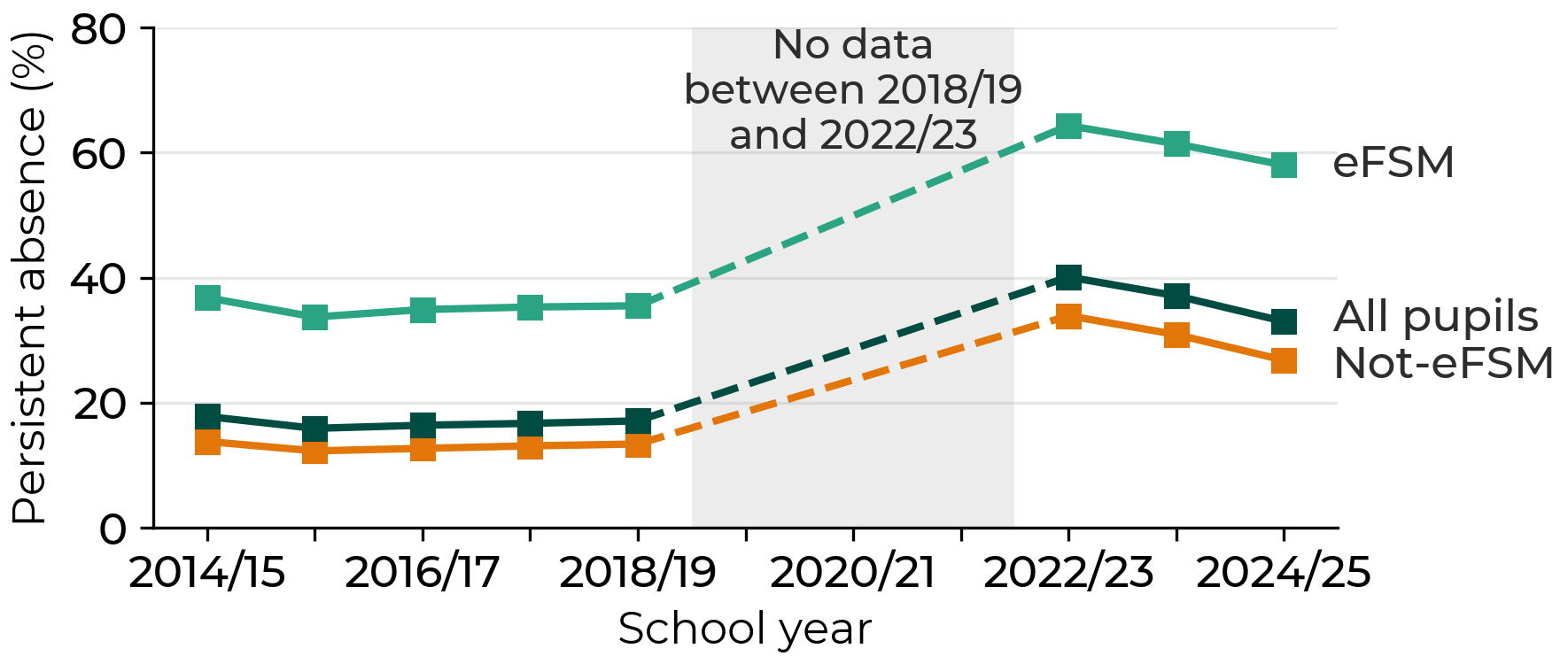
Nearly 60% of secondary-school pupils eFSM are persistently absent
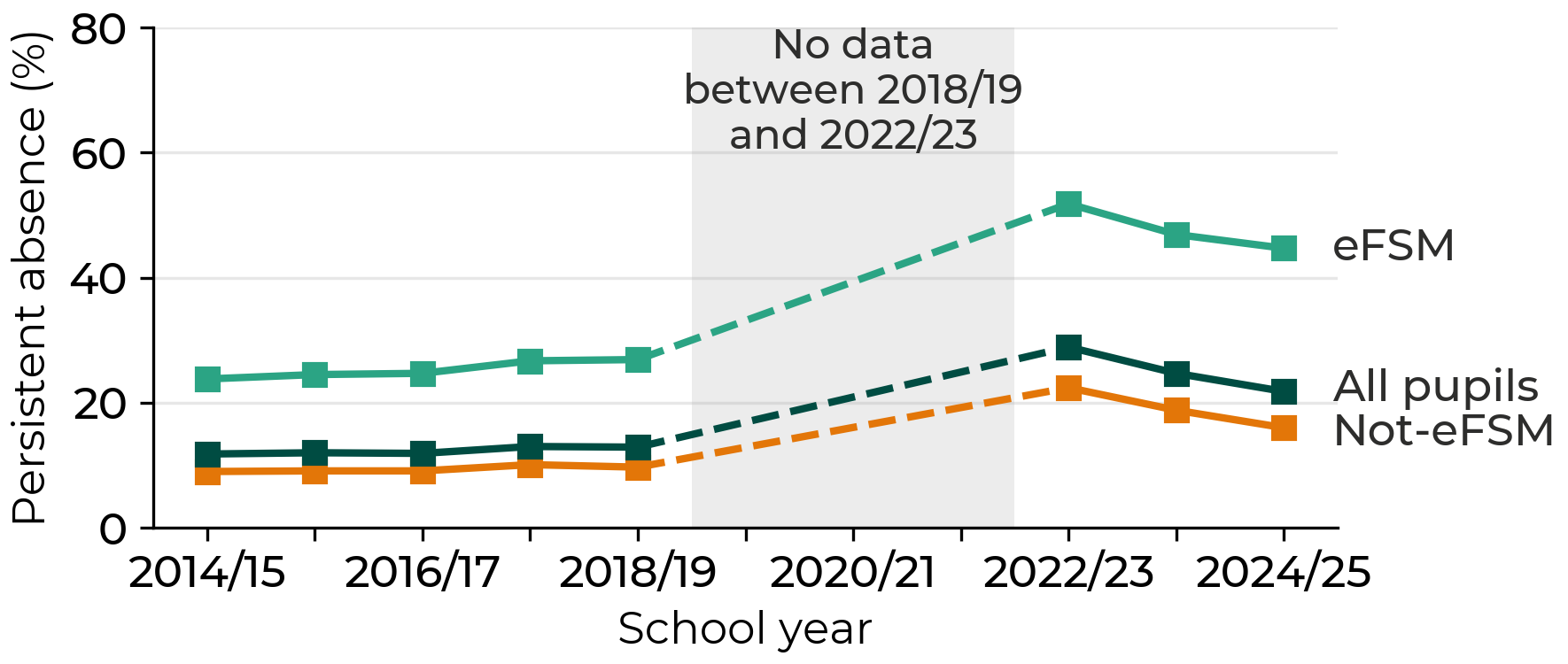
Persistent absence – now defined as missing more than 10% of school sessions - has followed a similar trajectory of a sharp rise during the pandemic (Figures 3 and 4). The 2024/25 figure of 27.0% is well above the 2018/19 level of 14.7%. Persistent absence is disproportionately concentrated among pupils eFSM. In 2024/25, nearly half of eFSM primary-school learners (44.7%) and over a half of eFSM secondary-school learners (58.0%) missed more than 10% of school sessions. This compares with 26.9% of primary school learners and 35.5% of secondary school learners in 2018/19.
These high levels of persistent absence among pupils eFSM point to complex, often overlapping challenges. Various stakeholder evidence suggests that this includes unmet additional learning needs (ALN), a lack of free transport within three miles, housing insecurity and poverty, health-related issues and anxiety, and family pressures and instability.
Ex-Labour MP Alan Milburn, who is currently conducting a UK-wide review into the rise in young people who are not in education, employment or training (NEET), commented that the “cascade effect” from school absence into long term unemployment was a “social and economic disaster happening in real time.”
Figure 3: Percentage of pupils persistently absent (missing 10% or more of half-day sessions): primary school
Source: Welsh Government, Attendance and absence from primary schools: September 2024 to August 2025, Table 9 and Table 11, 27 November 2025
Figure 4: Percentage of pupils persistently absent (missing 10% or more of half-day sessions): secondary school
Source: Welsh Government, Attendance and absence from secondary schools: September 2024 to August 2025, Table 9 and Table 11, 30 September 2025
Worsening behaviour and exclusions
Concerns about pupil behaviour, long predating the pandemic, have become more prominent, with teachers, children and young people reporting increased disruption, aggression and wider difficulties in managing emotions.
Estyn’s thematic report identified persistent low-level disruption, defiance and occasional physical confrontation in secondary schools, often linked to external influences such as social media and peer dynamics. Research from Bangor University highlights the rising frequency and intensity of challenging behaviours, while teaching union NASUWT reported in April 2025 that violent incidents in Welsh schools had more than doubled over the past three years. In a 2025 NASUWT survey of members, over half of respondents said that verbal or physical abuse has made them consider leaving the profession.
A report by the Welsh Youth Parliament’s Committee on Crime and Behaviour painted a bleak and detailed picture for children and young people. It said “some pupils don’t feel safe where they learn”, which “needs to be addressed for their own wellbeing, and to allow them to give 100% towards their education”. The Welsh Government accepted all 8 of the Welsh Youth Parliament’s recommendations.
In 2025, the Welsh Government convened a roundtable on violence and safety and a National Behaviour Summit, both of which emphasised national consistency, trauma-informed practice, professional learning, multi-agency collaboration and datasharing, improved community and family engagement, and stronger learner voice. Following the summit, the Welsh Government issued a new behaviour ‘toolkit’.
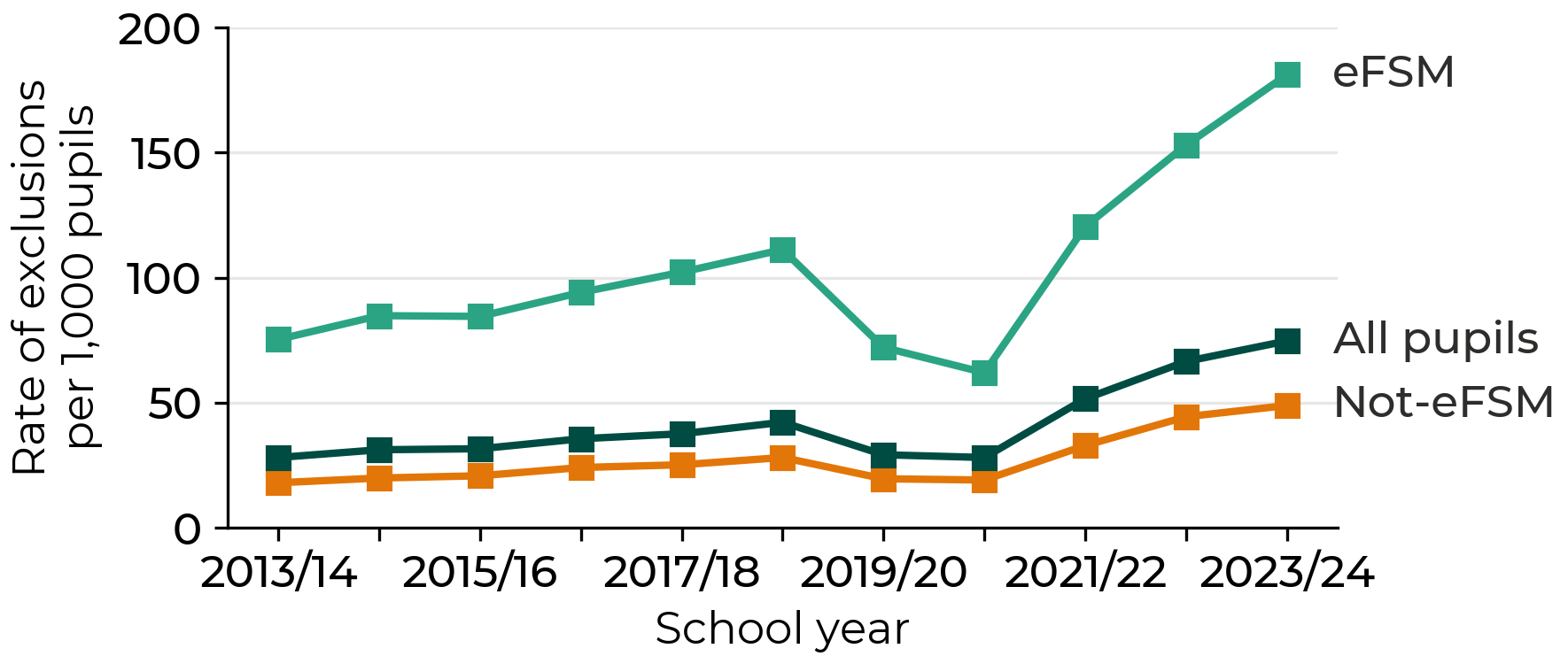
The behaviour of learners is much broader than the issue of school exclusion, but exclusion trends form part of the picture. The provisional data shows the rate of fixed-term exclusions for secondary schools almost doubled from 78.3 per 1,000 pupils in 2018/19 to 149.9 per 1,000 pupils in 2023/24. Across all settings, learners eFSM receive fixed-term exclusions at almost 4 times the rate of pupils not-eSFM.
Unlike attendance rates, which have shown slight improvement since the pandemic, exclusion rates (both fixed-term and permanent) have risen every year since 2021/22 and are now at their highest level since the data series began in 2011/12. Earlier this year, both the then First Minister and Cabinet Secretary for Education described this as “unacceptable”. These patterns raise questions about the education system’s capacity to meet rising needs, the effectiveness of early intervention, and the increasing demands on pastoral and behaviour support teams.
Figure 5: Rates of fixed-term exclusions by all pupils, pupils eFSM and pupils not-eFSM
Source: Welsh Government, Permanent and fixed-term exclusions from schools: September 2023 to August 2024 (provisional), Table 4, 11 November 2025
Fewer learners are satisfied with their life now than in 2017
Pupil well-being has been elevated up the agenda through the Welsh Government’s emphasis on the ‘whole-school approach’ to mental health. Learner well-being is unsurprisingly seen as closely linked to attendance and behaviour.
Findings from the School Health Research Network (SHRN) 2023/24 secondary-school survey show a decline in both life satisfaction and mental wellbeing among learners. Life satisfaction across secondary-aged learners fell from 84.8% in 2017 to 80.0% in 2023. The data also highlights persistent inequalities. There is a 13.6 percentage point gap in life satisfaction between pupils with the lowest (70.9%) and highest (84.5%) Family Affluence Scores.
There has also been a sharp rise in pupils showing high or very high levels of difficulties across peer problems, hyperactivity, emotional issues and conduct.
This proportion has increased from 25.8% in 2019 to 35.2% in 2023.
A 2022 survey for the Children’s Commissioner found that 63.2% of 7-11 yearolds and 66.6% of 12-18 year-olds were “worried or concerned” about their mental health/well-being. Drivers of low well-being include increased anxiety, family stress, social media pressures, and the long-tail effects of the pandemic on social skills. Schools continue to report increasing demand for counselling, pastoral support and external mental-health services. These pressures are felt more acutely in communities with higher levels of deprivation.
Persistent gaps
Pupil engagement is shaped by interconnected factors including attendance, persistent absenteeism, behaviour and wellbeing. Disadvantaged learners, particularly those eFSM, continue to face greater barriers across all areas.
Although some indicators show modest improvement, significant gaps remain.
Article by Dr Nyle Bevan-Clark, Senedd Research, Welsh Parliament