








Tuesday 24 February 2026 marks four years, or 1,461 days, since Russia launched its full scale invasion of Ukraine. In the days that followed, over 2,000 kilometres away at the Senedd, Wales’ political parties united in condemnation as Ukraine’s flag was raised and the building’s lights shone yellow and blue. The response was as wide ranging as the war’s effects, which reshaped the global order in weeks.
Seven years earlier, NATO had adopted the Wales Declaration on home soil in 2014. Earlier that year, Russia had annexed Crimea and, when western leaders gathered in Newport six months later, they used the summit’s Declaration to warn that “Russia's aggressive actions against Ukraine have fundamentally challenged our vision of a Europe whole, free, and at peace.”
This article marks the fourth anniversary of the invasion. It traces Senedd and Welsh Government support for Ukraine and follows our previous articles which are listed at the bottom of this page with links to other useful information.
Cross-party support for Ukraine
Members’ support for Ukraine has not ebbed. The Welsh Government’s initial £4m donation was followed by medical equipment and supplies. Members have visited Ukraine, including Mick Antoniw MS and Alun Davies MS, who continue to regularly deliver vehicles and supplies worth more than £1m to date.
The Senedd has passed multiple cross-party motions condemning Russia, expressing solidarity with Ukraine and its people, and warning of the war’s lasting effects, such as on global food security. In the last four years, Ukraine has been mentioned around 600 times in Senedd documents and proceedings alone.
Examples of calls from individual Members include support for an International Criminal Court investigation, for Russian cargo ships to be diverted away from Welsh ports and for energy and economic embargoes. Members paid tribute to Wales’ armed forces defending NATO’s eastern flank in Estonia, raised concerns about sex trafficking of women and children, and outlined steps taken by the Senedd Commission to divest from holdings in Russia.
Shared culture, shared history
Each November, the Senedd commemorates Holodomor, the devastating famine wrought on Ukraine by Stalin and first exposed by Welsh journalist Gareth Jones in 1933.
92 years later, Members of the Culture, Communications, Welsh Language, Sport and International Relations Committee investigated Wales’ role in the UK-Ukraine 100 year partnership agreement. In correspondence with the Committee, the First Minister outlined the Welsh Government’s “unwavering support to Ukraine and its people” and Wales’ role in delivering the historic treaty.
This too is reflected in support from civil society. For an event celebrating Ukrainians in Wales, the Welsh Refugee Council considered both countries’ shared history, including through the mining industry and a deep appreciation for poetry and literature. The Institute of Welsh Affairs’ collection on the war provides in-depth analysis, while art exhibitions have been held in Caerphilly, Pwllheli, Swansea and beyond. In September 2025, British Council Wales made the case for why cultural connections with Ukraine matter more than ever after its Kyiv office was bombed:
Even from 1,400 miles away, we can choose connection over silence. Creativity over destruction. Hope over fear. Culture reminds us of our shared humanity. And right now, that matters more than ever.
Nation of Sanctuary
|
Of the three visa routes for those seeking sanctuary initially opened by the UK Government, only the Homes for Ukraine (HFU) scheme remains open. HFU continues to allow individuals to sponsor refugees and provide accommodation but there have been several changes to the original scheme. |
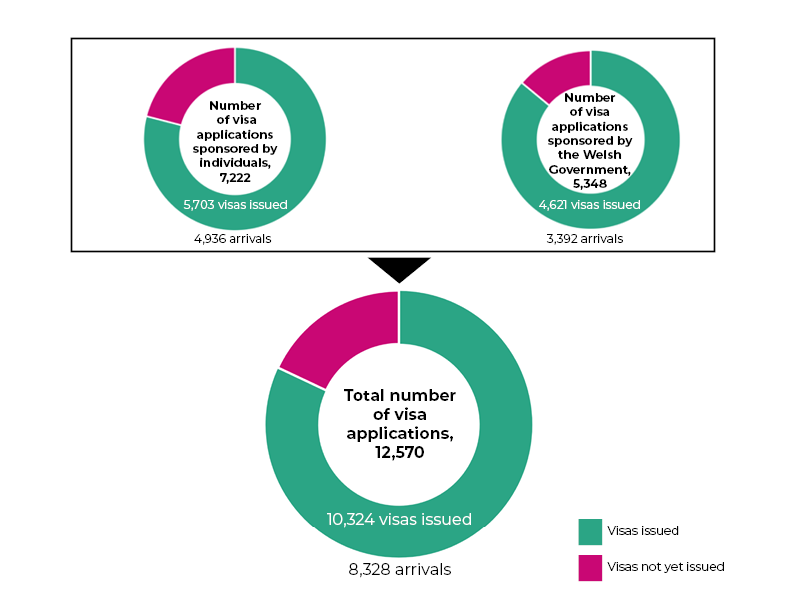
Through HFU, the Welsh Government became a ‘super sponsor’, providing initial accommodation and direct support to just over 3,000 of the estimated 8,328 Ukrainian refugees who have arrived in Wales via the scheme.
Number of visa applications and visas issued through the Homes for Ukraine scheme as at 30 September 2025
Source: UK Government
Alongside sponsorship, the Welsh Government has offered additional support as part it’s Nation of Sanctuary approach, including providing a free helpline, funding to the Welsh Refugee Council to deliver a specialist Ukraine support service, and funding the charity Settled to provide immigration advice. Up to April 2024 it also provided free bus and rail travel
In recent months both the Welsh Conservatives and Reform UK have called on the Welsh Government to scrap Nation of Sanctuary, raising issues with the cost and the fact that immigration control resides with the UK Government. Criticism has been aimed at the policy more broadly, despite individual members of both parties continuing to express support towards Ukrainian refugees.
The Welsh Government recently confirmed £58.22m had been spent on the Ukraine response. This accounts for 91% of all Nation of Sanctuary’s spending from 2019-2025, indicating that the overwhelming majority of the programme’s budget has been directed towards supporting people arriving from Ukraine.
A Welsh welcome
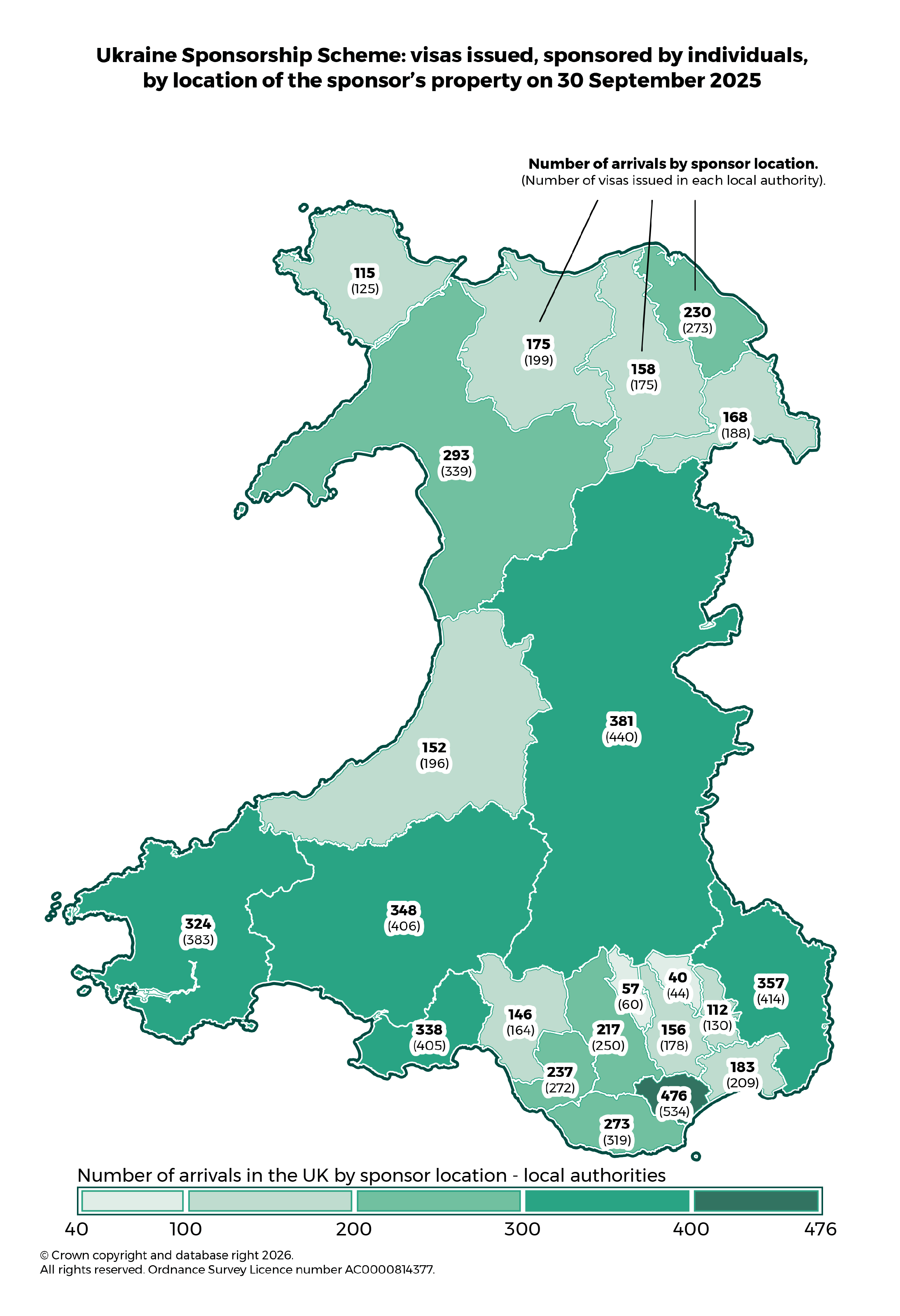
An estimated 4,936 Ukrainians have been sponsored by individuals living in Wales and there are many examples of communities coming together to welcome them. Examples like the Cardiff Ukrainian Hub demonstrate efforts to provide support. The First Minister unveiled a commemorative plaque at the hub, which read “it began as a response to a crisis but blossomed into something remarkable”.
Source: UK Government
Ukrainians have also been helped to integrate into Welsh life, setting up businesses in Wales, contributing to community projects and the education sector and learning Welsh.
Welsh public bodies and the third sector have played a critical role in supporting the delivery of the HFU scheme and publishing guidance on what support is available to Ukrainian refugees. Local authorities also committed to divesting from Russia, including up to £200m in pension schemes.
As part of its 2025 inquiry into social cohesion in Wales, the Equality and Social Justice Committee heard evidence from Ukrainian refugees who reflected positively on their time in Wales and the support received from sponsors.
A report by the British Red Cross found that while some Ukrainians had “initially planned to go back when it was safe, their views changed as they began to rebuild their lives here in the UK”. As one Ukrainian living in Wales told them:
My son is why I’m so desperate to stay. In Ukraine, he struggled and had no friends. Here, he’s thriving in a great school and, for the first time, has close friends.
Life-changing decisions remain with the UK Government
While many Ukrainians have settled and built a life in Wales, decisions over whether they can stay in Wales remain with the UK Government. Unlike standard visas or grants of refugee status, the Ukraine visa schemes don’t provide a route to permanent residency. The visas initially granted a maximum stay of three years.
In January 2024 the Minister for Social Justice and Chief Whip, Jane Hutt MS confirmed that she “regularly raised with UK Ministers the need for clarity and a route to settlement for Ukrainians”. The Minister also acknowledged the UK Government may need to work with the Ukrainian Government to develop longer-term plans.
Since February 2025, visa holders have been able to apply to extend them for another 18 months. The UK Government has since announced a second extension of an additional two years.
Peace deal remains elusive
As the war enters its fifth year, the Center for Strategic and International Studies (a not for profit think tank based in Washington, D.C.) has predicted that Ukrainian and Russian casualties could reach 2 million by Spring 2026.
President Zelensky is reportedly preparing to announce both presidential elections and a referendum on the US-led 20-point peace deal. He told media that the US has set a June deadline for Ukraine and Russia to reach a peace settlement.
Inside the Senedd, support for Ukraine has not wavered. Outside, Ukraine’s flag still flies.
Useful information
UK Government:
- UK support to Ukraine: factsheet (February 2026)
Welsh Government:
- Get help if you are a Ukrainian coming to Wales (February 2024)
Senedd Research articles:
- The Senedd in solidarity with Ukraine (March 2022)
- Supporting Ukrainian refugees fleeing conflict (April 2022)
- Wales, Ukraine and the war (May 2022)
- How is Wales meeting the needs of Ukrainian refugees? (July 2022)
- Wales and Ukraine: one year on (February 2023)
- Wales and the war in Ukraine: two years on (February 2024)
- Wales and Ukraine: three years on (February 2025)
Article by Sara Moran, Claire Thomas and Nigel Barwise, Senedd Research, Welsh Parliament
