The Senedd and Pierhead buildings will be closed to the public on Thursday 15 October. Read information about the closure.









Representing Wales: the Welsh Government at EU meetings
Published 16/07/2026 | Reading Time minutes
As Brexit approached, over 30 new forums were set up for the UK and the EU to take decisions on their relationship, including on matters which are devolved to and/or affect Wales. The forums were set up under two treaties:
- The Withdrawal Agreement sets the terms for the UK’s withdrawal from the EU; and
- The Trade and Cooperation Agreement (TCA) sets the terms for their post-Brexit relationship.
Focusing on the 23 intergovernmental forums set up under the TCA, this article presents updated analysis of Welsh Government attendance at these meetings, where important decisions that affect Wales are taken. It finds that there has been a strong pattern of Welsh Government attendance across meetings, with a few notable exceptions.
Explainers on these arrangements and their history can be found in a series of drop-down menus at the end of this article.
Welsh Government attendance
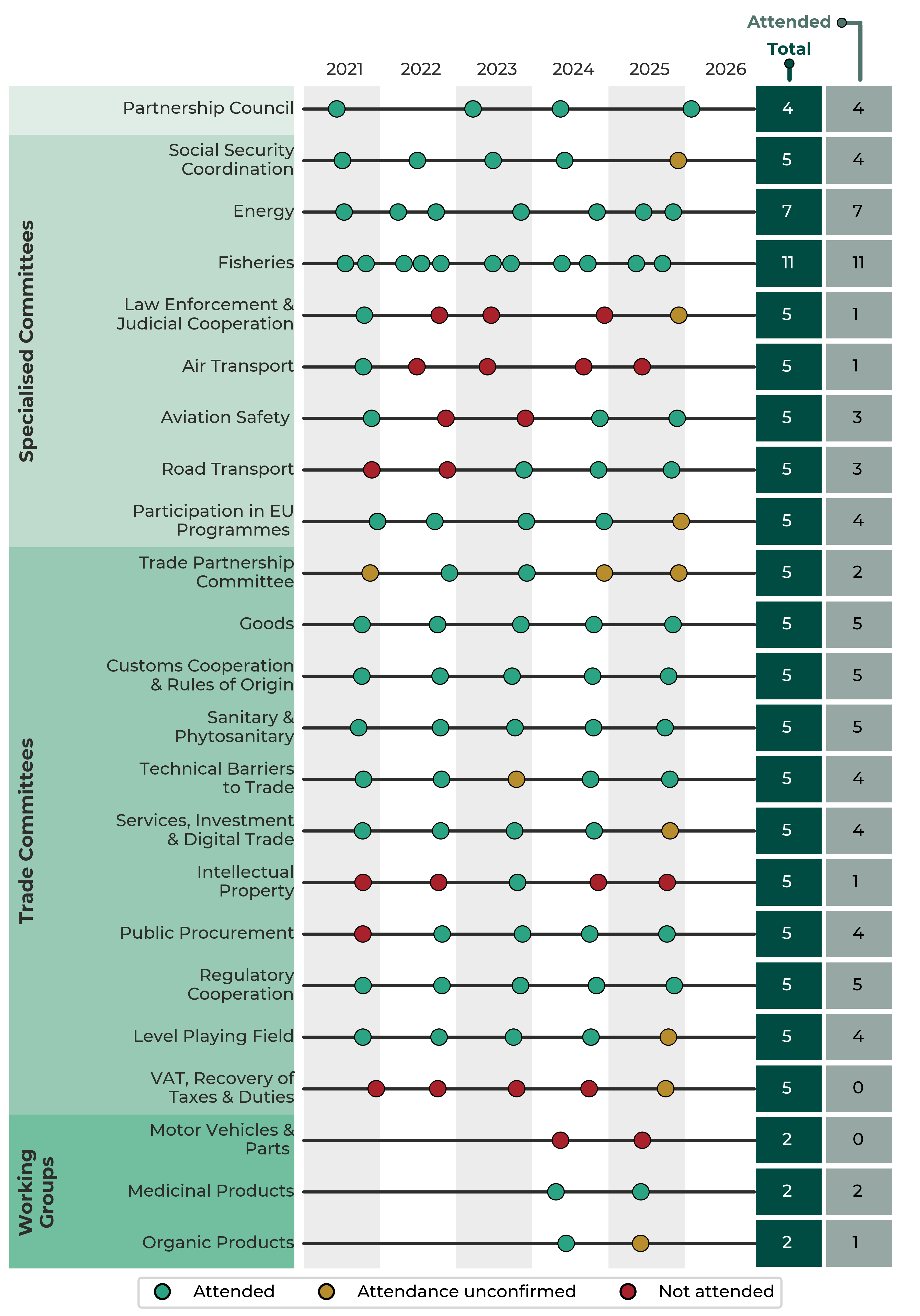
Attendance by Welsh Government is recorded in meeting minutes. Figure 1 uses a colour code to denote attendance (green), non-attendance (red), or where attendance is not specified (yellow). As attendance is at the UK Government’s discretion, it may be that the Welsh Government was not invited to attend a particular meeting. Information on whether or not a devolved government was invited is not published.
Since January 2021, there have been 113 meetings. The Welsh Government was at 80 of these (70.8%) but didn’t attend 22 (19.5%). For the remaining 11 meetings, their attendance was not confirmed.
Figure 1: Welsh Government attendance at meetings held under the UK-EU Trade and Cooperation Agreement (2021-2026)
Source: Meetings of the EU-UK Partnership Council and Specialised Committees under the Trade and Cooperation Agreement (European Commission)
While there is a strong pattern of Welsh Government attendance at meetings, there are notable exceptions for meetings on air transport, law enforcement and judicial cooperation, VAT and intellectual property.
Academic research by Royles, Rowe and Minto concluded that, while devolved government involvement in TCA meetings has improved over time, participation from Scotland and Northern Ireland has been greater than that from Wales. This they attribute to “their more enhanced devolved competences”, pointing to greater attendance at the meetings listed above on air transport, law enforcement and judicial cooperation, VAT and intellectual property. Their research formed the basis of evidence submitted to Sixth Senedd committees in 2024.
Who negotiates UK-EU agreements?
Although the Welsh Government can act in an international capacity, it cannot enter into legally binding commitments. Only the UK Government can do this for the UK, and does so on behalf of the four nations.
The Welsh Government’s role in this process is important because UK-EU agreements either effect Wales or fall in devolved competence. The Welsh Ministers and the Senedd are responsible for putting these arrangements in place under the Government of Wales Act 2006.
The parts of the TCA that fall in devolved areas include fisheries, health security, the economy, the environment and some aspects of trade. Reserved matters, like trade or law enforcement and judicial cooperation, also have a significant impact on cross-border cooperation.
How is the TCA governed?

29 new joint forums oversee the TCA which are shown in Figure 2. The main forum is the Partnership Council, which is supported by committees and working groups. The participation of civil society is also provided for, as well as parliamentary cooperation between the UK and European parliaments.
Figure 2: UK-EU forums under the Trade and Cooperation Agreement
How is Wales represented?
The UK Government granted the Welsh Government observer status at TCA meetings in 2021. This means that representatives can attend but can’t speak or vote. Domestic intergovernmental pre-meetings take place to discuss potential agenda items and UK positions to take.
The previous Welsh Government initially strongly criticised observer status. Former Minister for Economy, Vaughan Gething MS, wrote to the UK Government in June 2021 to say it was a position that he could not “credibly support”. By 2025, however, the then Cabinet Secretary for Economy, Energy and Planning, Rebecca Evans MS, said that:
Obviously, the observer status wasn’t our preference but I think that, so far, it does appear to be working, and I think that the way in which the UK Government has engaged with us through our officials has been really helpful in that regard.
So, we’re able to propose agenda items, for example, and we’re able to explore those debating lines, if you like, with the UK Government so that we have agreed positions that are being discussed. So, I think that’s all been very positive in terms of those opportunities to engage and influence.
What has the new Welsh Government said?
Plaid Cymru’s election manifesto said that, in government, it would:
Insist that the Welsh Government has a seat at the table whenever European issues are discussed that directly impact on Wales.
It has not yet set out what this means in practice. Doing so may clarify if this refers to domestic or international meetings (or both). If it means the UK’s international meetings, this is could be broader than just the EU.
As set out above, the Welsh Government already attends relevant domestic intergovernmental meetings and can attend TCA meetings, although its participation is limited by its observer status at the latter.
The new Government has committed to a new European Strategy and the First Minister, Rhun ap Iorwerth MS, said in June that “engagement has already begun on developing” one. The Welsh Government says Wales’ best interests would be best served by rejoining the EU, starting with membership of its Single Market and customs union.
What has the Senedd said so far?
Like the previous Welsh Government, Sixth Senedd committees also criticised the role afforded to the devolved nations in UK-EU relations.
In 2025, a joint inquiry by four committees received evidence supporting Wales having a greater say. Academics Royles, Rowe, and Minto called specifically for the devolved nations’ observer status to be upgraded. The report supports this position, with committees having made similar recommendations in the years prior.
The committees’ report also revisited their previous individual findings on the role of the Senedd and the need for further information and transparency on UK-EU matters, both by the Welsh and UK governments and at a UK-EU level.
The committees’ findings are summarised in another article, Reviewing the Brexit deal: Wales’s first four years of the Trade and Cooperation Agreement.
Where can I find out more?
This article builds on our previous updates on the UK-EU relationship.
These include our 2021 article, A seat at the table: representing Wales in the new UK-EU relationship, and a follow-up in 2022, The room where it happens: Wales in UK-EU relations. Collectively, they explain the TCA governance structures and Welsh Government’s role in them.
Our guides on Wales and the TCA also explain key parts of the agreement and what it means for Wales in more detail.
Regular updates are also published on the Senedd Research Brexit topic page.
Article by Maddy Phillips, Sara Moran, Nia Moss, Sam Jones, Senedd Research, Welsh Parliament