








Responsibility for international affairs is not as clear cut as is often portrayed and is shared between the UK and Welsh governments.
International arrangements can fall to the Welsh Government, the Senedd, public bodies and others to put in place.
For these reasons and more, it’s important that the Senedd doesn’t lose sight of international affairs.
Like all nations, Wales is not immune to the effects of international developments. As it emerged from the pandemic at the start of the Sixth Senedd, Brexit and its effects loomed large. The pace of developments since has been relentless. Russia’s full-scale invasion of Ukraine and conflicts in the Middle East are some examples of international affairs having far-reaching consequences.
Devolution gives the Welsh Government scope to carry out its own international activity. Other areas, like trade, include a mix of UK and devolved responsibilities. Even areas that are exclusively the purview of the UK Government, like defence, have implications for Wales.
Against a backdrop of geopolitical uncertainty and changes to the world order, the Seventh Senedd and the Welsh Government will need to decide their respective approaches and how to respond.
International relations
‘International relations’ are reserved matters and the governments across the UK work together on the UK’s international relations.
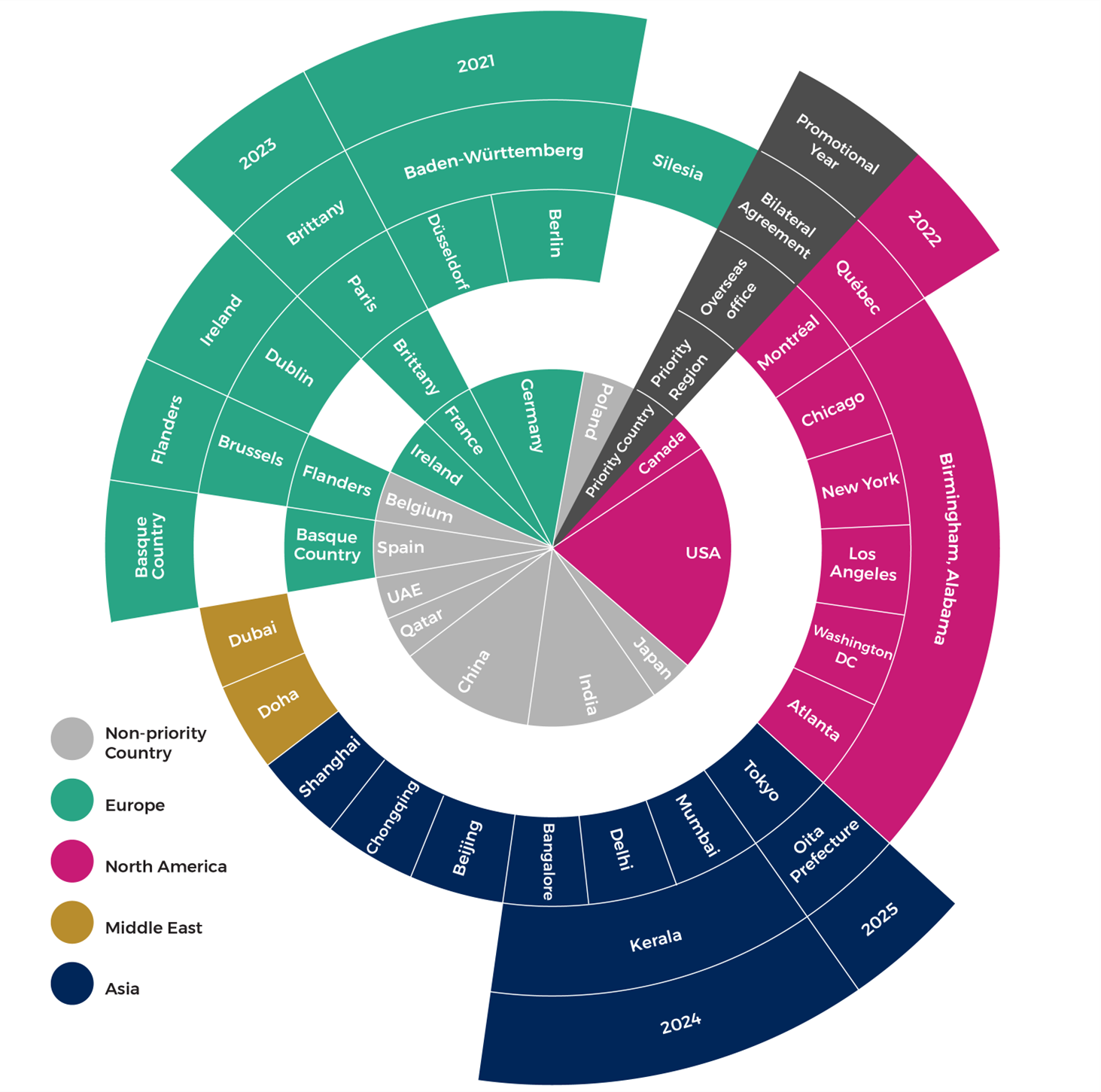
Devolution provides scope for the Welsh Government to also act in an international capacity, such as agreeing non-binding agreements for Wales in devolved areas. The former Welsh Government had multiple international plans, like its International Strategy, trade policy and the Nation of Sanctuary. It also had other arrangements, like its overseas offices and priority international relationships, shown in Figure 1.
At the end of the Sixth Senedd, the committee responsible for international relations called on future governments to adopt ‘Mission Cymru’, a set of twelve new principles it devised to guide Wales’ international relations. The committee believed the principles would “guarantee that Wales consistently delivers on its international relations ambitions and realises its potential”.
Figure 1: the Welsh Government’s international arrangements
Source: Senedd Research (2026)
Foreign aid and international development
‘International development assistance and cooperation’ are reserved matters but devolution provides scope for the Welsh Government to carry out activity.
‘Foreign aid’ and ‘international development’ are distinct terms. The former relates to assistance provided, often in response to emergencies, while the latter generally relates to targeted funding by developed countries towards long-term programmes in disadvantaged and/or developing regions. Historically, Welsh Governments have done both.
Foreign aid
The previous Welsh Government regularly made financial and non-financial donations to emergency appeals launched in response to crises, such as natural disasters and armed conflict. For example, in 2022 it donated £4m to the Disasters Emergency Committee (DEC) Ukraine Humanitarian Appeal, as well as medical supplies, and donated a total of £450,000 to the DEC Middle East Humanitarian Appeal since the Hamas attacks of 7 October 2023.
International development
The previous Welsh Government’s approach to international development was grounded in a key aim of its International Strategy to establish Wales as a ‘globally responsible nation’, and in its long-standing Wales and Africa programme.
Its funding of the Wales and Africa programme began in 2013-14 and, from 2020, was set out in the Welsh Government’s Wales and Africa action plan. The plan includes the Mbale tree planting programme in Uganda. The target to plant 25 million trees was achieved in March 2025.
Whether or not the Welsh Government should carry out this activity was often debated during the Sixth Senedd.
International trade
While international trade is generally considered a reserved matter, important aspects of it are devolved. In particular, Welsh Ministers are responsible for Wales’ biosecurity, food safety and sanitary and phytosanitary (SPS) controls. SPS controls protect animal, plant and public health.
In 2025, the value of Wales’ total trade in goods was £39.5bn. The EU is Wales’ largest trading partner, accounting for £18.4bn (47%). The value of its second and third largest partners, the USA and China, was £6.6bn and £2.4bn, respectively. Amongst individual EU Member States, trade in goods with Germany, France and Ireland was of greater value than trade with China, at £3.8bn, £2.9bn and £2.8bn.
The UK and EU are negotiating new arrangements in devolved areas, which will have important implications for Wales and the Senedd. Chief amongst these are an SPS agreement, which could reduce or even eliminate the need for trade checks at new border control posts, and an EU Partnership Bill to align the UK to EU rules.
UK-EU negotiations, new trade deals, trade diversions away from Welsh ports and the resilience of Holyhead port, will all also remain fundamental to Welsh trade flows.
International law
Although the Welsh Government can act in an international capacity, it cannot enter into legally binding commitments. Only the UK Government can do this for the UK, and does so on behalf of the four nations.
International obligations cover legal duties and commitments the UK has agreed to, or universal rules of international law. Their implementation and observation are devolved, meaning Welsh Ministers must comply with them and are responsible for putting international law duties in place in devolved areas. This has implications for the Senedd, which must take an active role in scrutinising and passing this legislation.
The Senedd is the only devolved legislature to have had a dedicated treaty scrutiny process. Its former legislation committee’s ‘Lessons from 100 treaties’ report called for the Senedd to have a formal role in the UK Parliament’s process. Whether this scrutiny continues will be for the new Senedd to decide, with any formal role contingent on decisions at a UK level.
Working with the UK Government
Historically, cooperation between governments across the UK on international and EU relations were contained in two concordats that formed part of a 2013 Devolution Memorandum of Understanding (MoU).
Plans for an International Relations Concordat formed part of a 2022 review of intergovernmental relations but never materialised. The review introduced a number of new bodies attended by ministers from each nation, including an Interministerial Standing Committee (IMSC), which has considered international matters. There are also specific groups on UK-EU relations and trade. In March 2026, the then First Minister said that the Welsh Government had also pushed for a group on international relations, together with the Scottish Government.
The governments also coordinate the UK’s response to conflicts, such as between Russia-Ukraine, Israel-Gaza and US/Israel-Iran. How they work together on international affairs will be a decisive factor in the future.
The future of international affairs
The new Welsh Government’s approach will be crucial in determining Wales’ international future. In responding to global developments, it will have to navigate the effects on Wales, including the daily lives of people.
As important is what course the Senedd charts. New Members have choices to make on whether and how to build on the Sixth Senedd’s international affairs legacy.
Article by Sara Moran, Senedd Research, Welsh Parliament