The Senedd and Pierhead buildings will be closed to the public on Thursday 15 October. Read information about the closure.









NHS waiting times in Wales: what do they measure – and what do they miss?
Published 11/06/2026 | Reading Time minutes
NHS waiting times remain a central issue in Welsh health policy and a frequent topic of debate in the Senedd. While headline figures provide an important indication of pressures within the system, they do not always capture the full experience of patients.
In particular, questions are regularly raised about how waiting time statistics reflect the experiences of people who receive treatment outside Wales. This issue is especially relevant in border areas such as Powys and parts of North Wales, where many residents access hospital services in England.
This article explores what NHS waiting time statistics in Wales measure, how they compare with England, and what is known about cross-border healthcare. See also ‘What you need to know about cross-border healthcare: Wales and England’.
|
Cross-border healthcare includes primary, secondary and tertiary care, and patients move in both directions across the Wales-England border. However, for the purposes of understanding waiting time statistics, the main focus here is on hospital care, because this is where referral to treatment pathways and most cross-border waiting list data are recorded. |
What do NHS waiting time statistics measure?
In Wales, planned care waiting times are generally measured through referral to treatment (RTT) pathways, which record the time from referral to the start of treatment. Since the pandemic, greater attention has been paid to recovery targets, as set out in the NHS activity and performance summary: March and April 2026.
As of March 2026, around 666,700 patient pathways were waiting to start treatment in NHS Wales.
However, these statistics are based on activity within NHS Wales as a provider (that is, they measure care provided in Wales, not all care received by Welsh patients). They:
- capture waiting times for care delivered by Welsh providers; and
- reflect performance against Welsh Government targets.
But they do not fully capture:
- waiting times experienced by all Welsh residents; or
- treatment delivered outside Wales.
Cross-border healthcare is significant
Cross-border care is not a marginal issue. It is a routine part of how services are delivered, with many patients using hospitals in English border areas because of geography and service configuration. Latest Welsh Government statistics show that:
- in March 2025, there were around 30,000 Welsh residents on NHS waiting lists in England; and
- in 2024–25, there were 64,300 hospital admissions for Welsh residents treated in England.
These figures illustrate that a substantial number of Welsh patients receive care outside NHS Wales. However, they do not capture all treatment received outside Wales, such as specialist care provided by NHS England or privately funded treatment.
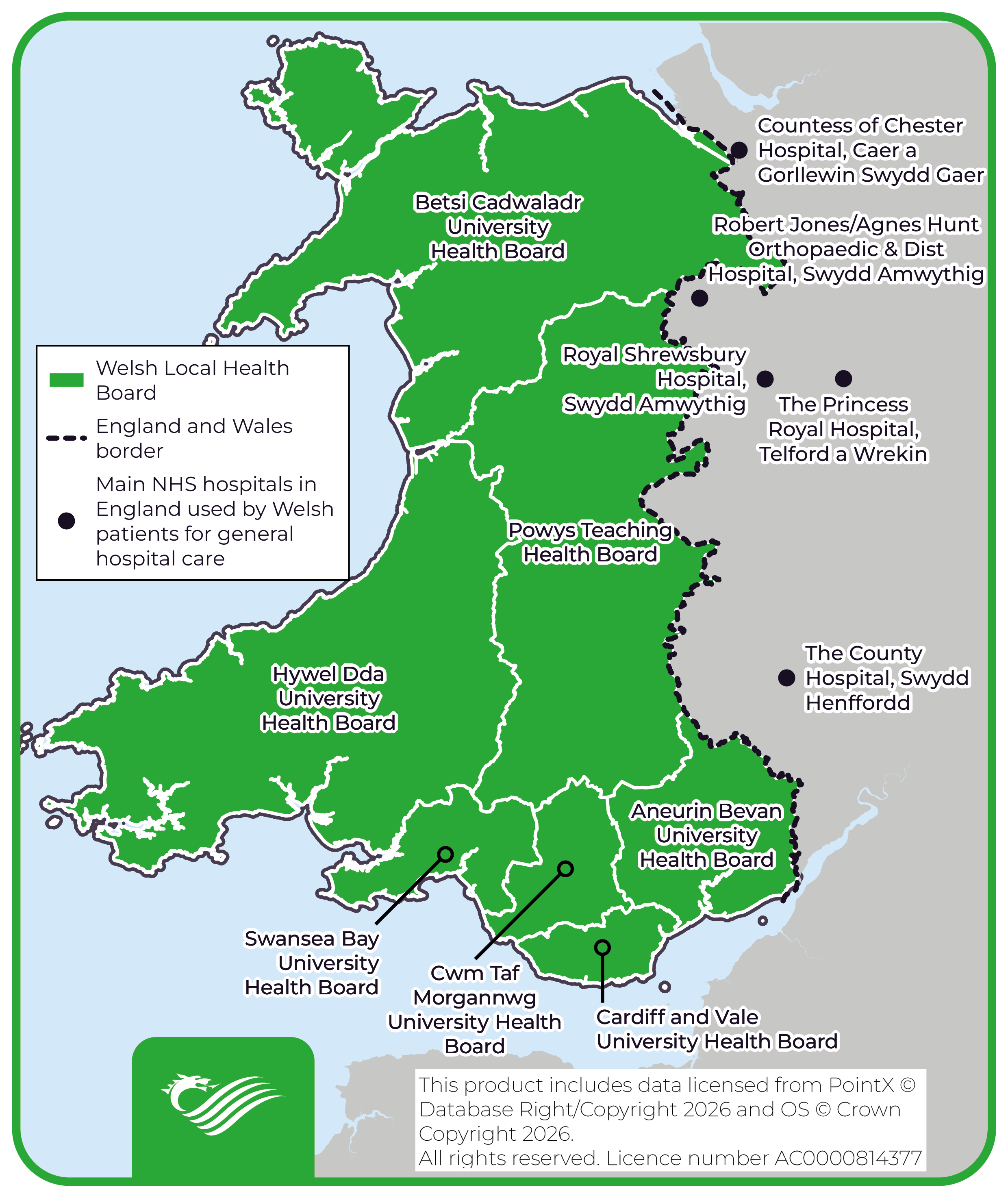
Evidence from Llais Wales (the independent body representing the views and interests of people in Wales in relation to NHS and social care services) suggests that around 15–20% of people in Wales use NHS services in England, with the proportion much higher in border areas.
For patients in different parts of Wales, this can mean using English hospitals such as Hereford County Hospital and Royal Shrewsbury Hospital in the east and mid-border areas, and the Countess of Chester Hospital for some patients in North Wales.
Why this matters for interpreting waiting times
Because the main NHS Wales waiting time statistics are reported on a provider-basis rather than a residence basis, they do not directly capture the full experience of Welsh residents, including those receiving treatment from providers outside their local health board. For example:
- the roughly 30,000 Welsh residents on waiting lists in NHS England are not included in main NHS Wales RTT totals; and
- their waiting times may be different from Welsh averages.
This means:
- Welsh data reflects system performance, not fully patient experience; and
- in areas such as Powys, where cross-border flows are particularly high, the headline statistics may be less representative unless they are read alongside separately published cross-border data.
Powys and cross-border care
Powys illustrates these issues particularly clearly. The county has no district general hospital, so residents often travel to neighbouring areas for hospital care, including to other Welsh health boards and to England. In Powys, cross-border care is part of the routine pattern of care rather than an exception.
In the minutes of its September 2025 board meeting, Powys Teaching Health Board reported long waits among patients treated in England (see page 14), including 331 patients waiting more than 52 weeks at Shrewsbury and Telford, and 824 at Robert Jones and Agnes Hunt, of whom 56 had waited more than 104 weeks.
The same discussion noted that cross-border commissioning can also create financial pressure. The health board noted that additional costs associated with NHS England commissioning had not been offset by Welsh Government funding as previously assumed, contributing to its in-year overspend. It also noted that NHS England had applied an additional 13% uplift for unplanned care tariffs.
In written evidence to the House of Commons Welsh Affairs Committee, the BMA Cymru Wales highlighted the extent of cross border healthcare for Powys residents. The Annual Accounts of Powys Teaching Health Board indicate that around 20% of their budget is spent on services across the border.
These pressures have also fed into political arguments about fairness and how cross-border waits are counted. In a general scrutiny session in February 2026, Russell George MS, the then Senedd Member for Powys, questioned the Welsh Government’s presentation of Powys waiting times, arguing that provider-based statistics could suggest that no one in Powys had been waiting more than two years, even though some Powys residents were being treated in English hospitals and waiting longer.
In Plenary, James Evans MS said that his constituents in parts of Powys were having their care delayed in England because the health board could not meet the funding requirements to pay for those operations.
Taken together, these points show why Powys is often at the centre of debates about equity, funding and how waiting time performance should be interpreted in a cross-border system.
Comparisons with England
Comparisons between NHS waiting times in Wales and England are common but complex. Key differences include:
- different targets (e.g. England’s 18-week standard vs Welsh recovery targets); and
- different data coverage and methodology.
The Office for Statistics Regulation has warned that NHS systems across the UK use different definitions, data systems and reporting approaches. This can make direct comparisons challenging and potentially misleading.
A gap in the data
Despite the scale of cross-border care, the main published NHS Wales waiting time statistics do not provide a single combined headline measure covering both treatment provided in Wales and treatment received by Welsh residents in England.
Some additional cross-border and residence-based data are published separately by Welsh Government and on StatsWales, but these are not presented as part of the standard headline NHS Wales waiting time figures. This means that the available statistics can still leave an incomplete picture of inequalities between different parts of Wales unless separate residence-based and cross-border sources are considered alongside the headline figures.
As NHS waiting times remain a key issue, there may be value in clearer signposting that Welsh data reflects provider activity, or in more regular publication of cross-border waiting time data. These steps could improve public understanding and support more informed debate.
Article by Sarah Hatherley, Senedd Research, Welsh Parliament