The Senedd and Pierhead buildings will be closed to the public on Thursday 15 October. Read information about the closure.









NHS waiting times in Wales: the position at the start of the Seventh Senedd
Published 28/05/2026
This article examines the latest position on NHS waiting times in Wales as the Seventh Senedd begins. It looks at the recovery targets set during the last Senedd, the progress made by the end of that term, and the pressures now facing the new Welsh Government.
At a glance
- Around 529,100 people in Wales were waiting for NHS treatment at the end of March 2026. Because some people were waiting for more than one treatment, the total number of patient pathways was higher, at 666,700.
- Waiting lists had fallen for 10 consecutive months, but none of the original planned care recovery targets set in 2022 had been met by the end of the Sixth Senedd.
- With around one in four people in Wales still waiting for treatment, NHS waiting times remain one of the biggest pressures on the health service as the Seventh Senedd begins.
Important note on coverage of the data
The statistics presented in this article are based on NHS Wales activity and therefore reflect waiting times within NHS Wales as a provider of services. They do not capture the full experience of Welsh residents, particularly where patients are referred for treatment outside Wales (for example, to NHS trusts in England). This is especially relevant in areas such as Powys, where a significant proportion of patients access services across the border.
The original planned care recovery targets
In April 2022, the then Welsh Government published its planned care recovery programme and set a series of targets intended to bring waiting times closer to pre-pandemic levels over the course of the Senedd term.
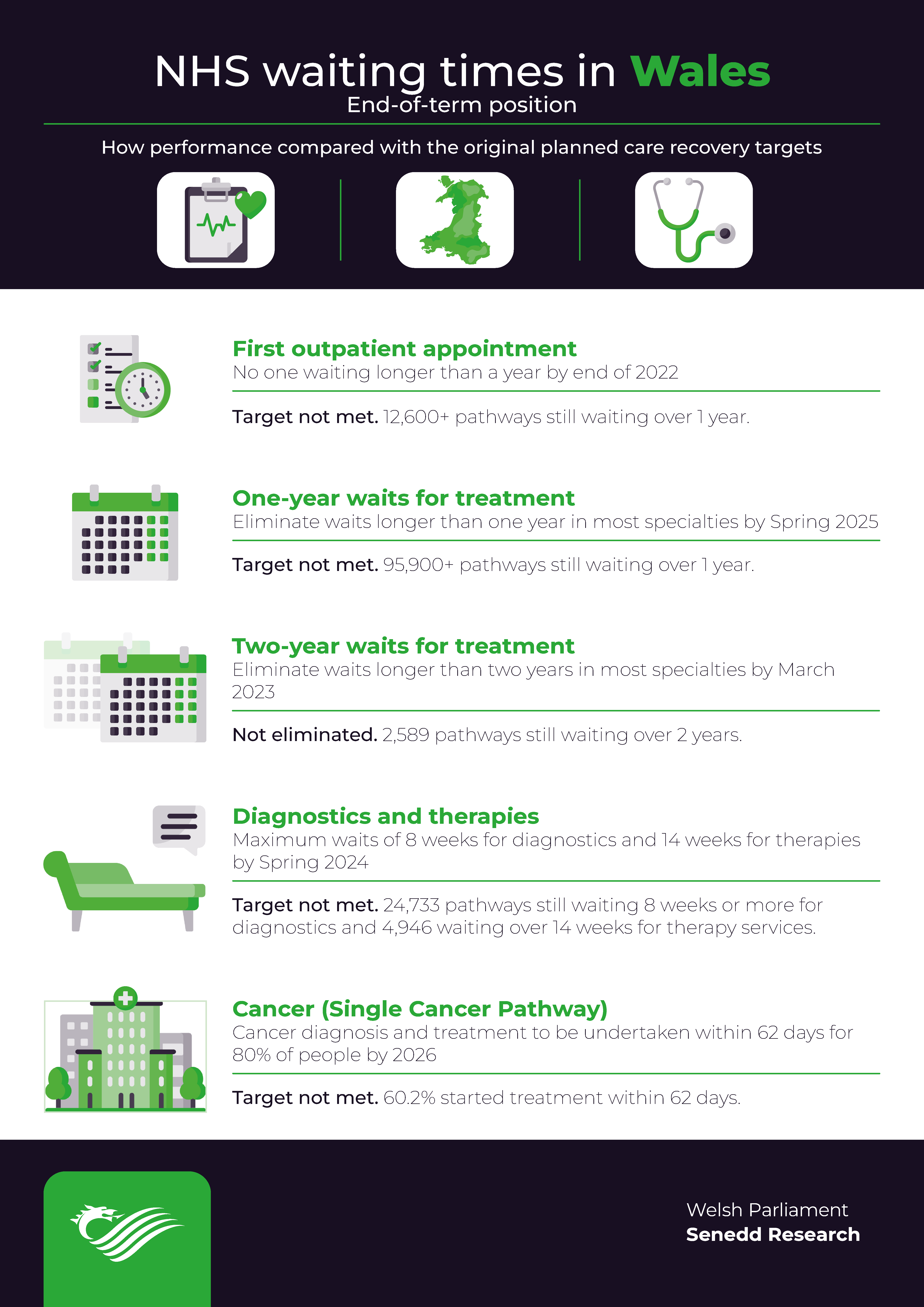
- First outpatient appointment: No one waiting longer than a year for their first outpatient appointment by the end of 2022.
- Two‑year waits for treatment: Eliminate waits longer than two years in most specialties by March 2023.
- One‑year waits for treatment: Eliminate waits longer than one year in most specialties by Spring 2025.
- Diagnostics & therapies: Reach maximum waits of 8 weeks for specified diagnostics and 14 weeks for therapies by Spring 2024.
- Cancer (Single Cancer Pathway): 62 days for 80% of people by 2026, with an interim recovery target of 70% by March 2023.
The programme was developed in the aftermath of the COVID-19 pandemic, when waiting lists had risen sharply across NHS Wales. Ministers argued that recovery would take the full Senedd term and backed the programme with more than £1 billion of funding.
Starting point in April 2022
When the recovery plan was published, just under 707,100 patient pathways were waiting to start treatment in Wales, including more than 68,000 waits of over two years.
What the end-of-term data show
By the end of the Sixth Senedd, around one in four people in Wales were still waiting for NHS treatment. Although performance improved during the later months of the term, waiting lists and long waits remained high by historic standards.
Position by end of March 2026
By the end of March 2026, just under 666,700 patient pathways were waiting to start treatment in Wales, including 2,600 waits of over two years.
Recent progress was supported by additional investment, including a £120 million package announced in June 2025. However, by the end of the Senedd term, none of the headline recovery targets set earlier in the term had been fully achieved.
The new Cabinet Minister for Health and Care, Mabon ap Gwynfor MS, has said a further £120 million will be spent on continuing efforts to reduce NHS waiting times in Wales.
The latest available statistics for March 2026 show the following position against the main recovery targets (the latest official data is for March 2026 and used in this article. Provisional data are available for April 2026).
Where pressures remain
Outpatients
Outpatient waits remain a major pressure point. These are the waits for a first hospital appointment with a specialist, before any treatment begins. The original target of eliminating waits of more than one year for a first outpatient appointment had been set for the end of 2022 and was later revised, but it was still far from being met by early 2026. Long outpatient waits matter because they can delay diagnosis, treatment decisions and onward referral.
Waits for treatment
Long waits for treatment fell substantially from their peak, but they were not eliminated. Two-year waits reduced sharply over the course of the term, yet 2,600 patient pathways were still waiting more than two years by March 2026. One-year waits for treatment also remained well above the target level. The overall picture is therefore one of improvement, but not full recovery.
Diagnostics and therapies
Diagnostic and therapy waits also remained above target at the end of the term, despite some improvement. The target maximum wait of eight weeks for diagnostics and 14 weeks for therapies had not been restored by March 2026.
Cancer
Cancer performance remained a further area of concern. The 62-day Single Cancer Pathway target of 80% by 2026 was still not being met, and performance continued to vary across Wales. Performance against the 62 day target in March 2026 was 60.2%.
How pressures vary across specialties
National waiting list totals show the overall scale of the backlog, but they do not capture how unevenly pressures are felt across the NHS. To understand where the system is under greatest strain, it is also necessary to look at variation between specialties, including where the largest backlogs and longest waits remain concentrated.
The previous Welsh Government identified seven “exceptionally challenging” specialties: trauma and orthopaedics, dermatology, general surgery, ophthalmology, urology, gynaecology and ear, nose and throat (ENT). While the recovery plan did not set out in detail why these specialties were particularly challenging, it noted that they already had large numbers of people waiting before the COVID-19 pandemic.
At the start of the Seventh Senedd, some specialties had improved more than others, while in some areas long waits remained especially pronounced. Among the specialties with the largest treatment backlogs waiting over a year, trauma and orthopaedics had the highest number of patients waiting, followed by general surgery and ophthalmology in March 2026. ENT, gynaecology and gastroenterology, among others, also continued to record comparatively large numbers waiting for treatment.
Figure 1: Number of patient pathways waiting over 53 weeks to start treatment in the seven specialties recognised as exceptionally challenging
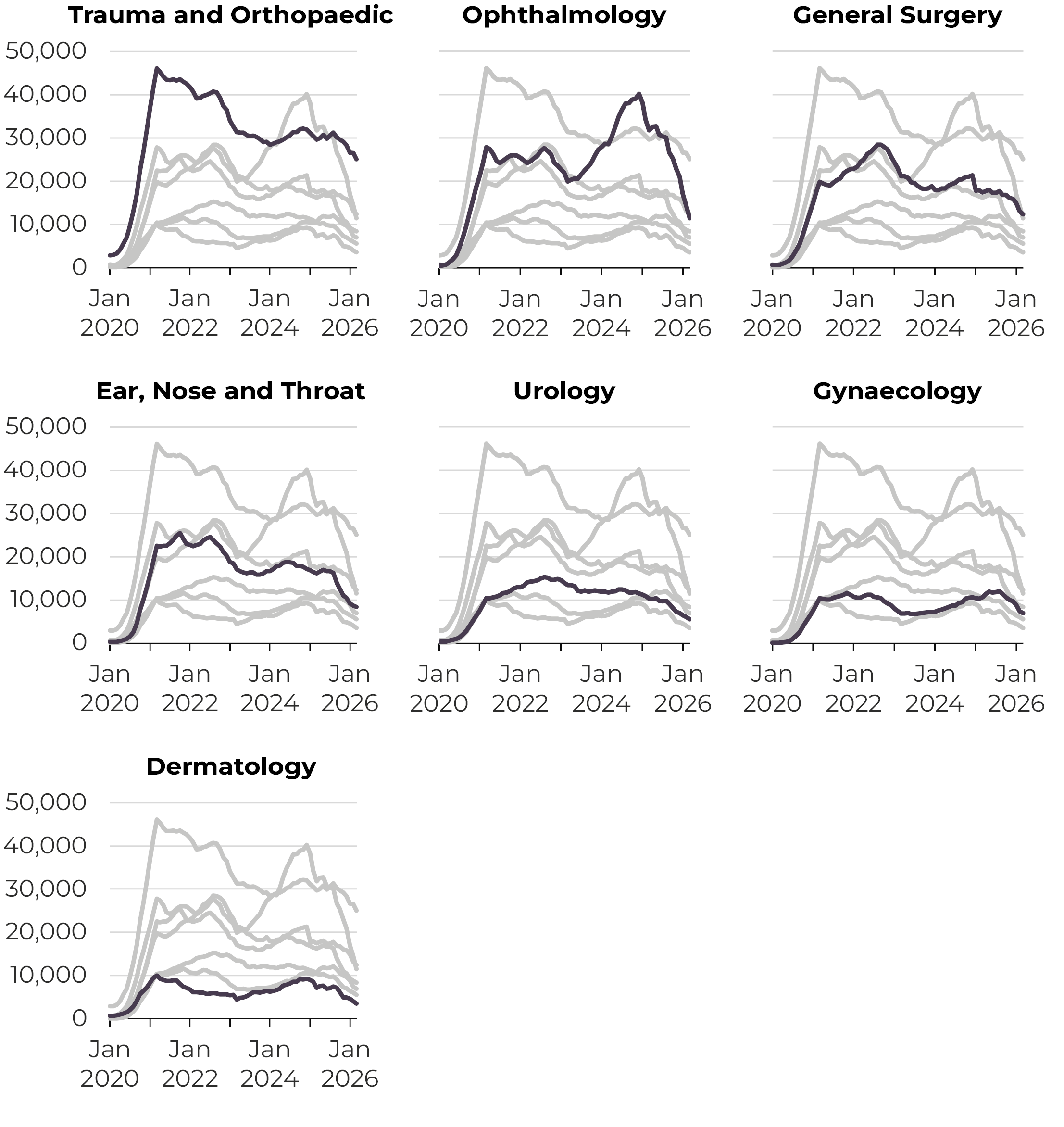
Figure 2: Number of patient pathways waiting over 105 weeks to start treatment in the seven specialties recognised as exceptionally challenging
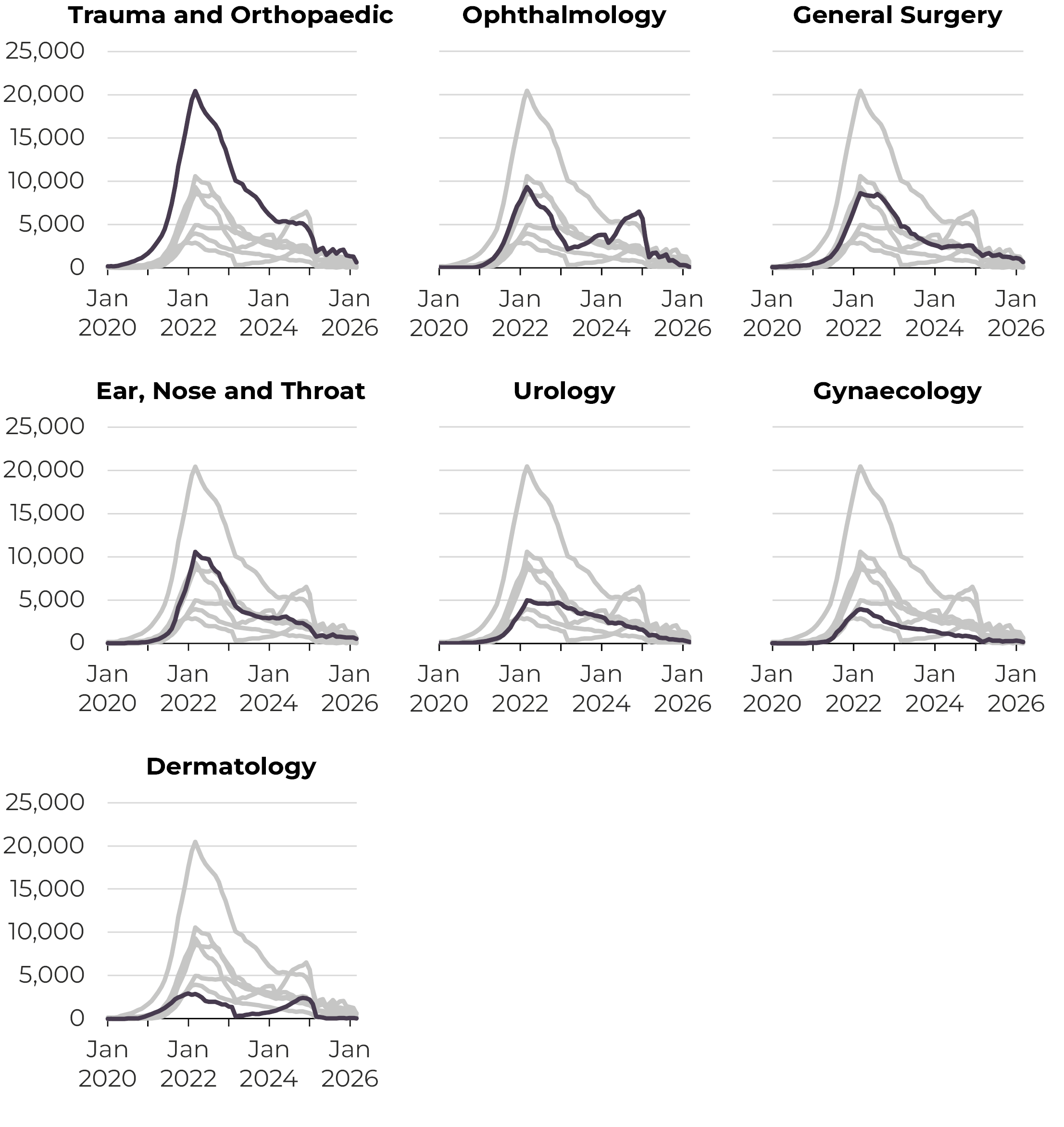
Specialty-level data can therefore help to show where pressure on services, and the impact on patients, may be felt most acutely as the new Senedd begins.
What the new Welsh Government inherits
The incoming Welsh Government has inherited a system in which NHS waiting lists were improving in the final phase of the last term, but where major recovery targets remained unmet.
An early question for the new administration is whether it will adopt a new set of measurable priorities for NHS recovery, or continue to work against the framework inherited from the previous government.
Plaid Cymru presented cutting waiting lists as an early priority in its 2026 Senedd manifesto, linking shorter waits to wider NHS reform and improved access to care. The party argued that reducing waiting lists was a necessary first step before broader service transformation could be delivered.
This is significant politically because waiting times are not only a measure of service performance; they are also bound up with wider questions about NHS capacity, public confidence and the ability of the health service to shift attention towards prevention and reform.
Article by Josh Jenkins and Sarah Hatherley, Senedd Research, Welsh Parliament