








GCSE results mark an important milestone for learners across Wales, but they are only one stage in a wider educational journey. We look at how learners performed in this year’s exams, how the results compare with those in previous years and across the UK, and what they might mean for the pathways learners choose after compulsory education.
What do this year’s results look like?
|
Taken together, the provisional results suggest that overall attainment in Wales remained broadly stable in 2026, although performance continued to vary across subjects and between groups of learners.
- The 2026 results data presented in this article is provisional. The data, which is published by the Joint Council for Qualifications (JCQ), reflects the position at the time results are issued and may be revised following further checks. The data covers qualification entries by learners of all ages. Qualifications Wales also publishes on-the-day information on results in Wales.
- GCSEs regulated by Qualifications Wales continue to use A to G* scale, while GCSEs awarded by English bodies are graded using a 9 to 1 numerical scale. To support comparison across England, Wales and Northern Ireland, JCQ publishes headline attainment measures at three key thresholds: A/7 and above, C/4 and above and G/1 and above. These indicators are used throughout this article.
- More detailed statistics, including subject-level outcomes, learner characteristics and Wales-specific measures such as capped 9 point scores, will be published by the Welsh Government later in the autumn and provide a fuller picture of attainment in Wales.
How do this year’s results compare with previous years?
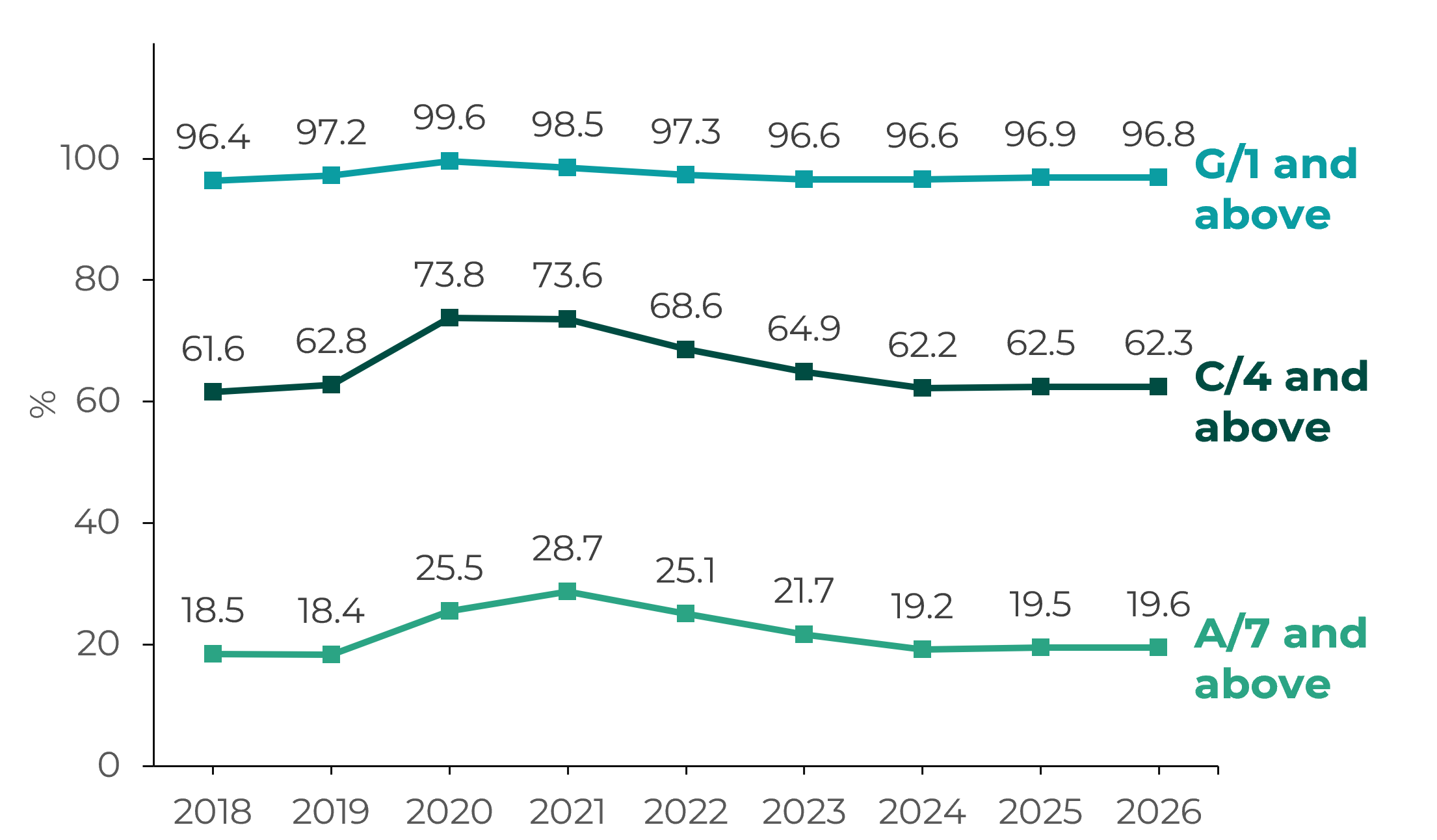
Figure 1. GCSE results in Wales, 2018 to 2026 (percentage of all grades awarded). All candidates.
Source: Qualifications Wales.
Caution is needed when directly comparing results with 2020 centre-awarded grades, 2021 centre-determined grades, and the ‘transition years’ in 2022 and 2023.
GCSE outcomes in 2026 are broadly in line with those seen in 2025, 2024 and before the pandemic. On average, 16-year-olds sat 8 GCSEs this summer. A total of 170 16-year-old learners who took seven or more GCSEs achieved the highest available grade (an A* or 9) in every subject.
Direct comparisons with results from 2020 to 2023 should be treated with caution. Qualifications awarded during these years were subject to alternative and transitional assessment arrangements as a result of the COVID-19 pandemic. As such, outcomes in those years are not directly comparable with results awarded under current assessment arrangements.
The infographic below summarises changes to assessment arrangements between 2020 and 2024.
How do the figures for core subjects compare at grade C/4 level and above?
Table 1. Core subjects: Percentage achieving C/4 or above. Male and female, all ages.
Source: JCQ.
Performance varied between subjects, with attainment generally highest in the separate sciences and lower in mathematics-related qualifications. Changes from 2025 were modest overall, although some subjects saw larger shifts than others.
Entry numbers fell noticeably in English, Welsh and Mathematics qualifications. This is likely to reflect, in large part, the phased introduction of Made-for-Wales GCSEs, with many Year 10 learners entering assessments linked to the new qualifications that will form part of full awards in 2027 (see below).
What does the data show by sex?
The attainment gap by sex widens as the attainment threshold rises and is most pronounced among the highest grades awarded. As in previous years, in 2026 females achieved higher outcomes than males overall, with 65.5% of grades awarded to females at C/4 and above compared with 59.0% for males. Female attainment remained particularly strong in English and Welsh subjects. Males continued to outperform females in Mathematics, Mathematics-Numeracy and Physics, although the differences were generally smaller than those seen in language subjects. Science subjects were otherwise relatively balanced, while attainment at G/1 and above was 97.0% for females and 96.7% for males across all subjects combined.
Can this year’s results be compared with England and Northern Ireland?
As in the previous two years, Northern Ireland recorded the highest attainment at all three thresholds in 2026, while Wales recorded the lowest, with England between the two. Northern Ireland achieved 31.7% at A/7 and above and 83.6% at C/4 and above, compared with 19.6% and 62.3% respectively in Wales. In 2026, 96.8% of GCSE entries in Wales achieved grades at G/1 and above, compared with 98.0% in England and 99.2% in Northern Ireland. This placed Wales 1.2 percentage points behind England and 2.4 percentage points behind Northern Ireland on this measure. This contrasts with recent A level results, where Wales outperformed England across all three headline attainment measures, as discussed in our recent article.
However, these comparisons should be interpreted with caution, as the figures relate to qualification entries rather than individual learners and the three nations operate different qualifications and assessment systems (as explained in a statement from the qualification regulators). Scotland is not included because its qualifications framework is not directly comparable.
Table 2. Provisional GCSE results in Wales, England and Northern Ireland, 2026 (2025 figures shown in brackets).
|
GCSE results |
A/7 and above |
C/4 and above |
G/1 and above |
|
Wales |
19.6 (19.5) |
62.3 (62.5) |
96.8 (96.6) |
|
England |
21.8 (21.8) |
67.0 (67.1) |
98.0 (97.9) |
|
Northern Ireland |
31.7 (31.6) |
83.6 (83.5) |
99.2 (99.1) |
Source: JCQ.
What’s next for learners?
Following their GCSE studies, learners have a range of options. These include going to college or sixth form to study A levels, Level 3, or Level 2 courses; starting an apprenticeship; getting a job; volunteering; or gaining experience through the Jobs Growth Wales+ scheme. Careers Wales has information on options at 16 and guidance on how to choose a post-school course or qualification. UCAS also publishes help on exploring options after GCSEs. Our article What are the options for school and college leavers? provides further information on the choices and pathways available to young people.
Learners who believe there may have been an error in the marking or administration of their GCSE results should speak to their school or college. Where appropriate, schools can request a review of results through the awarding body.
What’s next for policymakers?
GCSE results are one indicator of how Wales’s education system is supporting learners’ progression, alongside issues such as attendance, behaviour and wellbeing. Policymakers are also likely to focus on longstanding attainment gaps between different groups of learners, including those eligible for free school meals and their peers, which have remained a persistent challenge for the education system.
Recent Medr analysis shows that 85% of Year 11 learners stayed in some form of education in 2025/26, although the proportion progressing to Level 3 study (A level equivalent) has continued to fall. In 2025, the Sixth Senedd’s Children, Young People and Education Committee highlighted the importance of ensuring learners have access to high-quality careers advice and equal access to academic and vocational routes when making post-16 choices.
This year's results come during the transition to Made-for-Wales GCSE qualifications. While some learners sat examination units linked to the new qualifications in 2026, the first full cohort studying the new Curriculum for Wales-focused GCSEs will receive results in summer 2027.
Attention will soon turn to Wales’s performance in the OECD's Programme for International Student Assessment (PISA), with Wales's 2025 results due to be published on 8 September. The previous cycle placed Wales below both the OECD average and the other UK nations in mathematics, reading and science. The publication of the latest results is likely to provide a further focus for discussion about educational standards and reform in Wales.
Article by Dr Nyle Bevan-Clark, Senedd Research, Welsh Parliament