








Spring and summer 2026 have been exceptionally hot and dry in Wales. This weather can affect everything from health to agriculture. Climate change is amplifying this extreme weather, making it more common and intense.
This article looks at the causes and impacts of extreme heat in Wales, as well as responses and future adaptation needs.
Extreme heat is closely connected to drought, which you can find out more about in our article published in July.
What is a heatwave and why do they happen?
The Met Office defines a heatwave as three or more days when maximum daily air temperatures meet or exceed a threshold. The threshold is 25°C everywhere in Wales except the warmer southeast, where it’s 26°C.
UK heatwaves generally occur when the weather is dominated by slow-moving high pressure systems. This allows hot air to persist for days or weeks.
Climate change makes heatwaves more severe
Heatwaves occur naturally, but human-induced climate change is making them more frequent, more intense, and longer-lasting. Europe’s record-breaking June 2026 heatwave would’ve been ”virtually impossible” without global warming driven by human greenhouse gas emissions.
Welsh summers are getting hotter. The highest-ever temperature was recorded in July 2022, when Hawarden, Flintshire reached 37.1°C. Summer 2026 was the hottest on record by average June-August temperature, almost 3°C hotter than the late 20th century average. The previous record had been set in summer 2025.
Annual summer temperature anomaly in Wales from 1884 to 2026, compared to 1961-1990 average
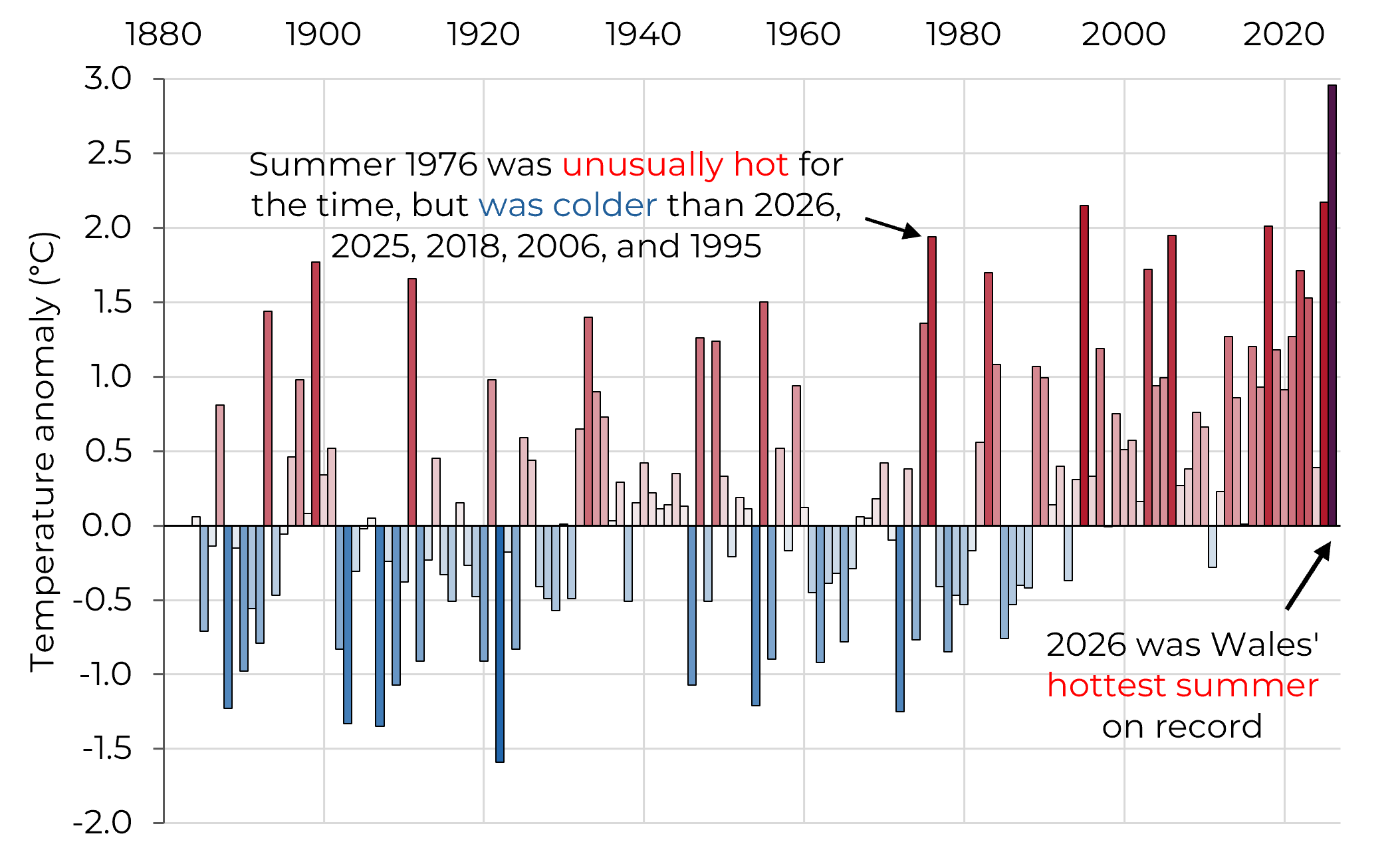
Source: Senedd Research analysis of Met Office data
Spring and summer 2026 have been exceptionally hot
Welsh temperature records go back over 140 years, but 2026 has proven an exceptional year for heat. By the end of August 2026, Wales recorded:
- its hottest spring and hottest summer;
- its highest ever May maximum and minimum (overnight) temperature;
- its highest ever June maximum and minimum (overnight) temperature;
- its driest and joint-hottest July, second hottest June and equal third-hottest May, by average temperature;
- its first ever red ‘take action’ weather warning for extreme heat, covering most of south Wales; and
- official heatwaves in May, June, July, and August.
Welsh weather stations recorded 17 days of heatwave on average by the end of August, although this varied significantly by location, as shown in the map below. Usk, Monmouthshire, experienced 42 heatwave days – the highest anywhere in Wales.
Number of heatwave days recorded at weather stations by 31 August 2026
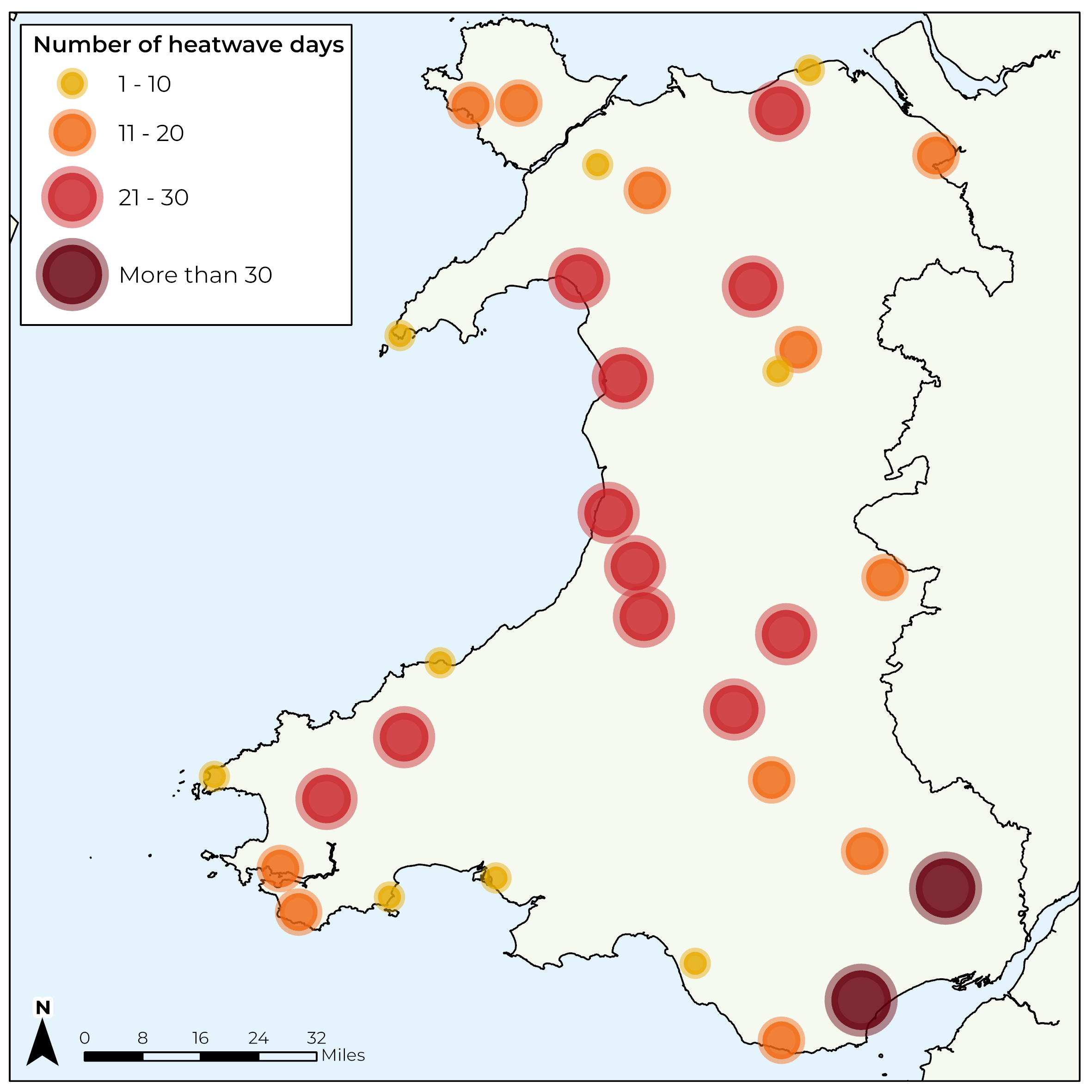
Source: Senedd Research analysis of Met Office data
Further afield, western Europe also experienced its hottest summer on record. In France, an unprecedented wildfire season has burned an area larger than Anglesey.
Extreme heat impacts all parts of society
Extreme heat can cause dehydration and heat stress even in healthy people. High temperatures increase excess deaths from heart attacks, strokes, and lung disease, with greater risks for vulnerable groups like older and disabled people.
Hot weather increases demands on the Welsh NHS. During the June 2026 heatwave, the Welsh Ambulance Service and Aneurin Bevan University Health Board declared critical incidents due to a sharp rise in demand.
In its first annual assessment of heat-related mortality, Public Health Wales found a significant increase in deaths during the hottest period of 2024.
An assessment of the May and June 2026 heatwaves, led by Imperial College London, estimated there were around 128 heat-related deaths in Wales. It estimated there were 2,700 total heat-related deaths across England and Wales, 42% of which would not have happened without human-induced warming.
Cwm Taf Morgannwg University Health Board cancelled 107 operations due to extreme heat in May and June 2026, and other south Wales Health Boards were similarly affected.
Building regulations require all developers to consider overheating, and the Welsh Government requires stronger minimum standards for social homes. Summertime overheating risk is expected to rise in the decades ahead, particularly in newer buildings and flats, increasing demand for passive and active cooling.
There is no statutory requirement for schools to close during extreme heat, in contrast to cold weather. Nonetheless, more than 700 Welsh schools closed during the June 2026 heatwave. Headteachers have discretion on school opening during extreme weather, but may follow Welsh Government guidance.
There is limited data on active cooling systems in Welsh public buildings. However, more than 90% of NHS staff responding to a UK-wide Doctors’ Association survey during in June, reported no or limited air conditioning and uncomfortably hot conditions in their workplaces. The Royal College of Physicians has asked the Welsh Government to invest in ventilation and cooling for healthcare buildings to build resilience to extreme heat.
Transport for Wales (TfW) warned against all non-essential travel during the peak of the June 2026 heatwave. Some trains were cancelled and other services ran with reduced speed to minimise the risk of track damage.
Heatwaves can impact electricity grid stability by reducing electricity production (including from gas power stations and wind farms), increasing demand (e.g. from air conditioning), and overloading power lines. After whistleblowers raised concerns about UK grid stability during the June 2026 heatwave, Ofgem commenced a review of energy system operation during extreme heat.
Natural Resources Wales (NRW) says hot, dry weather in 2026 has reduced grass growth and forage availability, and created concerns for livestock welfare. NFU Cymru says the weather is impacting crop yields and forcing farmers to deploy forage stocks set aside for the winter.
Marine heatwave conditions have persisted in Welsh seas for most of summer 2026. Hotter seas impact ecosystems, shifting species’ ranges and impacting fisheries.
Wildlife on land can also be badly affected by extreme heat and drought, as food and water sources dry up and seasonal cycles change.
Extreme heat combined with a lack of rainfall creates conditions in which wildfires can spread. Wildfires destroy landscapes and infrastructure, while wildfire smoke poses risks to public health.
A detailed discussion of the summer 2026 wildfires can be found in another Senedd Research article.
Fire and Rescue Services declared four major incidents for wildfires in July and August, at Conwy Mountain; Llanwonno Mountain, Rhondda Cynon Taf; Llangynidr Reservoir, near Ebbw Vale; and Rhandirmwyn, Carmarthenshire..
Locations of Welsh wildfires in 2026, up to 31 August
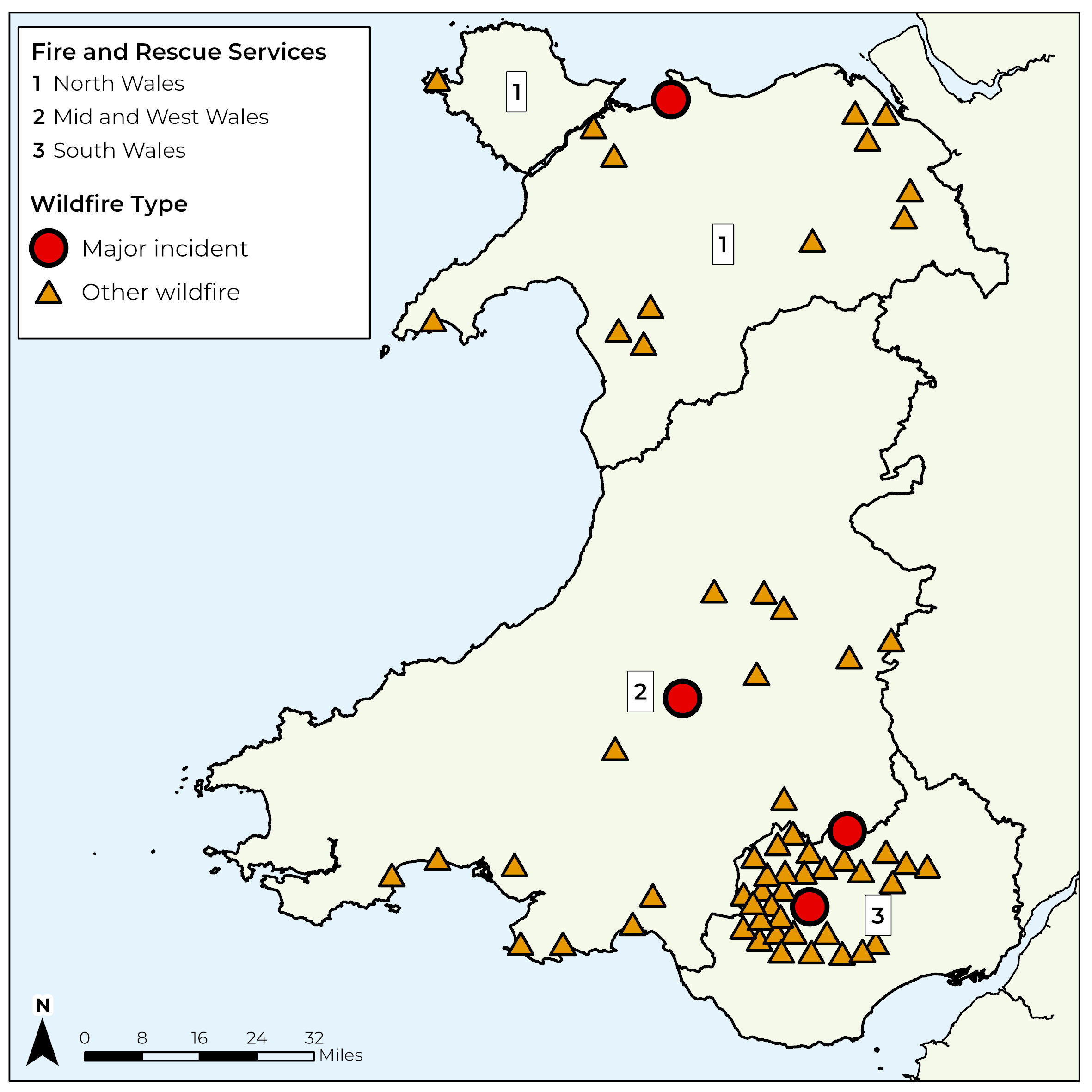
Source: Senedd Research analysis of public statements by North, Mid and West, and South Wales Fire and Rescue Services, and local newspapers.
Note: Fire and Rescue Services report incidents in different ways, and may not make public statements for all wildfires attended. This map is therefore likely to underestimate the total number of wildfires. Some points have been offset to improve readability.
In October 2026, the First Minister, Rhun ap Iorwerth MS, will “convene a climate change and resilience summit, focusing on wildfires.
Extreme heat can impact the economy by reducing worker productivity, creating health issues, and damaging infrastructure.
The Office for National Statistics estimates the UK lost an average £1.2bn in gross value added (GVA) per year between 1998 and 2021 due to heat-related reductions in worker productivity. International studies indicate heat-related productivity losses are worse for small firms compared to large ones.
Adapting to the new normal
Extreme heat is becoming increasingly common. The average number of hot days in Wales doubled between the end of the 20th century (1981-2000) and start of the 21st (2001-2020), as shown in the chart below. Wales can anticipate another 50% rise in hot days under the level of global warming expected by 2050.
Average annual number of days with maximum temperature exceeding 25°C
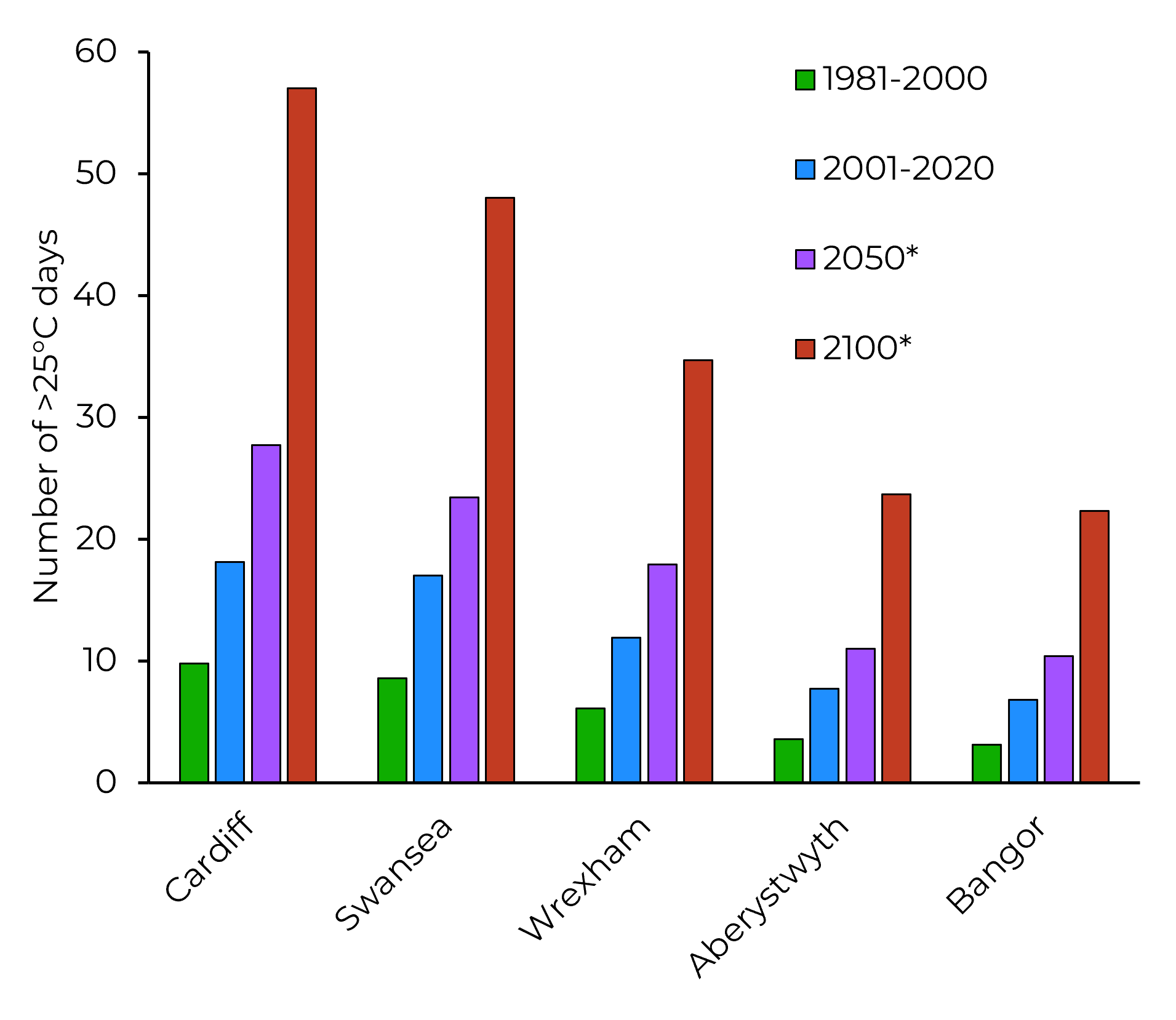
*2050 and 2100 projections correspond to 2°C and 4°C of global warming, respectively. The Climate Change Committee has asked governments to plan for this pace of warming.
Source: Senedd Research analysis of Met Office data
Intensifying heat and rising drought are two of the UK’s priority climate risks, according to the independent Climate Change Committee (CCC). To better adapt for these risks, it recently recommended governments should:
- invest in active and passive cooling for key public services, such as hospitals, schools, prisons, and care homes;
- set maximum working temperature regulations; and
- accelerate the uptake of cooling for the most vulnerable.
The last Welsh Government set out its policies for minimising risks from extreme heat in its Climate Adaptation Strategy. Last year, the National Infrastructure Commission for Wales recommended introducing a legal climate adaptation framework, to give adaptation equivalent standing to Wales’ existing decarbonisation framework.
Climate scientists are unequivocal that global warming will continue until the world reaches ‘net zero’ greenhouse gas emissions. Until then, Wales faces an escalating need to adapt to heatwaves, droughts, and flooding.
Article by Dr Matthew Sutton, Senedd Research, Welsh Parliament