








Wales experienced a severe wildfire season during summer 2026, along with much of western Europe. A Welsh Government oral statement on Tuesday 15 September will give Members of the Senedd an opportunity to discuss these wildfires.
This In Brief provides background information about this year’s historic wildfire season, policy action to address risks, and long-term options for building resilience.
For additional information, Senedd Research has also recently published articles on the wider impacts of extreme heat and drought.
Responsibility for wildfire management
- Wildfire management is devolved to Wales. The Welsh Government oversees Wales’ three (North, Mid and West, and South) Fire and Rescue Services (FRSs) and has responsibility for land management policy.
- Wales’ four Local Resilience Forums also play a key role in preparing for, and responding to, emergencies like wildfires.
Overview of the summer 2026 wildfires
- Detailed Wales-level wildfire statistics for 2026 are not yet available, but UK-level data up to 1 September indicates 28,299 hectares of land has been burned, already making this year the second-highest on record.
- By mid-August, Welsh and English FRSs had responded to more wildfires than during the whole of 2025, even though 2025 was the UK’s most severe wildfire year on record.
- Welsh FRSs declared four wildfire-related major incidents in July and August, at:
- Conwy Mountain;
- Llanwonno Mountain, Rhondda Cynon Taf;
- Llangynidr Reservoir, near Ebbw Vale; and
- Rhandirmwyn, Carmarthenshire.
Locations of Welsh wildfires in 2026, up to 31 August
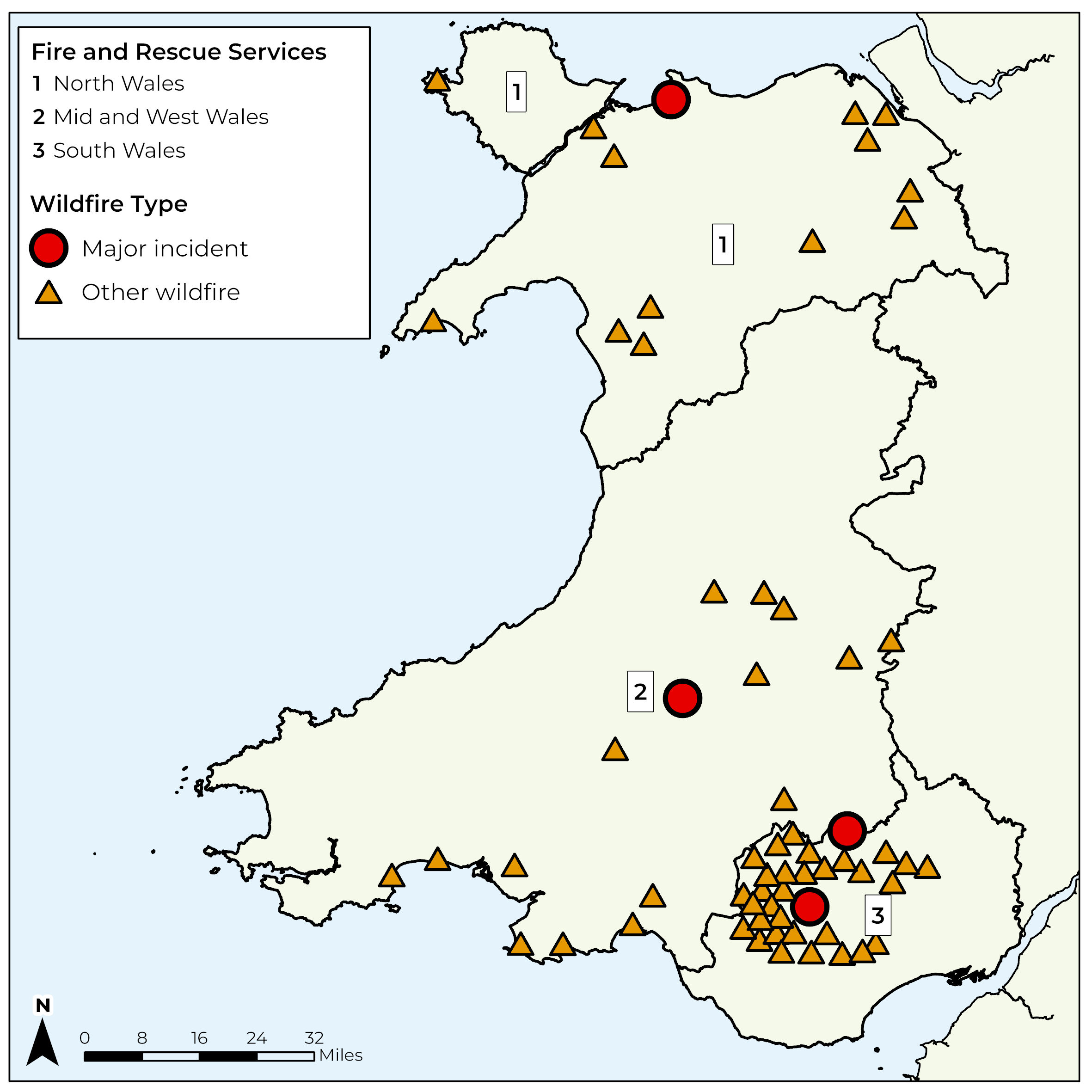
Source: Senedd Research analysis of public statements by North, Mid and West, and South Wales Fire and Rescue Services, and local newspapers.
Note: Fire and Rescue Services report incidents in different ways, and may not make public statements for all wildfires attended. This map is therefore likely to underestimate the total number of wildfires. Some points have been offset to improve readability.
- South Wales FRS received military assistance to support firefighting in August. Welsh FRSs also received mutual aid from English FRSs for several large wildfires.
- In rural areas wildfires can destroy agricultural and nature-rich landscapes. In built-up areas they can damage homes, businesses, and infrastructure.
- Wildfire smoke negatively impacts local air quality and ash can contaminate water. Burning vegetation also releases greenhouse gases, contributing to climate change.
What causes wildfires?
- Wildfires rely on three key factors: available fuel, weather conditions, and an ignition source.
- Summer 2026 was Wales’ hottest on record, and one of its driest (including the driest-ever July).
Annual Welsh summer temperature from 1884-2025, compared to a 1961-1990 average
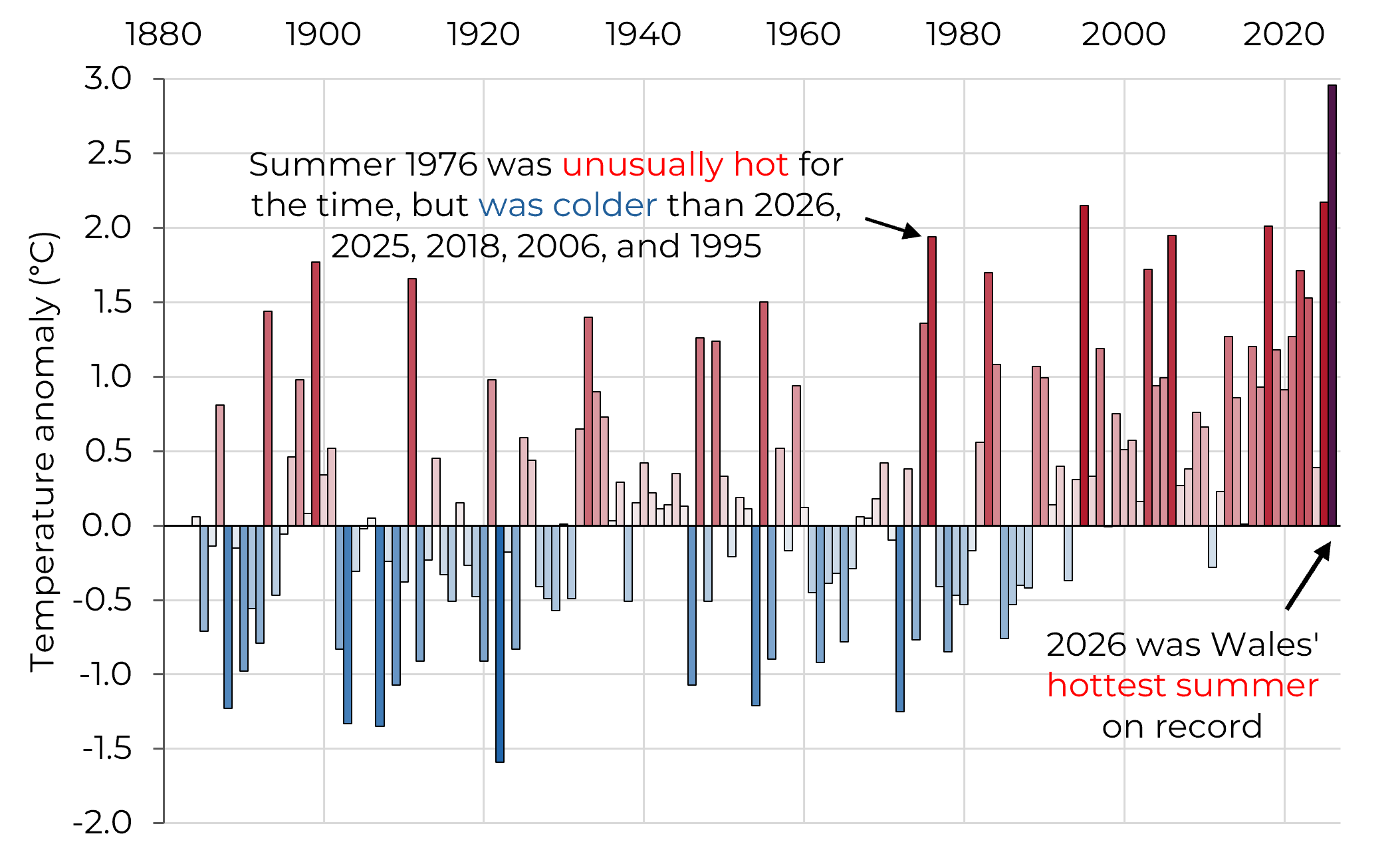
Source: Senedd Research analysis of Met Office data
- Climate change is making Welsh summers hotter and drier, more regularly creating conditions suitable for wildfires. Wildfires now occur for more of the year and in more places than they did in the past.
- Most UK wildfires are started by human action. No detailed public dataset of wildfire ignition source is available for Wales, but evidence from England and Scotland suggests most wildfires start from deliberate initial ignitions.
- A 2011 study found that the most deprived areas of the south Wales Valleys are disproportionately likely to experience wildfire, likely due to deliberate ignitions.
Responses to wildfires
- The Welsh Government addressed its plans to reduce wildfire risks in response to a written question in August 2026, saying it:
- is addressing land management practices;
- is funding youth intervention programmes; and
- will convene a Wildfire Summit later in 2026.
- The Welsh Government has issued two statements on wildfires this summer:
- On 22 July it said it would review Wales’ ability to fight wildfire, following concerns about a lack of aerial firefighting supportin Gwynedd. It later said it would discuss a co-ordinated approach to aerial firefighting with the UK and other devolved governments.
- On 14 August it said the First Minister had attended a UK Cabinet Office Briefing Room (COBR) meeting on wildfires and highlighted the role of public messaging in preventing them.
- The UK Government temporarily banned the sale of disposable barbeques in August, and issued an Emergency Alert warning people against doing anything that might spark a fire.
- The Chair of the UK-wide National Fire Chiefs Council (NFCC) has called for the creation of a long-term wildfire strategy that would include specialist wildfire teams and dedicated aerial firefighting capacity.
How could Wales become more wildfire resilient?
- Due to human-induced warming, the number of days with very high wildfire danger is projected to double by 2050, compared to 1981-2010, with particular risk in moorland areas of Wales.
- The previous Welsh Government’s 2024 Climate Adaptation Strategy acknowledged the growing risk of wildfire. It said risks will be managed through the Wales Wildfire Board and the multi-agency taskforce Operation Dawns Glaw.
- The NFCC highlights the lack of a dedicated funding pot for FRSs to fight wildfires and asks for:
- sufficient resource for tackling wildfires;
- better data quality on changing risks; and
- improved joint-working in decision making.
- Managing landscapes in certain ways can reduce the ability of wildfire to start and spread. Most Welsh land is privately owned, but the Welsh Government influences management, for example through the Sustainable Farming Scheme and dedicated grants.
- Improving landscape-scale wildfire resilience could include:
- Increasing land-based water storage (or ‘re-wetting’) to create firebreaks, which can also improve drought resilience and lower flood risk.
- Re-wetted peatlands in the Tywi Forest and Elan Valley were resilient to wildfire in 2025 and 2026. Both restorations were funded by a Welsh Government programme.
- Evidence from North America suggests wetlands created by beavers are resistant to wildfires and offer shelter for other species.
- Reducing fuel loads, like dried out vegetation, to restrict the ability of wildfire to spread.
- Vegetation can be managed through selective grazing and controlled burning.
- Woodlands can be made more resilient by integrating firebreaks and planting broadleaf trees.
- Increasing land-based water storage (or ‘re-wetting’) to create firebreaks, which can also improve drought resilience and lower flood risk.
- Given that most UK wildfires are started by people, education and awareness-raising may reduce risks.
- South Wales FRS leads the Healthy Hillsides initiative in the south Wales Valleys – where authorities engage communities in wildfire-prone areas.
Article by Dr Matthew Sutton, Senedd Research, Welsh Parliament