The Senedd and Pierhead buildings will be closed to the public on Thursday 15 October. Read information about the closure.









Wales’ Budget and public finances: past changes and future challenges
Published 03/06/2026 | Reading Time minutes
The Sixth Senedd saw the end of pandemic funding; cost-of-living pressures; and shifting UK Government fiscal policy. As a new Senedd term begins, questions around how funding has changed, where spending is heading, and how future pressures will shape decisions are becoming increasingly urgent.
Over the current UK Parliament term (2023-24 to 2028-29), the Welsh Government’s revenue budget is due to grow on average 1.9% in real terms, which is 0.8 percentage points less than the previous parliamentary term (2.7% on average in 2018-19 to 2023-24).
With slower funding growth and changing demands for services, the new Welsh Government inherits tough choices over tax and spending allocations.
Funding growth in the Sixth Senedd
The Sixth Senedd operated during a period of real terms growth in Welsh Government funding, marking a clear shift from the funding cuts experienced during much of the 2010s. The Institute for Fiscal Studies (IFS) reports that core resource funding was 11.9% higher, per person in real terms, than in 2019-20, and 7.4% higher than 2010-11.
The UK Government largely drove this increase through higher block grant allocations following the pandemic, on average a 2.8% annual increase in real terms over the Sixth Senedd. Cardiff University’s Wales Fiscal Analysis (WFA) states:
… this represents the fastest increase in the budget since the 2nd Assembly term (2003-2007) and double the increase suggested by the outlook ahead of the last Senedd elections in 2021.
Almost four-fifths of Welsh Government funding comes from the UK Government through the block grant. The remainder of the funding comes from borrowing and devolved taxes: Welsh Rates of Income Tax (14.3%), nondomestic rates (4.3%), Land Transaction Tax and Landfill Disposals Tax (1.6%).
The devolution of taxes has had an increase on available funding for the Welsh Government. During the Sixth Senedd they’ve lead to an equivalent growth of 3.8% on day-to-day funding, however progress in expanding these powers has been slow. But, with new and further taxes on the table, policymakers in the Seventh Senedd will have the opportunity to further shape Wales’ fiscal devolution journey.
Shifting priorities within a growing budget
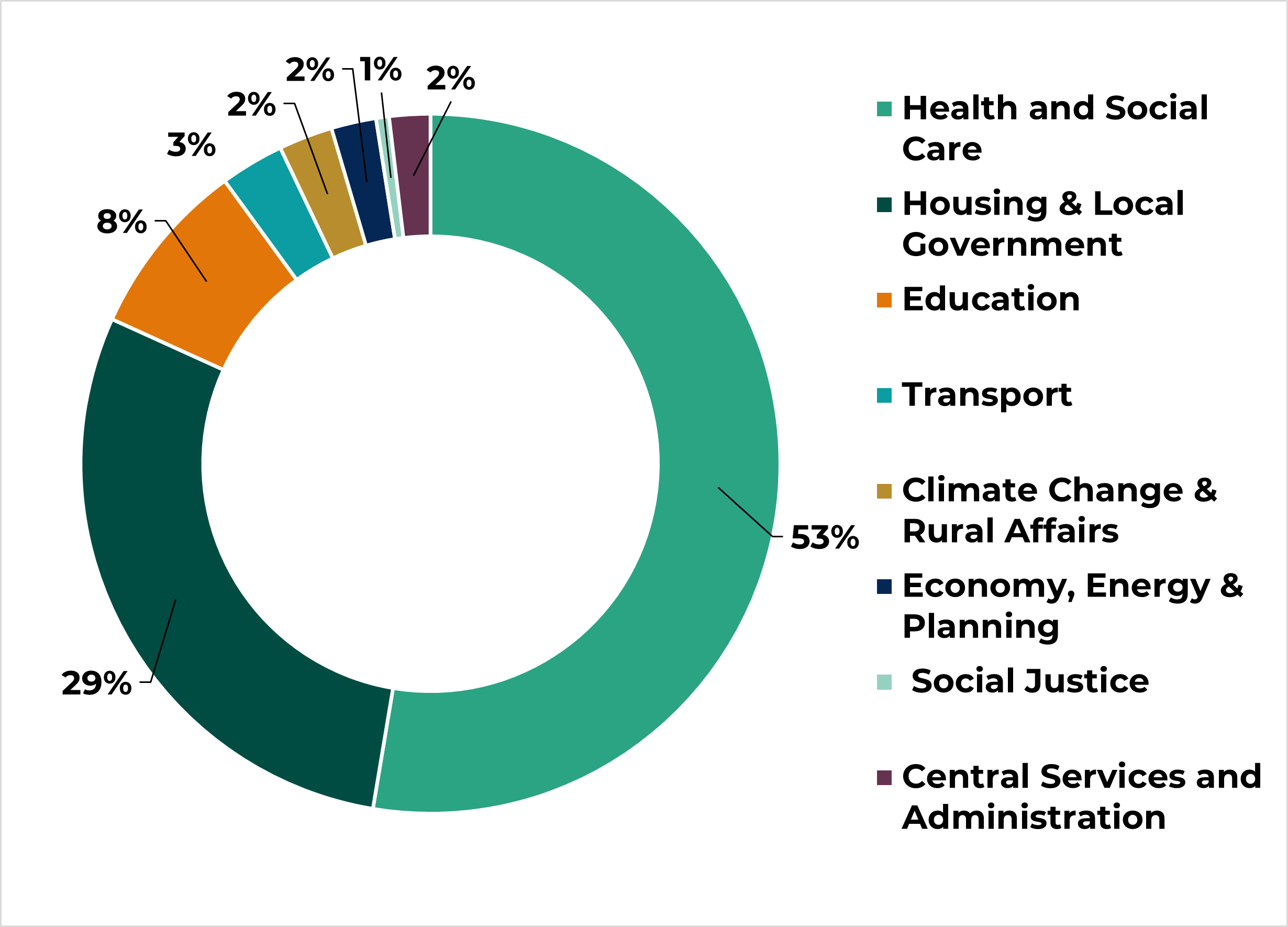
While overall funding has grown in real terms, how that funding is allocated has changed. The Welsh Government’s Final Budget for 2026-27 had the following profile of spending across departments.
Figure 1: Day-to-day spending proportion across Welsh Government departments for the Final Budget 2026-27
Source: Welsh Government Final Budget, Wales Fiscal Analysis, Senedd Research
Health and Social Care funding is consistently the biggest area of spending, and accounts for over half of the day-to-day spending in 2026-27. Of that spending, £12.1bn is spent on ‘NHS services’, a 1.7% increase in real terms since 2025-26. This is significantly slower than recent increases of 3.7% per year from 2019-20 to 2024-25, and the long-term average annual increase of 3.6% since the 1950s.
Housing and Local Government funding makes up over a quarter of day-to-day spending, with the majority, £6.6bn, for local authorities, which includes funding for social care and schools. Local authority funding has seen a higher increase than the NHS in recent years, increasing by 2.9% per year on average in real terms from 2024-25 to 2026-27.
Cardiff University’s Wales Fiscal Analysis (WFA) notes that two other Main Expenditure Groups (MEGs) have seen a large increase in funding over the past Senedd term: ‘Transport’ and ‘Economy, Energy and Planning’. Between 2024-25 and 2026-27, funding for transport will have increased in real terms by 8.4% per year. This is due to increases in strategic road network contractual payments, rail services support (Transport for Wales) and bus service support. Economy, Energy and Planning funding will have increased in real terms by 7.5% per year between 2024-25 and 2025-26, and mainly reflects an underspend from the Development Bank of Wales and the green energy budget.
Slower growth and tougher decisions ahead
The cost of rising UK debt interest shapes the overall fiscal environment. The IFS reported that in 2025 the UK’s debt interest spending was more than double than in 2022. The IFS identified UK Government efforts to stabilise debt as a key factor behind tighter future spending plans for devolved administrations.
For the remainder of the current Spending Review period (2027-28 and 2028-29), the core block grant is set to increase by 0.5% per year on average in real terms, with slightly higher increases forecasted until 2030-2031.
The IFS notes the first half of the 2020s saw substantial increases in real terms revenue and capital funding, driven by block grant funding, for the Welsh Government. The second half will see a slower real terms growth in revenue, and a fall in capital. WFA notes capital spending is set to fall in real terms to 2029-30 and says “the outlook looks challenging for the next Welsh Government”.
Previous Welsh Government plans for funding increases for the rest of the decade are well below historic increases in spending on health, social care and local government. Therefore, unless this scenario changes, the incoming Welsh Government will be faced with tough decisions to protect key services.
How UK spending decisions shape Wales’ budget
Rules around how the Welsh Government is funded are set out in the 2016 Fiscal Framework. As discussed above, most of the Welsh Government’s money comes through the Welsh block grant, which is linked to UK Government spending through the Barnett Formula.
How the Barnett Formula works
The Barnett formula is used to calculate how much budget the Welsh Government gets as a consequential of UK Government spending in devolved areas, and is also used to calculate the block grant.
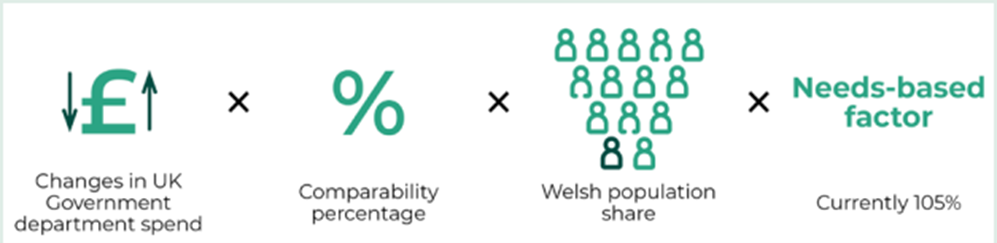
It uses the annual change in a UK Government department’s budget and applies a comparability percentage based on the extent to which that department’s services are devolved, it also takes into account the relative population of Wales.
Wales also has a block grant floor, set at 115% to reflect Wales’ greater needs. This is designed so that Wales will receive at least 15% more funding per person than England. Currently, funding for Wales is around 20% higher per person than England, meaning the block grant floor has not yet been triggered. As a result, a temporary needs-based factor is set at 105%.
Figure 2: Explanation of the Barnett formula for Wales
Source: Senedd Research
Comparability factors are recalculated and published at UK Spending Reviews. There are frequent disagreements between the UK and devolved governments about which spending should be classed as ‘comparable’ to devolved responsibilities. These classifications directly affect how much funding Wales receives through the Barnett formula. When spending is deemed comparable to devolved responsibilities, Wales receives a population based share, when it is not deemed comparable, no consequential follows.
A recurring example is funding for HS2 railway. Rail infrastructure is largely devolved in Wales, however, HS2 has been classified by the UK Government as an ‘England and Wales’ project, meaning no Barnett consequential for the Welsh Government. All Sixth Senedd parties disputed this classification and have called for a “fair share” of HS2 funding to be allocated to Wales.
These disputes highlight how decisions taken at UK level have financial implications for devolved governments. The incoming Welsh Government will be tasked with building effective intergovernmental relations to help safeguard Wales’ financial and policy interests.
A tense starting point for the new Welsh Government
The new Welsh Government will inherit a tighter financial outlook than the Sixth Senedd enjoyed. Slower growth in the block grant, falling capital budgets and rising pressures in key services mean tough decisions lie ahead.
At the same time, Wales’s devolved tax powers, and potential future reforms to the Fiscal Framework, offer opportunities to shape how the budget evolves.
Article by Peter Davies, Senedd Research, Welsh Parliament