








|
The following is a guest article by Dewi Knight and Hannah Ellis. Dewi is the Director of PolicyWISE and Hannah is a Research Assistant at PolicyWISE. PolicyWISE is the UK and Ireland comparative policy, research, and knowledge exchange think-tank, hosted at The Open University. It was highly commended as ‘One to Watch’ in the Smart Thinking think-tank awards for 2025. It aims to inform and improve policymaking through cross-nation and comparative research and analysis. |
In making the above statement during his last year in office, President Eisenhower emphasised that nations’ “broadly based strength” should lead to the building of “productive partnerships”, achieving “security, freedom and peace”.
While some predict a certain coolness – if not quite a Cold War – for future UK intergovernmental relations (IGR) following May’s elections, our research and polling suggest it presents a positive opportunity for stronger cross-nation working.
And people in Wales expect to see improved partnership working between the governments on international matters, as well as on domestic policy challenges.
We surveyed 806 people in Wales and 1,035 in Scotland in early February 2026. PolicyWISE worked with More in Common on this polling, the first of its kind to examine Scottish and Welsh public attitudes specifically towards intergovernmental co-operation across the UK.
Things can only get better?
PolicyWISE has recently published a new research report 'the strength to co-operate'. It brings together the results of polling, engagement with policymakers and civic leaders, and analysis of IGR in the UK and internationally.
The report argues that the UK’s multi-level governance, and multi-national character, can be a strength for tackling major policy challenges. This is what the public expects, and wants, to happen.
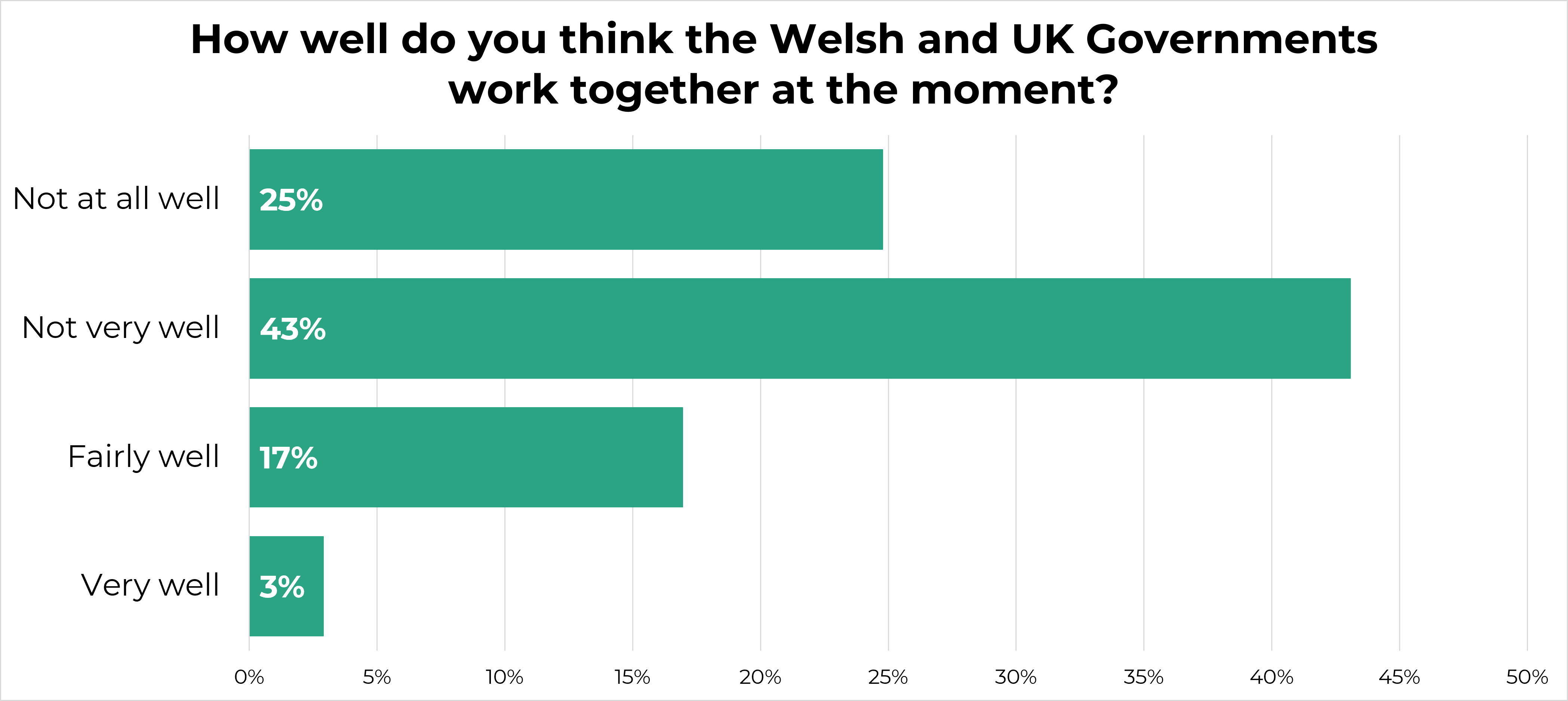
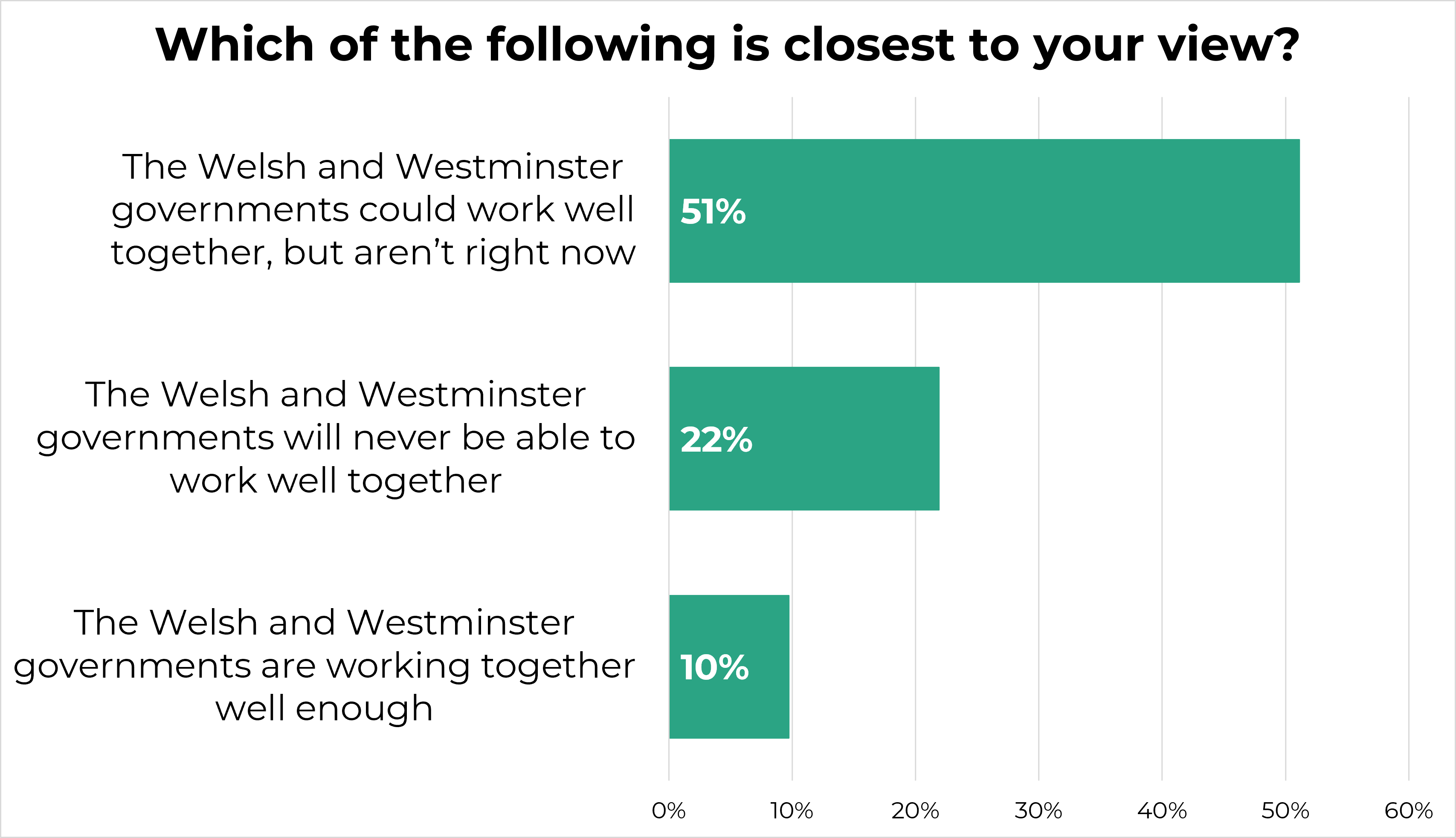
When asked in February (before the Senedd election and the change in government) people in Wales did not think relations between governments were in a good place. Just one in five believed that the (then) Welsh and UK governments were working well together. But a majority believe that collaboration is possible, despite the perceived lack of co-operation.
Only a fifth of people in Wales think it is impossible for the Welsh and UK governments to work well together, suggesting significant public optimism and support for improved IGR.
Voters say that closer cooperation is needed on the issues that matter most including the cost of living, the economy, the NHS, energy, immigration and tackling violence against women and girls.
Source: PolicyWISE
Source: PolicyWISE
Policy priorities
Looking to what matters most to them, the public want to see governments co-operating, no matter whether Cathays Park or Whitehall has the lead responsibility. There is support, and expectation, that governments work together on both devolved and reserved issues.
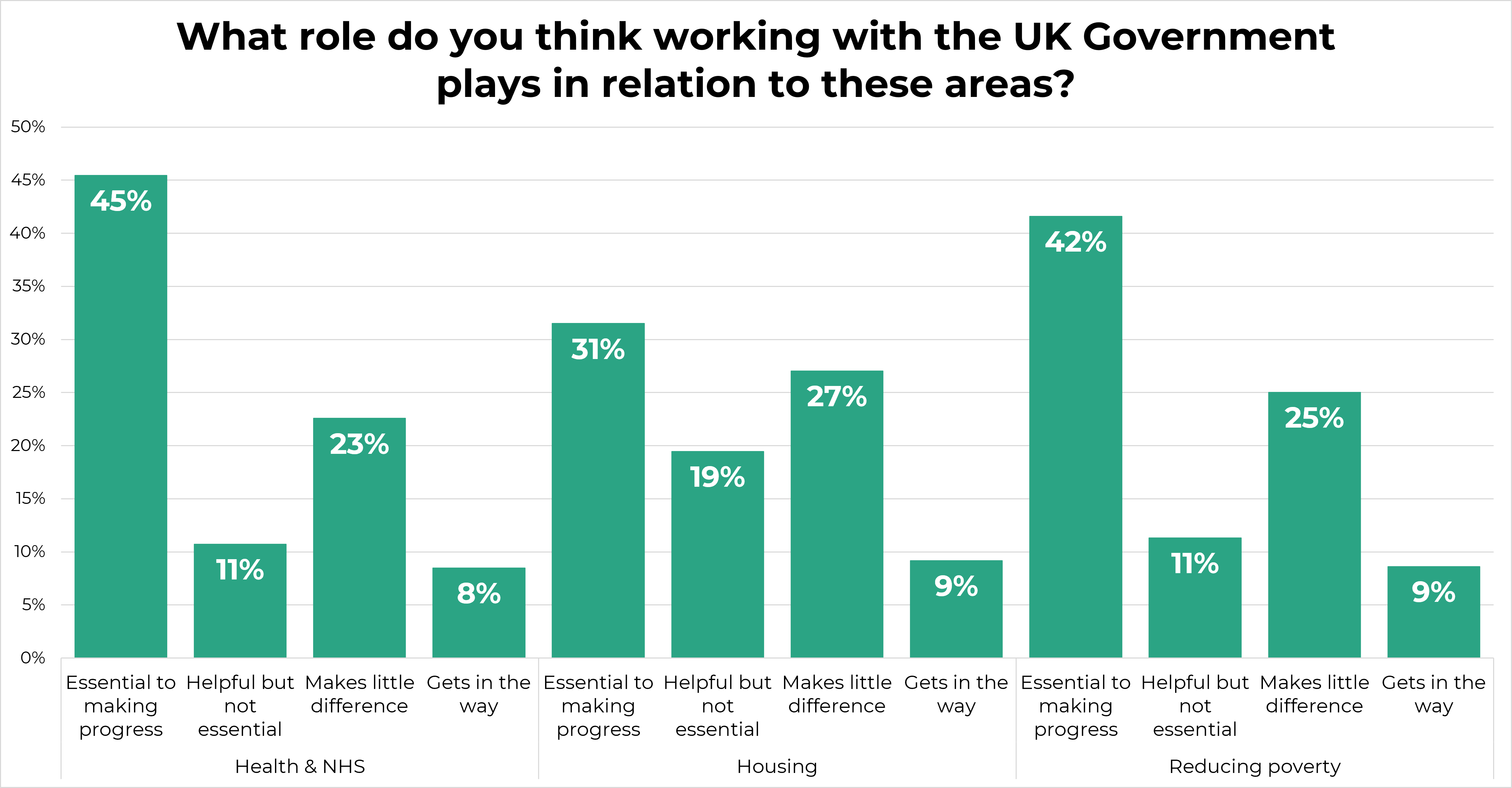
On the NHS, two-thirds of people in Wales think that collaboration between the Welsh and UK governments is “essential” or “helpful”, despite it being a devolved responsibility. Only 8% think that working with the UK Government “gets in the way” of devolved government action.
On housing policy, a majority (52%) think that intergovernmental cooperation would be “essential” or “helpful” and just 8% thought it “gets in the way”.
The same trend is evident across education, climate change and poverty reduction, with majorities supporting co-operation and very small proportions seeing it as a barrier.
Source: PolicyWISE
For UK, see England?
Achieving more effective collaboration also depends on greater clarity about the UK Government’s role. In particular, there is a need to distinguish when it is acting as the de facto national government for England, and when it is operating on behalf of the whole of the UK.
Successive UK governments have been reluctant to formally recognise this duality, but the polling shows that the public in Wales are ahead of them on this issue.
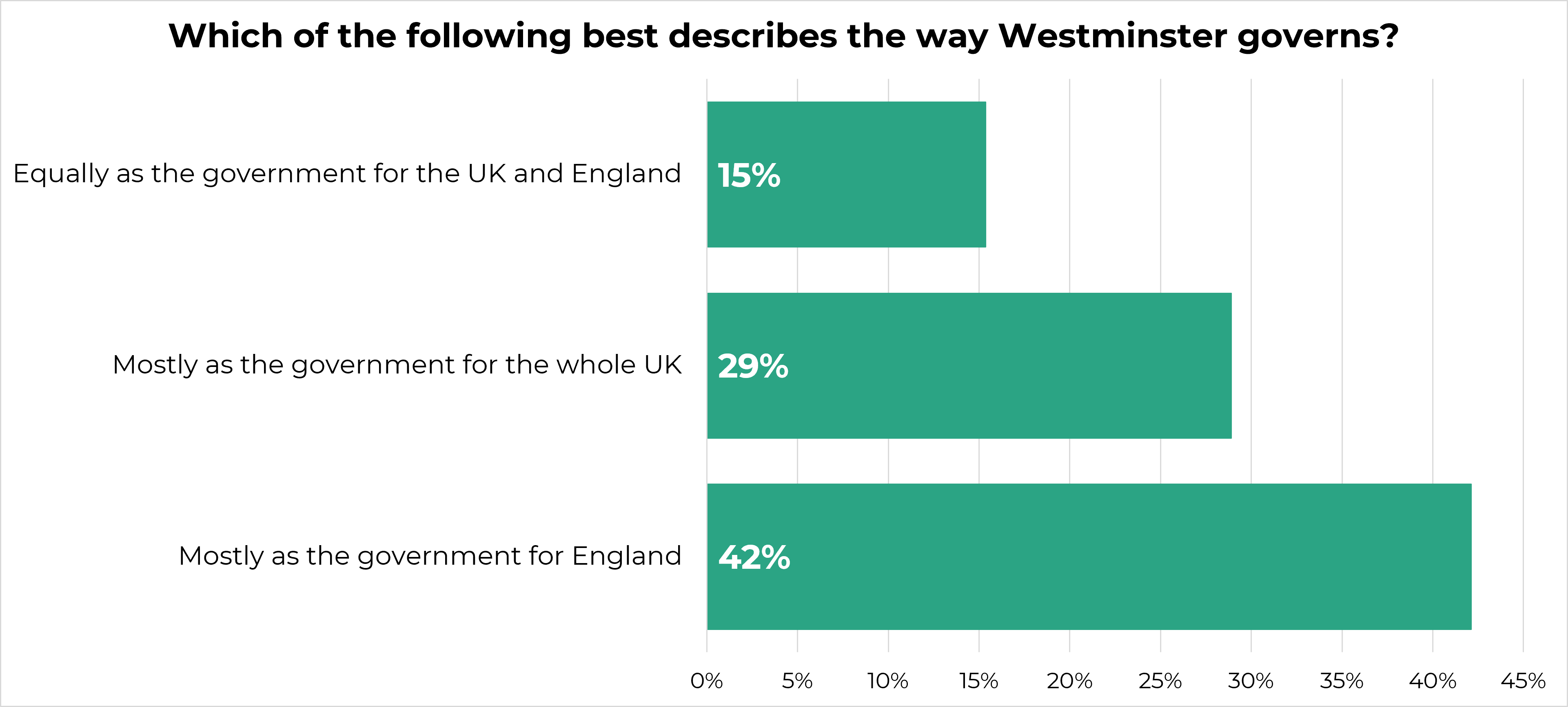
41% of people in Wales believe the UK Government acts mainly as a government for England, and only 29% think it mostly operates as a UK-wide government. Fewer than one in three also think that the UK Government is clear in communicating when its decisions affect only England.
These findings underline a key challenge for UK governance, devolution and English decision-making: without clearer communication and institutional recognition of this dual role, it becomes harder to support effective intergovernmental working and create the conditions for genuine collaboration that can be recognised by the population across the UK.
Source: PolicyWISE
Collaborative governance
Our new report recommends that the UK adopts a more collaborative approach to governance across its nations (and regions). The different governments of the UK should recognise that to achieve many of their priorities, they need to work with others.
Heads of government should collectively identify and agree their shared priorities and commit to working together to make progress on these issues. This identification, and prioritisation, should not rest with one government alone, and doesn’t mean the pursuit of the exact same policies.
This new way of working would involve governments systematically sharing learning and best practice, coordinating better across jurisdictions, and then considering whether to commit to clearly defined joint initiatives. IGR should be focused on selected, and collectively agreed, issues.
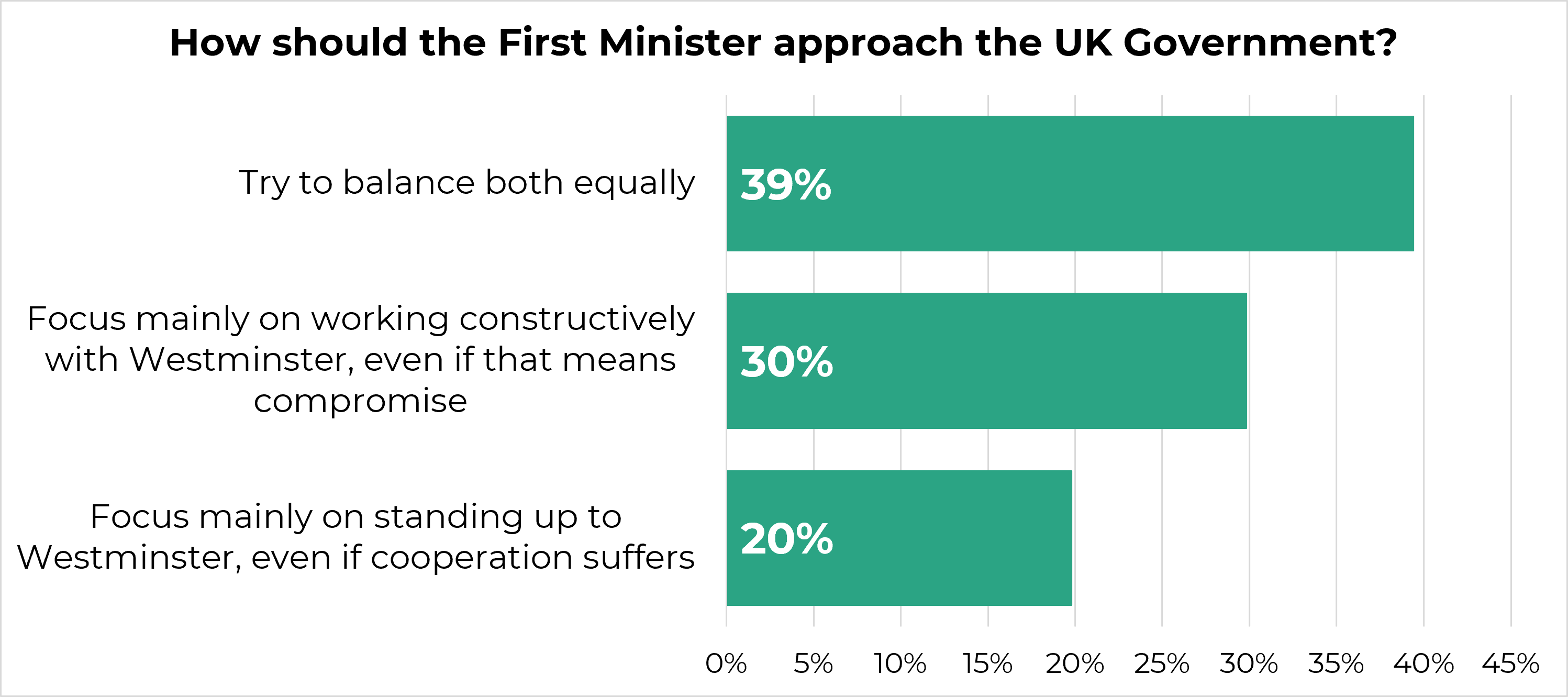
This is what people in Wales expect from intergovernmental relations. Half of the public think that “co-operating to solve shared problems” should be the focus of IGR in the UK, with 28% choosing cross-nation learning as a key IGR priority. Only 18% thought that the governments “standing up for their area” was an important intergovernmental relations practice.
Source: PolicyWISE
Beyond the geometry of powers – international best practice
There are potentially three categories of strategic issues which can benefit from improved intergovernmental relations:
- those ‘reserved’ to the UK Parliament,
- those that are shared or concurrent competence, and
- ‘devolved’ issues.
In proposing a more collaborative form of governance which cuts across responsibilities, PolicyWISE has examined the IGR models practiced in Australia and Canada, and the lessons they have for the UK.
In both countries, federal and ‘devolved’ leaders come together to co-operate and agree shared action on societal challenges such as gender-based violence (Australia), and international economic matters and relations (Canada).
Foreign policy, defence, and security are the exclusive domain of the ‘central’ government in almost all instances. However, geopolitics can have profound implications which cut across different spheres of authority. PolicyWISE’s polling shows that people in Wales (and Scotland) identify four priority issues for this kind of co-operation:
- immigration,
- energy policy,
- trade, and
- relations with the EU.
People are clear that they expect to see the Prime Minister working with the First Ministers, sharing his thinking, and seeking their input on these matters. Existing IGR forums could be used to bring devolved governments into dialogue with the ‘central’ government on these matters of shared importance.
Conclusion – a turning point for IGR?
PolicyWISE’s view is that governments across the UK should seriously focus on collectively identifying issues of shared concern and strategic importance – wherever they fall within the ‘geometry’ of reserved and devolved powers.
This ‘shared rule’ approach aligns with the public’s expectations. We are sharing our recommendations in this constructive spirit.
Moving to a more collaborative and productive mode of engagement requires flexibility and a recognition that no single governing authority in the UK – including the UK Government – can achieve its priorities alone.
This should also mean that the four legislatures – individually and collectively – engage positively with intergovernmental relations, monitor progress, and scrutinise developments within their jurisdictions and across the UK. The recent Scottish Parliament committee inquiry into these matters makes positive recommendations for greater inter-parliamentary working. This Senedd Research article provide an excellent overview of IGR and transparency.
Our polling shows that people expect their governments to work together to address central challenges such as reducing the cost of living, reforming public services and growing the economy in Wales, and across the UK.
In his farewell State of the Union address, President Eisenhower said that without strength in “productive partnership” there could be a “dark…turning point in history”. Our polling and research show that the public in Wales want a turning point in UK intergovernmental relations, focused on those priorities.