








The UK Government has described the Tobacco and Vapes Act 2026 as “the biggest public health intervention in a generation”. It is presented as a landmark step towards a smoke-free UK and a response to rising concerns about youth vaping.
Smoking remains the leading preventable cause of death, disability and ill health in the UK, responsible for around 80,000 deaths each year. The Act introduces a “smoke-free generation” policy by raising the legal age of sale over time, meaning children born on or after 1 January 2009 will never legally be sold tobacco. Alongside this, the Act includes powers intended to reduce the appeal and accessibility of vaping products to children and young people.
Why is youth vaping a growing concern?
Vaping among children and young people is an increasing public health concern across the UK, including in Wales. Public Health Wales says vaping is substantially less harmful than smoking for adults who switch completely, but it is “not risk-free and should not be used by children and young people”.
Recent evidence from Wales and across the UK suggests youth vaping is not limited to experimentation. It increasingly involves regular use, nicotine dependence and easy access. Young people report that vapes are widely available through shops, friends and online sources.
Key facts relating to children and young people and vaping
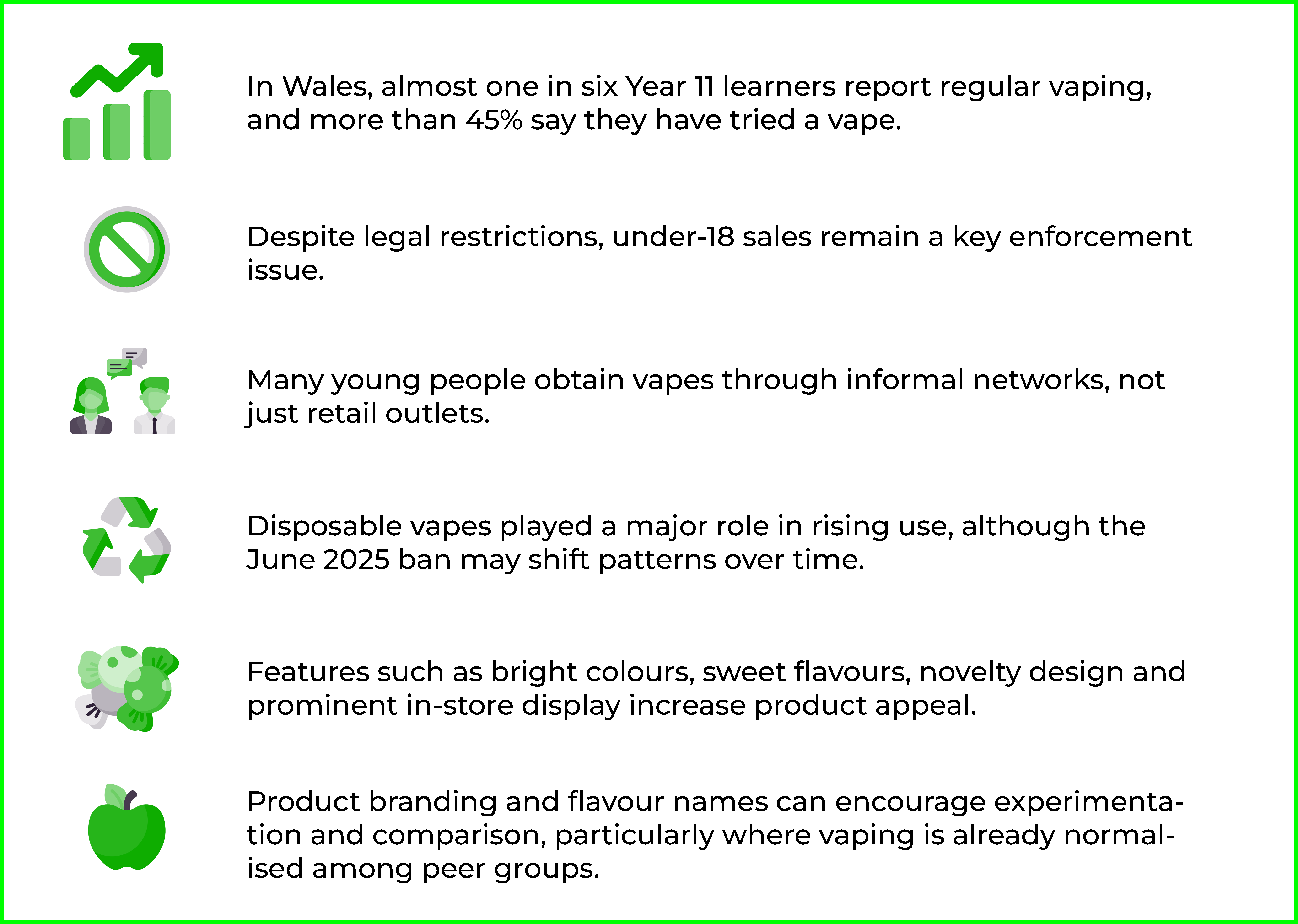
(Source: Prepared by Senedd Research using Youth vaping call for evidence analysis, UK Government)
A House of Commons Library briefing highlights the balance policymakers are trying to strike: supporting adult smokers to quit through vaping, while preventing children and young people from taking it up.
How common is youth vaping?
Survey data indicates that youth vaping remains at a relatively high level. Action on Smoking and Health (ASH) reports that 20% of 11–17-year-olds in Great Britain have tried vaping and 7% currently vape, equivalent to around 400,000 children. Around 3% vape daily.
In Wales, the picture is particularly striking. Public Health Wales (drawing on data from the School Health Research Network) reports that almost one in six Year 11 learners now vape regularly. Schools have also raised concerns about nicotine dependency, disruption in classrooms and increasing exclusions linked to vaping.
Research helps explain why the issue is difficult to address. A 2024 rapid review by the Behavioural Science and Public Health Network identified three key drivers:
- social influence and peer behaviour,
- widespread availability, and
- the appeal of product design.
The review found limited evidence on which interventions work best, suggesting that a combination of education and policy measures is likely to be needed.
Emerging research also points to broader risks. A 2025 umbrella review found associations between youth vaping and a higher likelihood of later smoking, as well as links to respiratory symptoms, substance use and some mental health outcomes.
Taken together, the evidence suggests youth vaping is shaped by a combination of behavioural, social and regulatory factors.
How are other countries responding?
Internationally, governments are moving towards tighter controls on the appeal and availability of vaping products. The World Health Organisation has called for action on flavours and product design, highlighting how these products are often engineered to attract young people through bright colours, novelty features and appealing flavours.
Countries such as New Zealand and Canada have taken steps to restrict how vaping products are sold and marketed. New Zealand has adopted one of the most structured approaches. Supermarkets can sell only tobacco, menthol and mint flavours, while a wider range of flavours is limited to specialist vape shops aimed at adults. Additional measures include restrictions on flavour naming (removing youth-appealing terms such as “candy” and “cola”), bans on product colouring, limits on product visibility in shops, tighter rules on retail location, and restrictions on promotions such as discounts and giveaways.
What could Wales do next?
The Tobacco and Vapes Act 2026 provides a framework for action in Wales by conferring powers on Welsh Ministers, particularly in relation to retail, enforcement, display and vape‑free spaces. The extent of change in practice will depend on how these powers are used by the Welsh and UK governments.
Product appeal
One area of focus is product visibility and presentation. Welsh Ministers have powers over how vaping products are displayed in shops. At the UK level, there are also powers to regulate packaging, branding and flavours. Together, these could reduce the use of bright colours, sweet flavour descriptors and eye‑catching displays that make vaping products resemble confectionery or lifestyle items.
Retail licensing and enforcement
Retail licensing and enforcement are another key lever. The Act introduces a licensing scheme for Wales, allowing conditions to be attached to retailers and penalties for breaches. In practice, this could strengthen oversight, support more consistent compliance checks and create clearer consequences for repeat offences. This is particularly relevant because sales to under‑18s are already illegal - the challenge is ensuring those rules are effectively enforced.
Vape‑free places
The Act also enables Welsh Ministers to designate vape‑free places and extend smoke‑free rules, subject to consultation and evidence. This does not provide a blanket power to ban vaping everywhere. However, it could support a more precautionary approach in settings closely associated with children and young people, such as school grounds or certain leisure environments.
Reducing access and exposure?
Welsh Ministers do not have powers over all aspects of vaping policy. Decisions about product design, flavours, packaging, and advertising remain with the UK Government.
However, the Act gives Welsh Ministers a range of practical powers to reduce access and exposure in everyday settings. These include stronger control of the retail environment, improved enforcement of age‑of‑sale laws, and measures to reduce product visibility in shops. These powers could help address some of the main drivers identified in the evidence, particularly ease of access and the normalisation of vaping among young people.
Looking ahead, the impact of the Act in Wales will depend on how actively these powers are used. If youth vaping remains at a high level, there may be growing expectation that available levers, such as display restrictions, retail licensing and enforcement, and the use of vape‑free spaces, are deployed in a more systematic and targeted way. This raises a broader policy question about how far existing powers in the Act can be used to influence behaviour, and whether further measures may be needed over time.
Article by Sarah Hatherley, Senedd Research, Welsh Parliament