The Senedd and Pierhead buildings will be closed to the public on Thursday 15 October. Read information about the closure.









Can Wales’ NHS end corridor care?
Published 28/08/2026 | Reading Time minutes
Patients being cared for in hospital corridors is a symptom of a health system under pressure. The use of inappropriate clinical spaces, like corridors and storage rooms, has been widely condemned. The Royal College of Nursing Wales (RCN) describes it as being unsafe and undignified for patients, and distressing for staff. Overcrowded emergency departments, with patients facing long waits on trolleys and chairs, have become emblematic of the challenges facing the NHS in Wales.
In December 2025, the Senedd debated a petition, submitted by the RCN and the British Medical Association Cymru Wales (BMA), calling for corridor care to be “eradicated” by the then Welsh Government. It attracted over 10,000 signatures in support.
In the first statement of his priorities as the new Cabinet Minister for Health and Care, Mabon ap Gwynfor MS, said, “emergency departments are buckling under the strain of relentless demand and insufficient capacity, whilst unsafe practices, such as corridor care, are becoming normalised.”
This article asks what we know about the prevalence of corridor care in emergency departments, and whether the Welsh Government’s policy direction and local health boards’ operational planning can reduce the demands placed on the health system and help to bring an end to corridor care.
How common is corridor care in Wales?
There is a lack of evidence about the prevalence of corridor care in Wales.
A snapshot survey by the Royal College of Emergency Medicine (RCEM) in January and February 2025 found that all 12 major emergency departments in Wales were treating patients in corridors. At the time of the survey, an average of 13.5% of patients in major emergency departments were being treated on trolleys in corridors or other inappropriate spaces. The survey took place over three days, so it cannot show how common corridor care is throughout the year.
The petition to end corridor care called on the previous Welsh Government to record and report its incidence. In response, the then Cabinet Secretary for Health and Social Care, Jeremy Miles MS, said local health boards (LHBs) are responsible for capturing operational data on hospital capacity and the number of people cared for in non-clinical environments. He said this data should be used “to take immediate action…to reduce the risk of harm”. It is not held nationally.
Meanwhile in England, the NHS now publishes data on the frequency of corridor care in emergency departments and in general and acute wards. It is estimated that around 4.8% of A&E attendances and 18.1% emergency admissions in England in May and June 2026 experienced corridor care.
Should the NHS in Wales produce similar data? The Nuffield Trust warns that the evidence base for the NHS England definition is “unclear” and could be open to “gaming” to reduce the count of corridor care cases, for example by keeping patients waiting in ambulances, at a risk to patient safety. However, doing so would provide greater transparency about NHS performance.
Emergency departments under pressure
Demand on emergency departments has increased, and at a greater rate than the corresponding increase in Wales’ population. In 2024-25 there were almost 1.1 million attendances at emergency departments in Wales, the highest on record.
There are two key Welsh Government targets for all emergency departments, including both major emergency departments and other emergency departments/minor injury units:
- 95% of new patients should spend less than 4 hours from arrival until they are admitted, transferred or discharged
- No patient should wait more than 12 hours from arrival until admission, transfer or discharge
Currently, emergency departments are not meeting these targets. In July 2026, 49.9% of patients spent less than 4 hours in major emergency departments. No major emergency department in Wales met the 4 hour or 12 hour targets.
Figure 1: Percentage of patients who spend less than the target time in major emergency departments
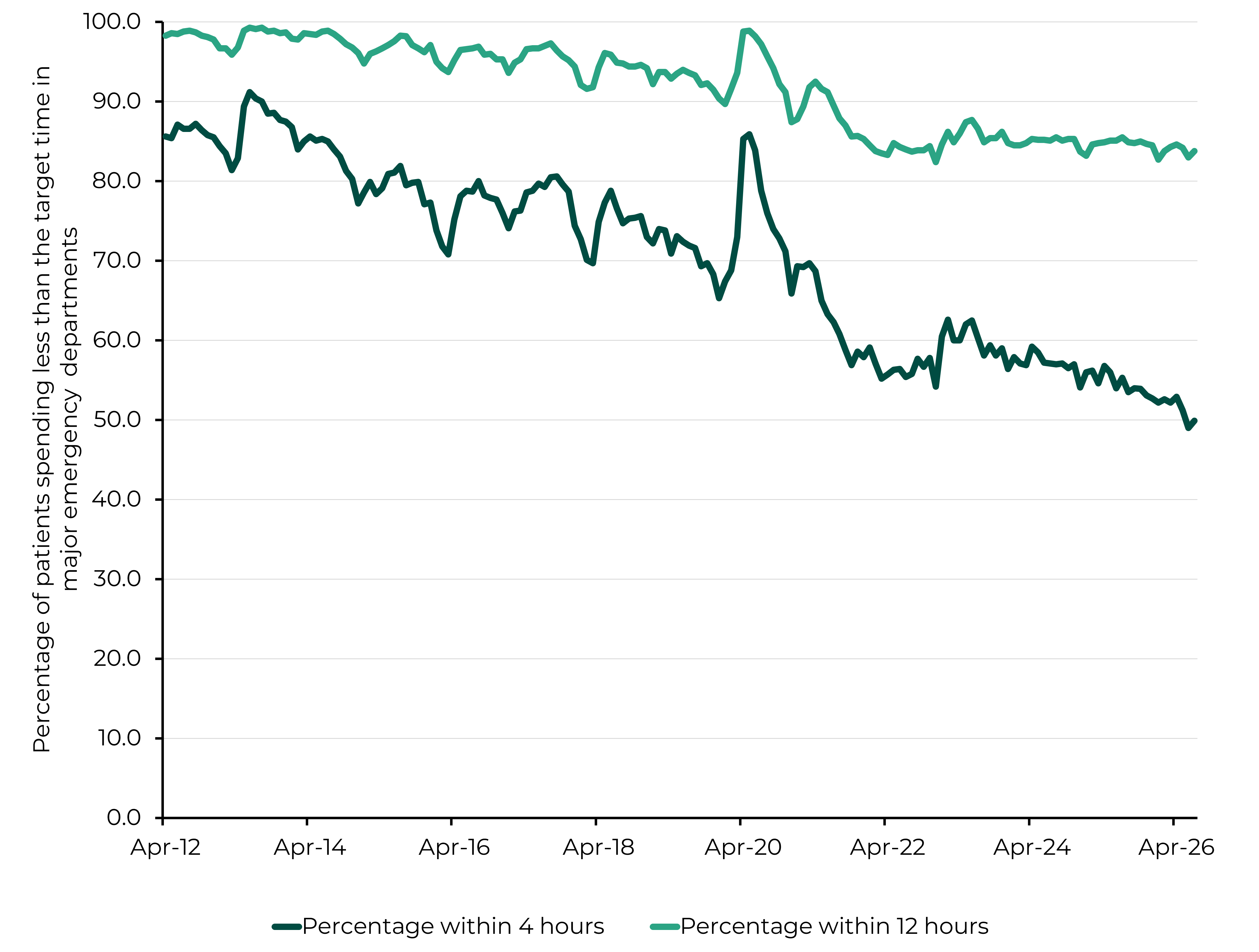
Source: StatsWales, Emergency departments: performance against waiting times targets, October 2009 onwards
Across Wales, other emergency departments/minor injury units are meeting the targets. In July 2026, 96.1% patients spent less than 4 hours and 100.0% spent less than 12 hours in other emergency departments/minor injury units, although there is variation between individual hospitals.
Long waits in emergency departments disproportionately affect older people, who are more likely to be living with frailty and multiple health conditions. The longest median waiting times to admission, transfer or discharge are consistently seen for people aged 85 and over.
Long waits in emergency departments have been found to increase patients’ risk of harm, including higher mortality and longer hospital stays. RCEM estimates that, in 2025, an average of 18 deaths every week were associated with waits of 12 hours or longer in Welsh emergency departments.
Understanding and addressing the causes of corridor care
The causes of long waits, overcrowding, and corridor care in emergency departments are complex and extend across the health and social care system.
During the Sixth Senedd, the Health and Social Care Committee and the Local Government and Housing Committee looked at patient flow through hospitals. Both found that a lack of social care capacity, alongside the need for better communication and cooperation between health services and social care, was contributing to delayed patient discharges. These delays create knock-on pressures throughout the system by reducing the number of beds available for new patients.
The Welsh NHS Confederation says that “maintaining, modernising and expanding the NHS estate” is crucial to improve patient flow. There is a £1.4 billion maintenance backlog in the Welsh NHS.
The previous Welsh Government introduced policies and extra funding to support urgent and emergency care, including the Six Goals for Urgent and Emergency Care programme. However, Audit Wales warns that some new services, which aim to reduce pressure on emergency departments, are underused and says there needs to be a focus on whole system planning.
Preparations are now underway across the NHS, local government and social care to manage this year’s winter pressures. The Cabinet Minister for Health and Care told the Senedd that the Welsh Government is “taking new action to ensure that lessons are learnt from the last winter”. He said “ambulance handover delays, long waits in emergency departments, [and] the persistence of corridor care” were the visible results of stresses in the healthcare system.
He promised a new approach to anticipating and planning for pressures in health and social care, to be embedded by 2030. This includes identifying people at risk of hospitalisation earlier through proactive frailty care in the community. LHBs have been asked to submit new improvement plans to prioritise early discharge from hospitals, in partnership with community care.
The new approach also means moving away from a winter focus to continuous, year-round planning. Summers getting hotter, and heatwaves becoming more frequent, will put new strain on health and social care services. High temperatures lead to increased death rates and exacerbate the symptoms of chronic conditions, particularly for babies and children and older people, increasing demand on emergency departments.
The coming years will test whether this new approach can reduce corridor care and deliver sustained improvements in Wales’ emergency departments.
Article by Angharad Lewis, Senedd Research, Welsh Parliament