








Water is a finite resource, a public health necessity, and a commodity. Yet current regulation is falling short, leading to rising pollution and higher bills. Policymakers now have a rare opportunity to reshape how Wales manages one of its most essential resources.
The water sector in Wales is about to undergo the biggest shake-up since privatisation. A recent Welsh Government Green Paper signalled the start of a “fundamental reset”, amid years of water company performance failings, increased pollution of waterways, and ever increasing water bills.
While water is largely devolved, economic regulation is currently done on an England-Wales basis by Ofwat, which is answerable to UK Parliament. This is set to change, with Ofwat being abolished, and new powers devolved to Wales that will enable a Welsh regulator to be established. Alongside wider changes to water governance in Wales, this will allow Wales full authority over water, and hold our water companies to account.
The sector’s past, including the controversial 1965 flooding of the Tryweryn Valley, means reforms carry political and cultural significance. With Wales in full control, incoming Senedd Members will be asked the fundamental question; what do we want from our water sector?
To ensure a sustainable supply?
Water and sewerage companies deliver an essential service; in its simplest form they deliver clean water, and take wastewater away. Regulators ensure companies provide safe, reliable, good quality water and wastewater services at fair prices for consumers and the environment.
Almost 12 million megalitres of water are licensed for abstraction, i.e. to be extracted from inland water or groundwater sources, in Wales each year, mostly for public water supply by two Welsh companies; Dŵr Cymru, Wales’s largest water company, and Hafren Dyfrdwy. Environmental regulator Natural Resources Wales (NRW) “strives to prevent pressures from licensed water abstraction“, yet only 40% of Welsh waterbodies are in good condition.
Water is a finite resource which should be used sustainably, both by customers and water companies themselves. However, around a fifth of water running through pipes, equivalent to 1,187 Olympic swimming pools of water, is lost every day in England and Wales to leaks. During 2020-2025, the overall (England-Wales) sector committed to reducing annual leakage by 16%, but delivered only 9%.
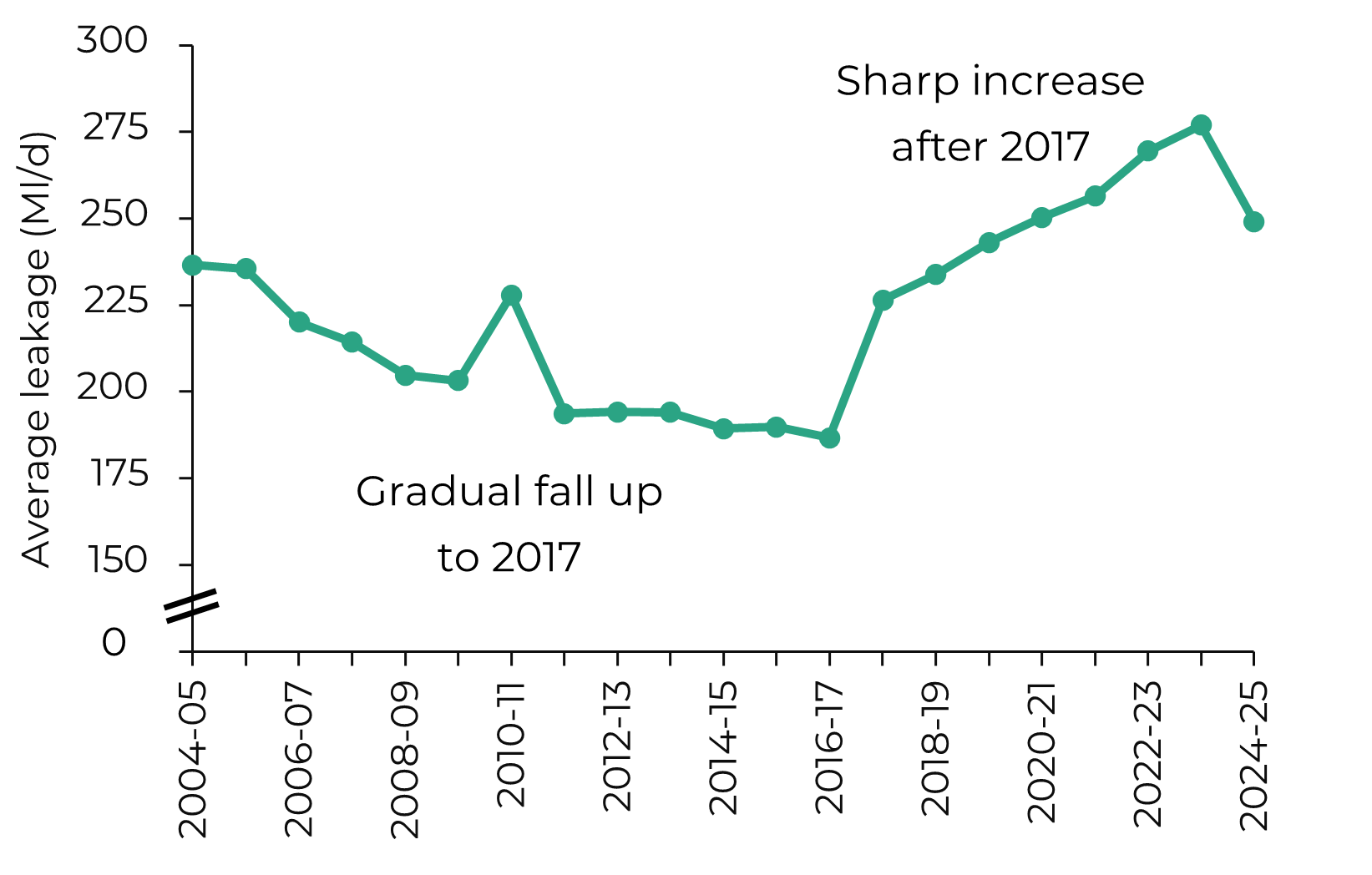
The Welsh sector’s annual average leakage has increased overall during the last 20 years, owing to a recent seven year trend of year-on-year increases, predominantly driven by Dŵr Cymru. However, figures decreased sharply in 2024-25 due to Dŵr Cymru “investment and focus”.
Figure 1: Welsh water companies’ combined annual average leakage in millions of litres per day (Ml/d)
Source: Ofwat, Leakage Dataset – November 2025
While Ofwat has set an overall England-Wales sector leakage reduction target of 17% for 2025-30, Dŵr Cymru’s individual target is 24%.
Companies missing targets are required to return money to customers. Underperformance across England and Wales resulted in over £700m being returned to UK customers over five years, including over £260m in 2024–25 alone. However money back in customer’s pockets doesn’t help long-term resource security, with NRW recently finding:
Zones covering 70% of Wales’ population could be in water deficit by 2050, unless leakage control and water efficiency measures are implemented
To embrace their role as environmental custodians?
The water sector’s responsibilities go beyond supplying water and treating sewage; they’re key environmental stewards because everything they do affects rivers, coastal waters, landscapes, and biodiversity. They have a duty to remove pollutants from wastewater, and monitor discharges to prevent harm.
Regulators impose strict standards, because failures have immediate consequences including unsafe water, and long term costs for communities. Yet infrastructure failures mean untreated wastewater frequently reaches rivers and seas. Overflows, meant for exceptional circumstances, are operating far more often.
Despite commitments to reduce the number of spills from overflows, Dŵr Cymru was found to have “discharged sewage 118,276 times, for a total of 968,340 hours” in 2024. In the same year it caused 155 pollution incidents, an increase on 132 in 2023, and the company’s highest number of sewage pollution incidents since 2015.
This pollution causes harm, both to public health and to the environment, with wastewater being a major contributor to poor water quality in Wales.
Not only are water companies failing to get a handle on untreated sewage discharges, but regulatory oversight of the issue is failing. The Welsh Government’s Green Paper says the current legislative and regulatory framework is “overly complex”, and parts are “outdated and may not accurately reflect the latest scientific understanding or public priorities”.
Proposals to review this framework could be a significant task for an incoming government. But with regular media reports about water pollution or water company performance, Welsh policymakers will have to respond to the public’s demands for action on this “significant issue”.
To deliver a public health necessity, or a commodity?
Water occupies a unique space in social, political, and economic policy. It’s both essential for human survival, and part of a vast infrastructure system requiring investment. In practice, water companies sit uneasily between delivering a public health necessity, and managing an economic commodity.
Everyone has a right to water, and companies cannot deny supply based on ability to pay, and investment in resilient infrastructure to deliver safe water is mandated.
However, since privatisation in 1989, water services are delivered by companies financed largely through customer bills and private investment, operating as regulated monopolies. Charges and investment programmes are set through market-style regulatory mechanisms which treat water as an economic asset.
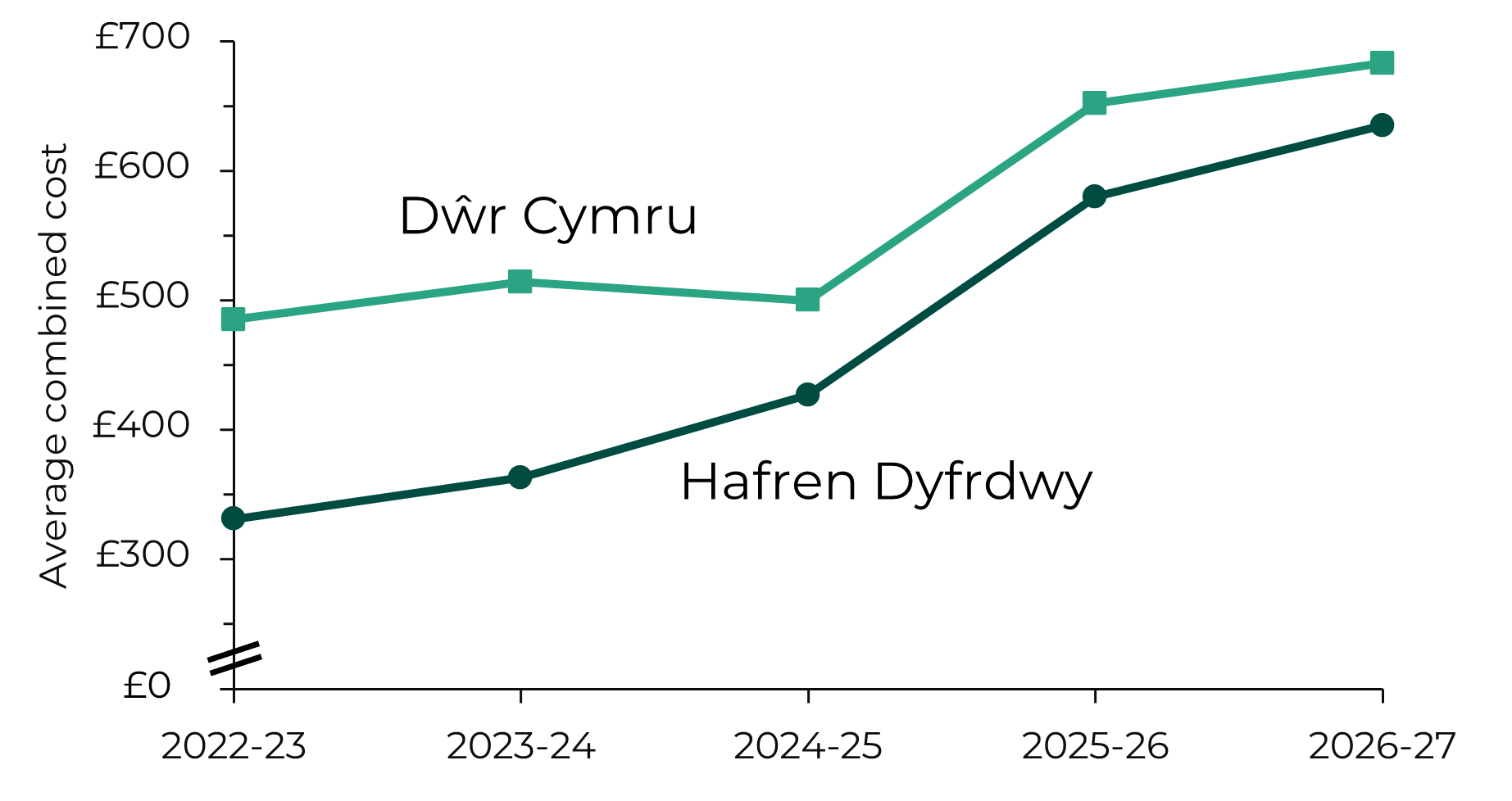
Regulators aim to manage the conflict of affordable bills with the need for major capital investment. However the scale of investment required to address failing infrastructure, and the increasing cost of financing it, means bills have steadily risen in recent years, and will rise further.
Figure 2: Average annual household combined water and sewerage bills (£) for both Welsh water companies
Source: Discover Water
A core challenge for Welsh policymakers will be delivering a regulatory system that ensures the public health aspect of water supply, treatment and environmental stewardship cannot be compromised by commercial pressures. This will need to be done while also keeping household bills affordable during a sustained cost of living pressures.
A water sector built for Wales?
Dŵr Cymru has a unique not-for-profit model, meaning regulation designed for shareholder-owned companies is less effective, and fines go to the UK Treasury rather than benefiting Welsh communities.
Meanwhile, executive pay at Dŵr Cymru during periods of poor performance has prompted scrutiny, and renewed debate on whether public ownership could deliver better outcomes.
Whether there is political will to nationalise the sector will depend on the incoming Welsh Government. For now, policymakers have an opportunity to build a regulatory system that holds Welsh companies accountable, ensuring culpability through mechanisms suited to a not-for-profit model, and alignment with Welsh environmental and public priorities.
To prepare for the future?
Climate change is increasing both flood and drought risks.
One in seven Welsh homes is already at risk of flooding, with more expected over the next century. During a flood, water companies are responsible for managing flooding from their assets. Longer term, investment is required to ensure resilience and protect communities.
Drought resilience also needs long term planning of reservoirs, water transfers, and demand management. But it’s not just the amount of water that changes over time, we also expect them to respond to emerging pollutants.
Investment planning in the water sector is done on a five year cycle. While these are useful for setting customer charges, longer 10 and 25-year horizons are being proposed to support strategic investment. The Green Paper suggests establishing a national system planning function to coordinate water management across Wales, and making this a function of the economic regulator, to “ensure short-term affordability is balanced with long-term infrastructure and environmental needs”.
What’s next?
The Well-being of Future Generations Act places long-term sustainability at the centre of Welsh policy, including policy to protect water, one of our essential assets. The Seventh Senedd has the opportunity to shape a Welsh-designed regulatory system, and create a resilient sector that supports communities, nature, and the economy, while ensuring secure, affordable water for future generations.
Article by Lorna Scurlock, Senedd Research, Welsh Parliament