








Victims across England and Wales increasingly doubt whether the criminal justice system can deliver justice for them. The Annual Victims’ Survey 2024 —one of the largest surveys undertaken, capturing the experiences of more than 6,500 victims — reports low confidence in the system’s fairness and effectiveness. As the Victims’ Commissioner for England and Wales, Baroness Newlove, put it, these findings “should trouble us all”.
For Wales, falling victim confidence raises questions about how effectively the shared justice system works and what this means for public trust and community safety, especially where devolved and UK run justice services must work together to support victims.
Victims’ experiences: what the survey tells us
Victims' experiences provide a valuable indicator of how the justice system operates in practice. While policy discussions often focus on offenders, institutions or structural reforms (as reflected in our wider criminal justice series), victims’ accounts highlight where processes may not be working as intended.
Findings from the Annual Victims’ Survey 2024 highlight concerns about delays, communication, and consistency:
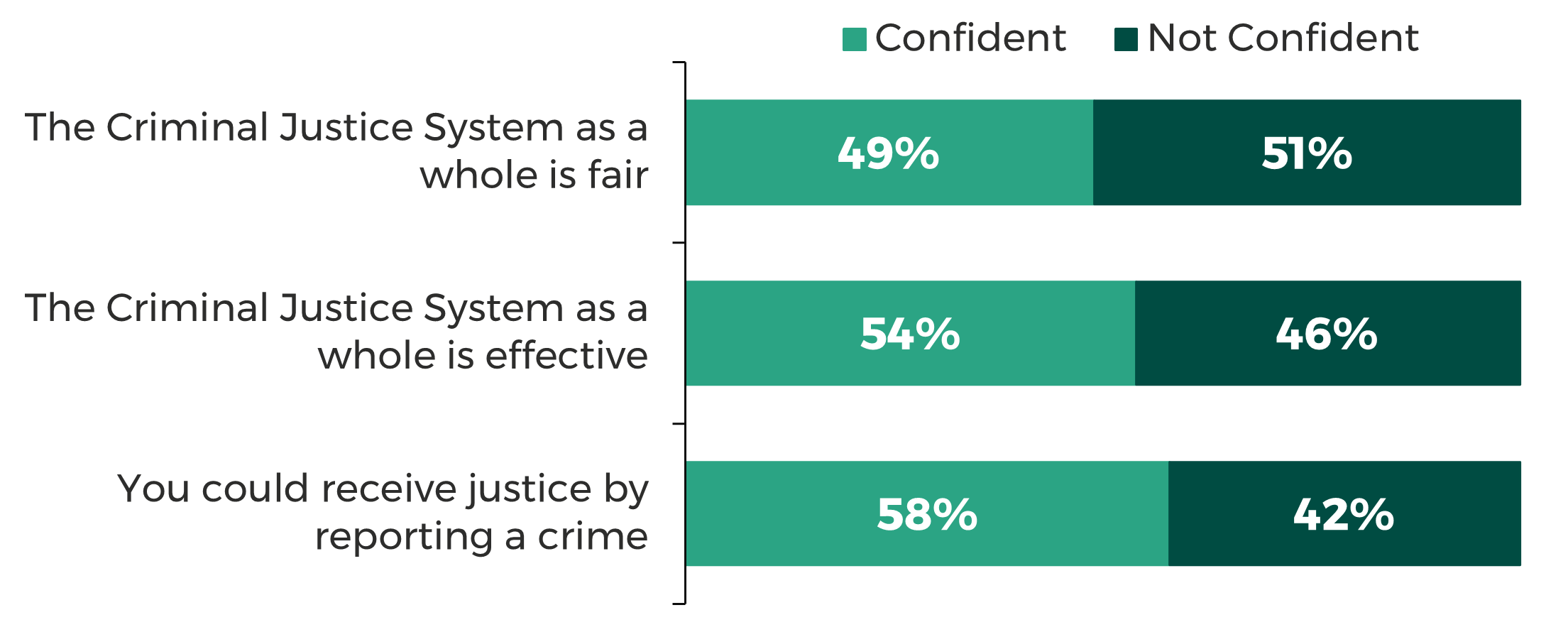
- Confidence in outcomes: 42% of respondents believed they would receive justice if they reported a crime, and 46% considered the criminal justice system effective.
- Confidence in prosecution: around half expressed low confidence that the Crown Prosecution Service (CPS) would prosecute effectively, with some reporting feeling disbelieved or dismissed.
- Delays and distress: Crown Court backlogs, with some trials listed as far ahead as 2029, were linked to distress and withdrawal from cases.
- Uneven confidence: confidence was lowest among groups who are more likely to be victimised, including women, disabled people and LGBTQ+ individuals.
Figure 1: Proportion of respondents who were confident or not confident with various aspects of the criminal justice system
Source: Annual Victims’ Survey 2024
Further, research published by the Victims’ Commissioner in March 2025, identified poor communication and long delays as barriers to participation. The report concluded that extended wait times may affect victims’ wellbeing and the quality of evidence, while also increasing pressures on victim support services. Justice staff and victims reported disengagement, capacity challenges and reduced confidence in the system’s ability to deliver timely justice.
Understanding rights: the promise and the practice
In 2004, the Victims’ Code was introduced in the UK under Section 32 of the Domestic Violence, Crime and Victims Act 2004.. The initial version came into effect in 2005. Since its introduction, the Code has undergone several updates and was most recently revised in January 2025.
The Code sets out the support that victims in England and Wales should receive. This includes clear updates about their case, help to access support services, and the opportunity to explain how the crime has affected them through a Victim Personal Statement – see ‘A summary of Victims’ Rights’.
However, evidence from the Victims’ Survey show that awareness of these rights remains consistently low. In the 2024 survey, only 19% of respondents reported they had heard of the Victims’ Code. In 2023, less than two thirds (60%) of victims recalled being offered the opportunity to make a Victim Personal Statement when cases had progressed to court.
The Commissioner noted that agencies ‘too often fall short’ in upholding victims’ rights. Many victims reported not being kept informed of charging decisions, court dates, or outcomes.
Legislative changes: strengthening victims’ rights
The Victims and Courts Bill, currently progressing through the UK Parliament, proposes strengthening statutory duties for the Victims’ Commissioner, including the introduction of an annual compliance report and improved co-operation from agencies. These proposals focus on enhancing the delivery of victims’ rights and ensuring the Victims’ Code is applied consistently in practice.
This builds on the existing legal duties for agencies to promote victims’ rights and monitor compliance with the Code under the Victims and Prisoners Act 2024. The Welsh Government recently told the Senedd’s Equality and Social Justice Committee it is broadly supportive of the Act’s provisions to improve victim support services. It is also considering its response to UK statutory guidance issued under section 16 of the Act, which sets out expectations for specified victim support roles.
Wales: key issues facing victims
The evidence shows a consistent pattern: long waits, low confidence and trust, pressure on services, and inconsistent outcomes. The Crown Court backlog has particularly severe impacts - victims may wait years and face late adjournments, prolonging trauma and increasing withdrawal rates, particularly in domestic abuse and sexual violence cases. Low charge rates, especially in sexual offences, also reduce confidence that reporting will lead to justice. Further, where victims feel rights are not enforced, existing complaints routes are often seen as complex or ineffective.
In Wales, these effects are amplified by fragmented funding. Services rely on a mix of Ministry of Justice, Police and Crime Commissioner, and Welsh Government funding.
The Association of Police and Crime Commissioners (APCC) has reported that inconsistent commissioning arrangements can harm victims and create uncertainty for providers. Specialist charities in Wales, including those supporting survivors of rape and domestic abuse, warn that funding pressures and rising costs risk service reductions, making engagement and recovery harder for victims.
Further, the UK Government announced in its Police Reform White Paper that Police and Crime Commissioners (PCCs) will be abolished at the end of the next electoral cycle in 2028, a change that may have implications for how victims’ services, currently commissioned by PCCs, are delivered in future. The Victim Services Commissioning Guidance provides a national framework to help PCCs commission effective victim support services, including hate‑crime support, diversion schemes addressing underlying causes of offending, and specialist provision such as support in safe accommodation and Sexual Assault Referral Centres.
What would rebuild confidence?
The APCC say that rebuilding confidence requires visible, practical changes: clear and regular communication, timely case progression, reliable access to support, and consistent delivery of rights.
The central challenge is ensuring that legislative commitments are translated into everyday practice so victims are treated with dignity and feel the system is responsive.
Ultimately, addressing these systemic issues matters not only for victims, but for the health and legitimacy of the justice system and for public trust in Wales. When victims lose confidence, the effects extend beyond individual cases, shaping community perceptions of safety, fairness and the credibility of justice institutions.
|
This article is part of a series exploring key aspects of criminal justice in Wales, from the current devolution settlement and intergovernmental working, to probation, youth justice policy, and policing. |
Article by Sarah Hatherley, Senedd Research, Welsh Parliament
The Crown Court backlog: England’s crisis or a shared jurisdictional problem?
