








The Welsh Government published its Second Supplementary Budget 2026-27 on 13 October. It proposed changes to the Final Budget 2026-27 and includes all the changes proposed in this Summer’s First Supplementary Budget and some additional changes as a result of a recent agreement with the Welsh Labour party.
In this article we take a look at the allocations across departments and how funding has changed. The Senedd will debate this Second Supplementary Budget on 3 November.
Welsh Government’s plans in July’s First Supplementary Budget
On 23 June 2026, the new Welsh Government laid its First Supplementary Budget 2026-27 before the Senedd. It reflected changes to the previous Welsh Government’s Final Budget 2026-27, which had been published in January.
A significant source of the available funding to the Welsh Government came as a result of Barnett consequentials, specifically £322 million from the UK Government’s 2026 Spring Statement. The majority of this came as a result of Special Educational Needs and Disabilities (SEND)-related deficits being written off coupled with £46 million for the UK Government’s Main Estimates.
However, despite the majority of additional funding coming as a result of SEND spending in England, the Welsh Government is not obliged to spend a Barnett consequential in the same policy area, referred to in Wales as Additional Learning Needs.
Key planned allocations in the First Supplementary Budget included:
£145m for NHS Wales, including £100m resource funding for waiting lists, £25m capital to begin the delivery of new surgical and diagnostic hubs, £20m capital to address maintenance backlogs across the NHS estate.
£55m for childcare, including £45m revenue and £10m capital, of which £20m is for expanding childcare to two year olds and £25m is to meet the existing demand against the Childcare Offer (including funding for the change in hourly rate since April 2026).
£2m revenue is made available to begin the pilot of the Cynnal child payment.
£5m capital through the Community Facilities Programme to improve local buildings and shared spaces.
£15m allocated to enable more secondary pupils to receive free school meals from September. This includes £5m revenue and £10m capital to invest in school kitchen and dining areas.
£40m capital to address what’s referred to as the “growing maintenance backlog across the education estate”.
£20m capital to support social housing.
£8m revenue to continue the £1 bus fare pilot for young people.
£2m revenue to support the north-south bus service, due to commence in early autumn.
£2m resource to support school swimming.
Senedd votes against those July plans
The Senedd debated and voted against the First Supplementary Budget 2026-27 in Plenary on 14 July 2026.
During the Senedd’s First Supplementary debate the issue of funding for Additional Learning Needs (ALN) was a key reason why some Members did not support the proposals. The WLGA has highlighted ALN as a major source of pressure on school budgets and Audit Wales has reported the system is “under strain”.
Between the First Supplementary Budget being published and the Plenary debate, the Welsh Government had offered to allocate an additional £40 million in each of 2026-27 and the following two years, which Welsh Labour felt to be insufficient.
Elin Jones MS, the Cabinet Minister for Finance called the outcome of the vote against the First Supplementary Budget as “deeply disappointing” and noted “real consequences arising from today’s decision”. The Minister went on to say:
We will bring back a supplementary budget later in the financial year, to regularise this funding, and will continue to manage our spending prudently.
£60m allocated for ALN but some view it as a “missed opportunity”
The Welsh Government’s Second Supplementary Budget 2026-27 was laid on 13 October. It restates the First Supplementary Budget and does not include any further adjustments to funding from the UK Government, Welsh devolved financing (taxes or borrowing) and the amount drawn down from the Wales Reserve: these all remain the same.
However as a result of a budget agreement between the Welsh Government and Welsh Labour, the resource (or revenue) allocation for the Education and Welsh Language MEG increases by £60m to provide further support for Additional Learning Needs (ALN) provision in this current financial year.
The allocation is broken down into:
£56m to the Education Reform strand of the Local Authority Education Grant, to be split 80/20 (£44.8m/£11.2m) directly to schools/Local Authorities;
£1.5m to support the development of a long-term sustainability plan; and
£2.5m to Medr for the Further Education sector.
Figure 1. Headline changes in Second Supplementary Budget 2026-27 compared to Restated Final Budget 2026-27
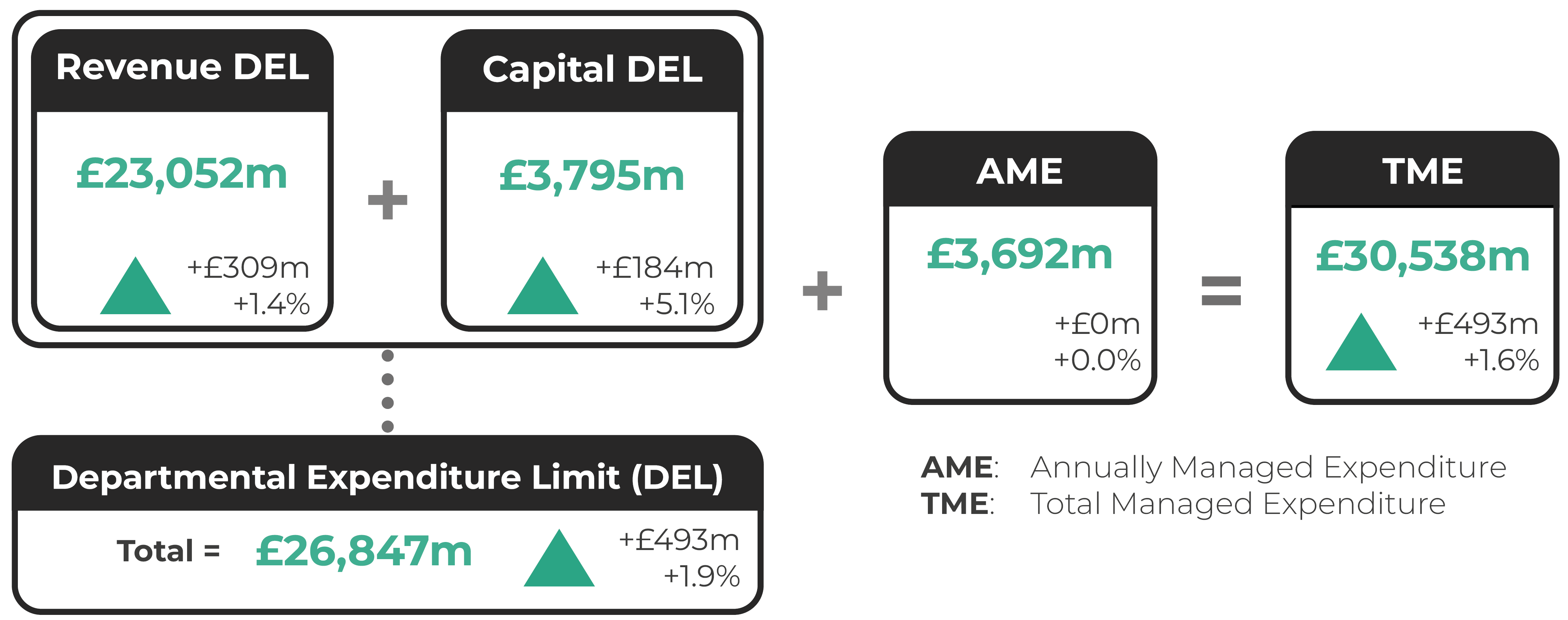
Departmental Expenditure Limit (DEL) includes the discretionary part of the budget that the Welsh Government chooses how to spend.
Annually Managed Expenditure (AME) is the non-discretionary part of the budget.
Source: Welsh Government and Senedd Research
While noting that the direct funding to schools is an improvement, NAHT Cymru ”expressed deep disappointment” at the level of the additional funding for ALN in the Second Supplementary Budget, noting it was a “missed opportunity to deliver the transformative investment that learners, schools and families were promised”.
Remaining reserves include £186.5m of unallocated fiscal resource, £29k general capital and £3.1m Financial Transactions Capital.
A Second Supplementary “stopgap”?
The Wales Fiscal Analysis have described the allocation for ALN as a “stopgap rather than a settlement and, the deal leaves the wider budgetary pressures largely unresolved”.
It’s unclear how the additional ALN funding will be reflected in future years. The Cabinet Minister for Education and the Welsh Language said in her statement:
Funding allocations for ALN for future years will be considered as part of our preparations for the Draft Budget for 2027-28, in the context of a need to reach cross-party support.
The Draft Budget 2027-28 will be a key marker for the Welsh Government’s spending plans going forwards and is due to be published on 17 November.
Prior to that the UK Government is due to publish its own Budget.
The issue of inflation still remains a key factor as the Bank of England expects CPI inflation to rise to around 3.7% in the last quarter of 2026 and around 4.2% in the first quarter of 2027. Added to this are potential budget pressures identified by the Institute for Fiscal Analysis that are associated with future pay awards.
As a result the Wales Fiscal Analysis has highlighted the Draft Budget 2027-28 as a “ real test” , going on to say:
[…] how far the Chancellor tops up English departments for inflation later this month will largely determine what reaches Cardiff Bay.
What’s next?
The Senedd will hold a debate on the Second Supplementary Budget 26-27 on November 3. You can watch the debate on SeneddTV.
Article by Božo Lugonja, Senedd Research, Welsh Parliament