The Senedd and Pierhead buildings will be closed to the public on Thursday 15 October. Read information about the closure.









What’s driving demand for HMOs?
Published 14/10/2026
Houses in Multiple Occupation (HMOs) have long been a contentious part of the housing market. Although HMOs are widely recognised as an important source of affordable accommodation, particularly for students and people on low-incomes, applications for new HMOs often prompt concerns about their potential effect on local communities and neighbourhood amenities.
The overall number of known HMOs in Wales has risen slightly compared to a decade ago, though trends vary across areas. There have been renewed concerns in some areas linked to the potential overconcentration of HMOs, and the use of HMOs as dispersal accommodation for asylum seekers.
This article will explore the data on HMOs in Wales, the drivers of demand, and the powers local authorities have to regulate how HMOs are developed and managed.
How many HMOs are there in Wales?
An HMO usually means a property occupied by three or more people from at least two households who share facilities, such as a bathroom or kitchen.
There were 14,954 known HMOs in Wales as of March 2025, though local authorities estimate the total number could be 18,490. The number of known HMOs has risen by 884 (or 6.3%) since 2014-15, while the estimated number has risen by 323 (1.8%). Both figures fluctuate from year to year, and the dataset does not show turnover within the HMO stock.
Figure 1: Estimated, known and licensed HMOs in Wales
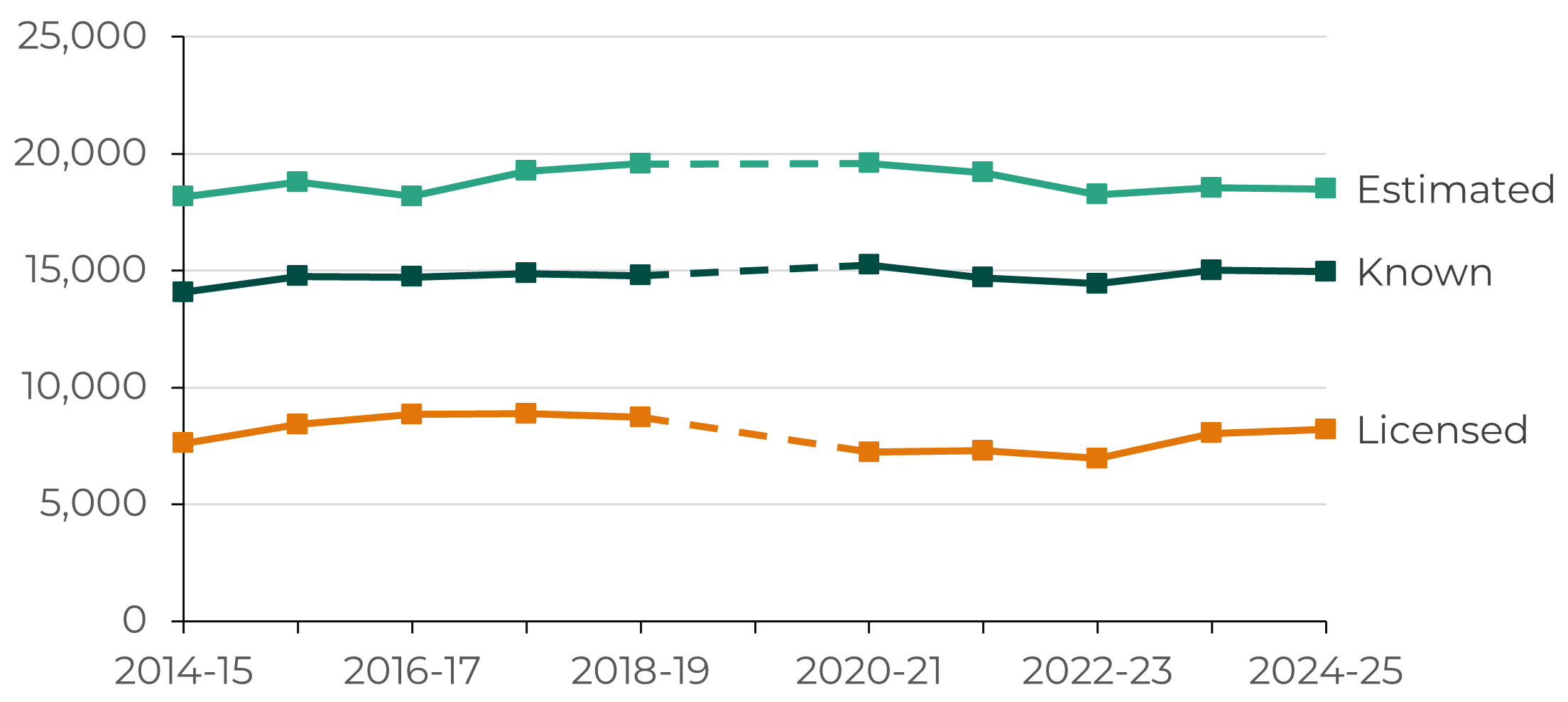
Source: Houses in Multiple Occupation (HMOs) by local authority area and Dwellings licenced by local authority area and licence type, StatsWales. Data not collected for 2019-20 due to the impact of the COVID-19 pandemic.
Local authorities also keep data on licensed HMOs, though this is only a subset of the total number of HMOs in most areas, and schemes vary across different local authorities. The number of licensed HMOs has risen by 594 since 2014-15, an increase of 7.8%.
|
Which HMOs must be licensed? Under the Housing Act 2004, local authorities must operate a licensing scheme for larger HMOs. To be subject to mandatory licensing in Wales, an HMO must comprise three or more storeys, and be occupied by at least 5 people. Local authorities may introduce additional licensing schemes for part or all of their local area, in areas where they consider a significant proportion of HMOs are being managed ineffectively. Local authorities can choose which types of HMO are covered by the scheme. As at March 2025, nine local authorities had additional licensing schemes in place. |
The highest concentration of HMOs is in Cardiff, which has 41 known HMOs per 1,000 dwellings. The lowest concentrations are in Torfaen, Flintshire and Pembrokeshire, each with around 1 known HMO per 1,000 dwellings.
Figure 2: Number of HMOs per 1,000 dwellings, by local authority
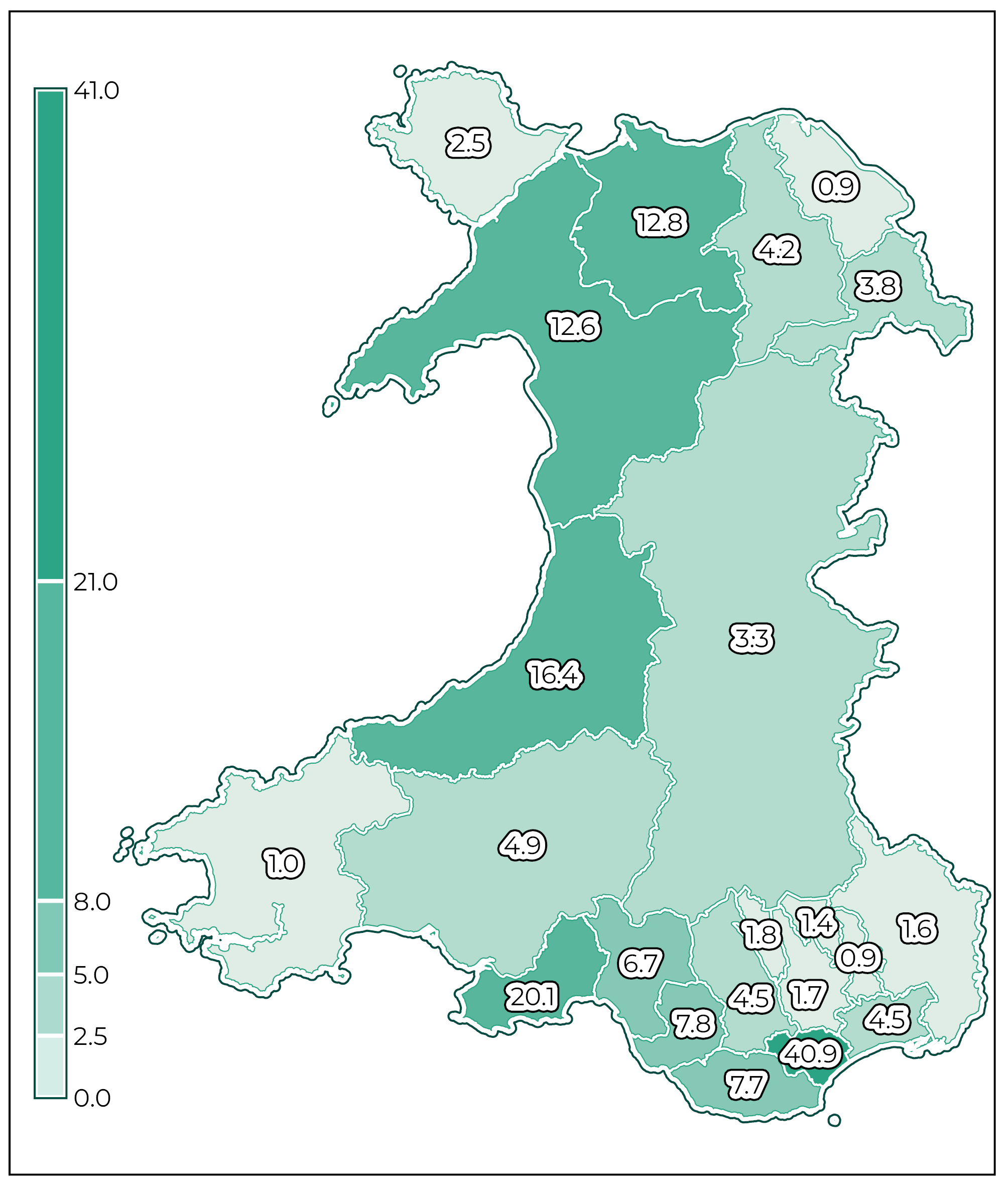
Source: Houses in multiple occupation (HMOs) by local authority area and Dwelling stock estimates by tenure and local authority area, StatsWales
Why is there a demand for HMOs?
HMOs have historically served tenants who are younger, in single-person households, staying for relatively short periods, and often on lower incomes.
A large number of HMOs are used as student accommodation. The steady growth in students throughout the 1990s and 2000s led to concerns about the “studentification” of certain areas, and HMOs continue to be concentrated in university cities and towns in Wales.
However, the market for HMOs is broader than students. Demand appears to be growing amongst professionals in their 20s and 30s. This may reflect affordability constraints facing young people, given increases in private rents and the decreased affordability of home ownership. Since 2012, housing benefit for most single renters under 35 has been restricted to a ‘Shared Accommodation Rate’, which is likely to have also increased demand for shared housing among young people claiming benefits.
In addition, HMOs continue to play an important role in providing accommodation for people with limited housing options. This includes people with multiple and complex needs, including those at risk of homelessness, prison leavers and people experiencing mental health or substance-use problems.
This breadth of demand may be one reason why private landlords are investing in HMOs. Paragon Bank – a specialist provider of buy-to-let mortgages – has said that Wales is a top location for landlord yields, with HMOs providing better returns than any other rental property. It has suggested that areas with sustained tenant demand and lower property values are likely to generate higher yields.
Why are public sector bodies using HMOs?
Local authorities have a legal duty to secure accommodation for particular groups who are at risk of homelessness, known as a Section 75 duty. As the number of people owed this duty has risen – particularly the number of single adults – local authorities have had to find different types of housing to accommodate them. In 2025-26, around 4,800 single person households were owed a Section 75 duty, which is five times more than a decade earlier.
Figure 3: Number of homeless households owed a Section 75 duty to secure accommodation
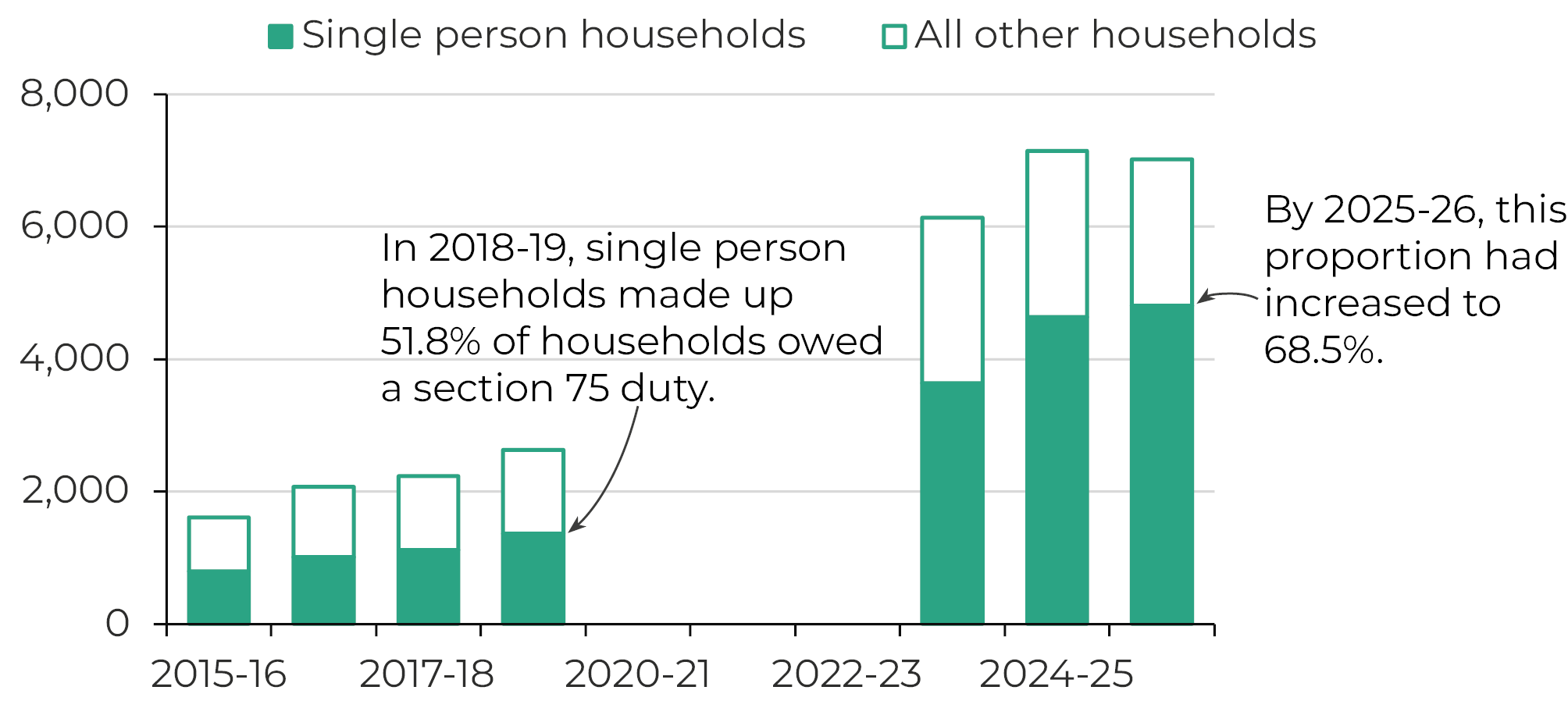
Source: Households found to be eligible, unintentionally homeless and in priority need during the year, StatsWales. Data was not collected between 2020-21 and 2022-23 due to the impact of the Covid-19 pandemic. A section 75 duty is an absolute duty to secure that suitable accommodation is available for occupation, for eligible applicants in priority need.
Several local authorities in Wales are increasing their use of HMOs to provide single-bed accommodation to house people experiencing homelessness, and therefore reduce reliance on temporary housing. Some HMOs used for this purpose may be managed by private landlords, while other properties are being purchased directly by local authorities or by housing associations.
Similarly, the UK Government has sought to make more use of HMOs to provide dispersal accommodation for asylum seekers in recent years. Clearsprings Ready Homes, which holds the contract to provide asylum accommodation in Wales, stated in written evidence to the UK Parliament that there were 254 HMOs in use as dispersal accommodation in Wales in August 2024 (up from 223 in August 2019).
The overall number of people staying in dispersal accommodation in Wales has remained broadly stable over the past decade, fluctuating between 2,582 and 3,178. However, dispersal accommodation is now distributed over a larger number of local authorities. Since March 2023, all local authorities have been expected to participate in dispersal. As a result, larger cities – including Cardiff, Swansea, Newport and Wrexham – have seen a fall in the number of people in dispersal accommodation compared to 2016, while other areas have seen increases.
Are there restrictions on the number of HMOs?
Local planning authorities have powers to manage the number of HMOs in a particular area. Since 2016, creating a new HMO in Wales, through either construction or conversion, has required planning permission. This differs from England, where local authorities have discretion over whether to require planning permission.
HMO applications are determined in accordance with national and local planning policies, and cannot be rejected without valid grounds. Planning authorities can create specific HMO policies as part of their Local Development Plans, and may set out further detail in supplementary guidance. Some examples of such provisions include:
- Setting a threshold for the number of HMOs in a particular area (e.g. 15% of properties in a 50-metre radius);
- Requiring particular consideration in cases where a residential property could end up surrounded by HMOs on all sides;
- Setting standards for amenities, space and facilities; and
- Requiring applicants to demonstrate that a proposal will not adversely affect local parking provision.
Local authorities must also operate HMO licensing schemes, though these are primarily aimed at improving housing conditions and management standards rather than controlling the growth of HMOs.
The Welsh Government says it has provided local authorities with “extensive licensing and planning powers” to manage HMOs. However, some local authorities have suggested there can be a disconnect between HMO licensing and planning regimes. For example, Newport Council supported a motion in January 2026 calling for better integration of the two systems, and for stronger enforcement powers against landlords who deliberately breach planning laws.
The range of demand for HMOs suggests they will continue to play an important role in meeting housing needs. Managing the growth and distribution of HMOs is therefore likely to remain an important issue for policymakers across Wales.
Article by Gwennan Hardy, Senedd Research, Welsh Parliament