








There is a long-standing debate on whether the fiscal powers devolved to Wales give the Welsh Government sufficient scope to govern effectively. The new Welsh Government has made pursuing fiscal reform a key priority in its Programme for Government.
Ahead of the Senedd’s fiscal reform debate on Tuesday 6 October, this article explores the current arrangements and what the Welsh Government is seeking to change.
Welsh fiscal powers and reform priorities
The Welsh Government’s fiscal powers are set out in the Welsh fiscal framework, which was published in 2016. It set out how the Barnett formula would operate, which included a ‘funding floor’. It also set out the Welsh Government’s capital borrowing powers; and budget management tools, including establishing the Wales Reserve, which give the Welsh Government the flexibility to manage its resources.
The fiscal framework set out total and annual limits for capital borrowing and the Wales Reserve, which remained unchanged since 2016. These limits had been eroded by inflation, meaning Welsh Government’s capacity to borrow and hold reserves had reduced.
In November 2025, the UK Budget 2025 increased these limits by 10%, which will be uprated in line with inflation each year from 2027-28.
Plaid Cymru’s 2026 Senedd election manifesto committed to:
- Replacing the Barnett formula.
- Greater tax powers, including the ability to set income tax bands and the introduction of a vacant land tax.
- Further reforms to the fiscal framework, including raising annual draw-down limits on the Welsh Reserve and increasing the Senedd’s total capital debt limit.
These commitments are reflected in the Welsh Government’s Programme for Government 2026-2030, which says it will:
Pursue fiscal reform, including fairness in the way Wales is funded, the operation of the Barnett Formula, greater fiscal flexibilities, fair funding of devolved powers, and further responsibilities for the Senedd over taxes in Wales.
What is meant by fair funding?
The fiscal framework modified the Barnett formula to include a needs-based factor from 2018-19, recognising that Wales has higher spending needs than England due to factors such as lower income and poorer health.
This was set at 115% and is based on the Holtham Commission’s findings published in 2010. However, funding per person in Wales compared to England is currently above 115% and until this funding drops to 115% the needs-based factor is set at 105%.
Barnett formula for Wales
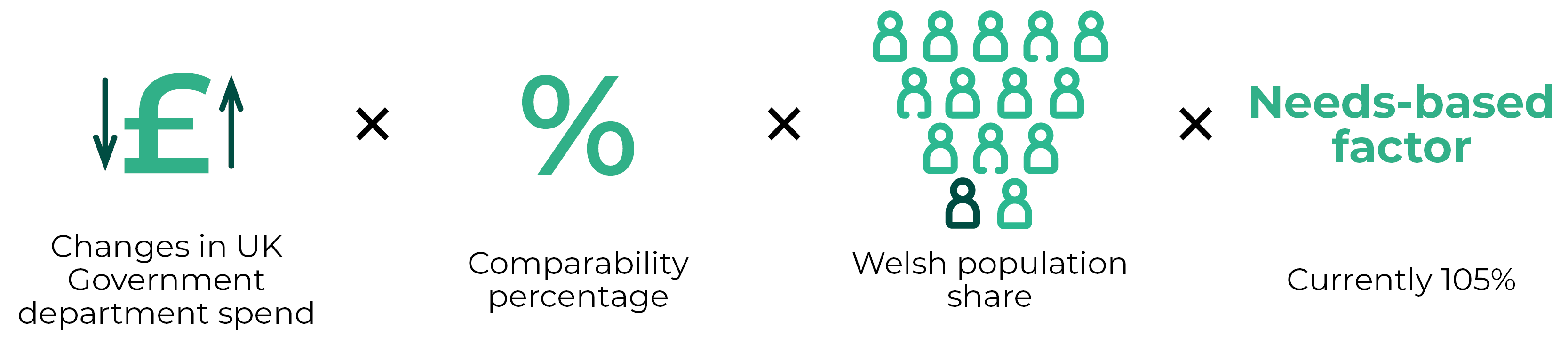
In February 2026, the Institute for Fiscal Studies (IFS) noted the estimated needs-based factor of 115% is based on data that is almost 20 years old, saying:
The UK and Welsh (and ideally other devolved) governments should jointly commission a new independent assessment of the relative spending needs of the different nations of the UK.
It added:
This would allow for a more informed debate about how much funding the Welsh Government and other devolved governments should receive. And better information on how funding compares to needs would help the electorate judge the performance of the Welsh Government.
In July 2026, the First Minister said during a debate on fair funding that the Barnett formula was “fundamentally outdated and unfair”. He explained that it makes Wales dependent on decisions taken in Westminster by tying Wales to spending choices for England, adding:
So, we can't instigate additional expenditure ourselves to match our needs as a nation. That's the fundamental problem of the funding settlement.
Wales Reserve
The fiscal framework established the Wales Reserve and set total and annual drawdown limits. The Welsh Government is able to hold up to £385m to spend in future years.
There are no annual limits for paying into the reserve but there are annual drawdown limits of £137.5m for resource and £55m for capital, which have been waived for 2026-27. All limits will be uprated in line with inflation each year from 2027-28.
This is in contrast to the Scotland Reserve with both UK and Scottish Governments agreeing that “annual drawdowns from the reserve will be unlimited”.
The First Minister noted the Wales Reserve’s total limit represented 1.4% of the Welsh Government’s budget. He said:
This prevents us saving for future investments to support economic growth and boost productivity. The Treasury will simply claw back any money where there is not enough space in our reserve to store it.
Capital borrowing
The Welsh Government’s total capital borrowing limit is £1.1bn with the annual limit being £165m from 2026-27. Both limits will be uprated in line with inflation each year from 2027-28.
There have been calls for the Welsh Government to have prudential borrowing powers like local authorities, which are based on self-determined affordability rather than limits imposed by the UK Government. The First Minister mentioned this during his speech on fair funding, saying:
It might surprise some Members—and I mentioned this earlier today—to know that, as a national Government, we have less generous borrowing powers than local councils, who can undertake prudential borrowing to support infrastructure investments.
Welsh taxes
The partial devolution of UK income tax in the form of Welsh Rates of Income Tax (WRIT) gives the Welsh Government powers to collect 10p in every £1 earned above the personal allowance for income tax from Welsh taxpayers.
Welsh Rates of Income Tax
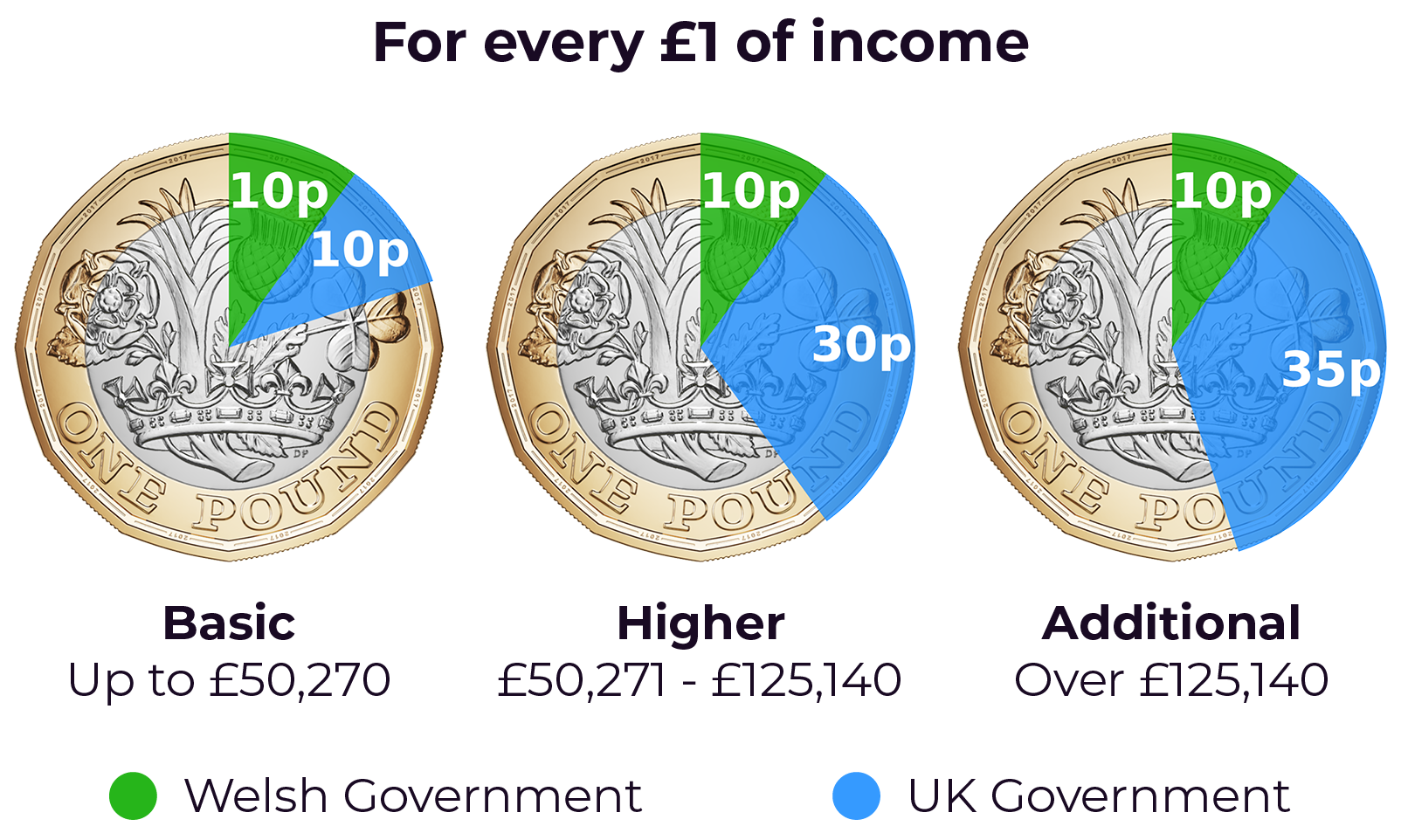
The Welsh Government has powers to change the Welsh rates of each income tax band but, unlike Scotland, does not have the powers to change the thresholds or introduce new income tax bands.
The Office for Budget Responsibility (OBR) noted Welsh taxpayers have lower incomes compared to the UK as a whole. Giving the Welsh Government powers to tailor the thresholds and create new tax bands could enable a more progressive approach to income tax in Wales.
New Welsh taxes
The Welsh Government could seek to devolve competence for new Welsh taxes through an agreed process with the UK Government. It tested this power by submitting a formal request to the UK Government in 2020 to devolve competence to introduce a vacant land tax.
There had been little movement on this for years with the former Finance Minister, Rebecca Evans, being critical of the process, saying it was unsuitable.
In February 2026, the UK Government agreed to hold a joint consultation on the devolution of powers to introduce a vacant land tax, but no timetable has yet been announced.
What’s next for fiscal reform?
The debate over fiscal reform therefore extends beyond the amount of funding Wales receives. It also covers how needs are assessed, budget and borrowing flexibility and devolved tax powers.
This week’s Plenary debate provides an opportunity to examine whether the current arrangements give the Welsh Government the resources and autonomy it needs, and which reforms it should prioritise.
Article by Christian Tipples, Senedd Research, Welsh Parliament