








The UK Covid-19 Inquiry is now well advanced, with four reports published and six more expected. The Inquiry was formally established on 28 June 2022 and has cost more than £200 million.
In Wales, questions remain about how the Inquiry’s findings should be scrutinised and whether any additional Wales-specific process is needed. While Plaid Cymru previously called for a Wales-specific Covid inquiry, its current position is to support a more targeted review of Wales’s Covid response. This article summarises the latest position and outlines how current and future findings could be scrutinised by the Senedd.
Where has the UK Covid-19 Inquiry reached?
The UK Covid-19 Inquiry has so far published reports on four modules:
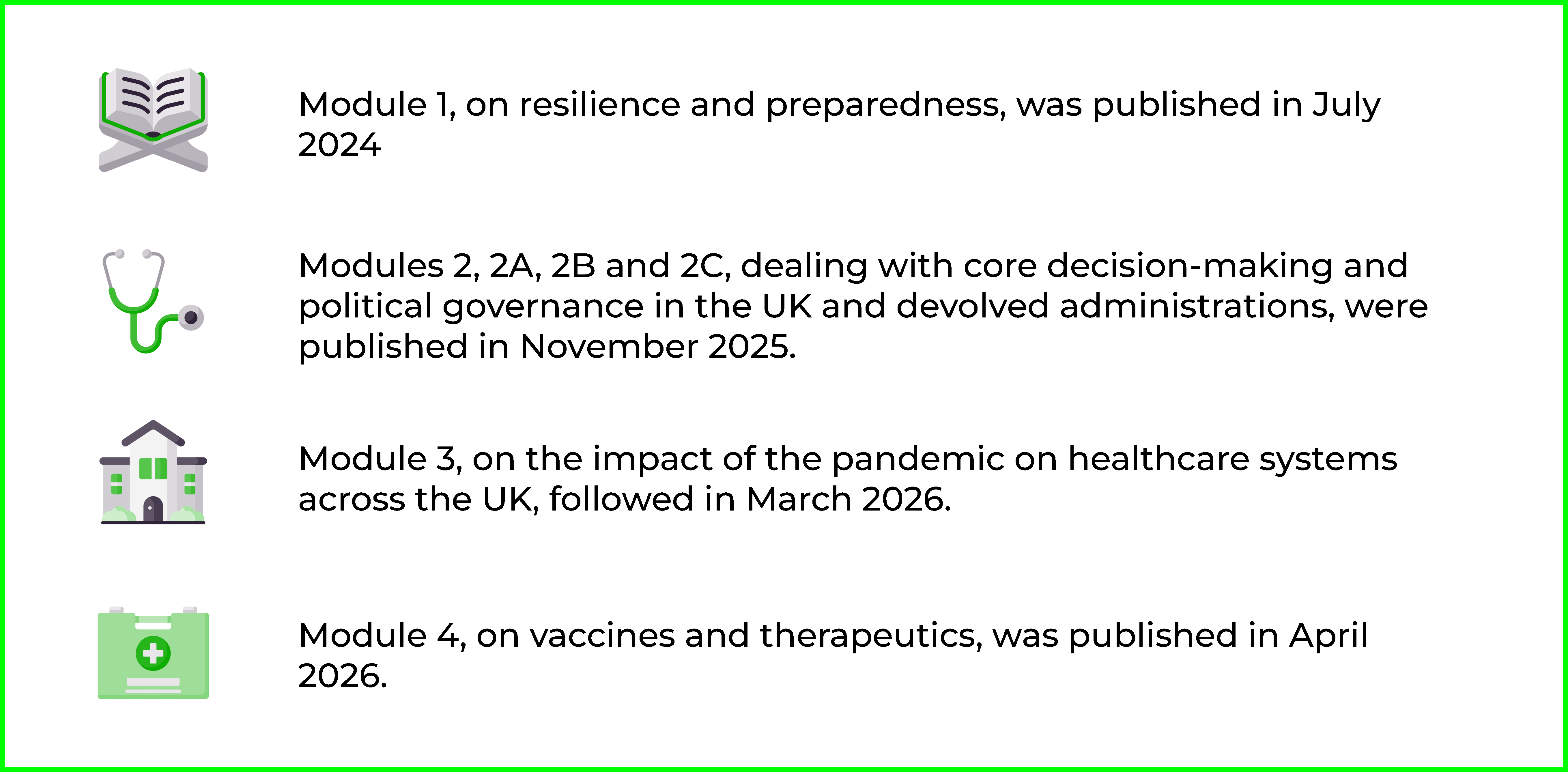
Source: Structure of the Inquiry - UK Covid-19 Inquiry
According to the Inquiry, six further reports are expected. Module 5, on procurement, is expected in summer 2026. The remaining active modules are:
- Procurement: Module 5 examines the procurement and distribution of key healthcare equipment and supplies across the UK, including PPE, ventilators, oxygen, and UK-wide procurement of lateral flow and PCR tests.
- The care sector: Module 6 examines the impact of the pandemic on the adult social care sector across the UK, including the consequences of government decision-making for those living and working in care settings and the sector’s capacity to respond.
- Test, trace and isolate: Module 7 examines the testing, tracing and isolation systems used across the UK, including the policies and technologies deployed, key decisions taken, public compliance and the preservation of future capability.
- Children and young people: Module 8 examines the impact of the pandemic on children and young people across the UK, including the extent to which their needs were considered in decision-making and the longer-term consequences for education, health and wellbeing.
- Economic response: Module 9 examines the economic interventions taken by the UK Government and devolved administrations in response to the pandemic, including support for businesses, jobs, the self-employed, vulnerable people and public services.
- Impact on society: Module 10 examines the wider impact of Covid-19 and of pandemic restrictions on the UK population, with a particular focus on key workers, vulnerable groups, bereavement, and mental health and wellbeing.
The previous Welsh Government responded to the first two published reports. It published its response to Module 1 in January 2025 and issued further six-monthly updates in July 2025 and January 2026. In April 2026, it published a dedicated webpage and implementation dashboard bringing together responses and progress updates. It also published its response to the combined Modules 2, 2A, 2B and 2C report.
This means that the issue in Wales is no longer only about participation in the UK Inquiry; it is also about tracking how recommendations are interpreted, implemented and monitored within Wales.
What is happening in Wales?
For several years, calls have been made for a Wales-specific inquiry into the handling of the pandemic. Plaid Cymru was among the strongest advocates of that position and argued that the Welsh experience could not be examined in sufficient detail by the UK-wide process alone.
In 2023, its then leader, Adam Price MS, said he was in “no doubt” that Wales needed its own Covid inquiry. However, that position shifted before the 2026 Senedd election. Plaid representatives indicated that the party was no longer proposing a full public inquiry, but instead a process intended to identify lessons more quickly.
In November 2025, Heledd Fychan MS said that a Plaid Cymru government in 2026 would conduct a dedicated ‘gap inquiry’. In its 2026 manifesto, Plaid Cymru pledged to:
“establish a review of Wales’s Covid response, its legacies and lessons for the future within the first year of the next Senedd term, with a targeted focus on Wales-specific matters and questions not covered by the UK-wide inquiry”.
The manifesto indicates that the party continues to regard some Wales-specific issues as requiring further examination, but frames the response as a targeted review rather than a broad new public inquiry. In a BBC News interview in March 2026, the Welsh Government’s new Cabinet Minister for Health and Care, Mabon ap Gwynfor MS, clarified that a Plaid-led Welsh Government would hold a “short and precise” look at Wales’s pandemic response with “a clear remit and timescale”.
Covid Bereaved Families for Justice Cymru has continued to call for a Wales-specific statutory public inquiry into the handling of the pandemic. Its published material states that such an inquiry is “essential” to restore trust, strengthen public services and ensure that lessons are learned in Wales.
At the same time, the group’s website also states that Wales does not need simply to replicate the UK-wide process. Instead, it refers to a short, focused and more economical Wales-specific inquiry, and calls for a process that prioritises victims and seeks achievable recommendations.
How can the Senedd scrutinise current and future modules?
The previous Senedd established the Wales Covid-19 Inquiry Special Purpose Committee in May 2023 to consider reports at each stage of the UK Inquiry, identify any gaps in the scrutiny of the Welsh Government and Welsh public bodies, and recommend areas for further examination.
The Committee commissioned a gap analysis from Nottingham Trent University, consulted stakeholders and published a report in March 2025 identifying nine areas where further Welsh scrutiny was needed. The Committee ceased to exist in October 2025 after political disagreement over its future role.
Follow-up scrutiny on Module 1 was then taken forward by the Sixth Senedd’s Public Accounts and Public Administration Committee. It examined the Welsh Government’s response to Module 1, changes to civil contingencies arrangements, and the gaps identified by the Special Purpose Committee. The Committee took evidence in late 2025 and early 2026 and published a report in March 2026, which was later debated in Plenary.
How scrutiny of future modules will be organised remains unclear. However, the Senedd has already shown that Inquiry findings can be examined through committee scrutiny and Plenary debate.
Given the public resources committed to supporting the Welsh Government’s engagement with the UK Covid-19 Inquiry, the Senedd may wish to consider how this work is scrutinised as further findings emerge. From the perspective of bereaved families, the key question is whether the processes now in place will provide clear answers about what happened in Wales and sufficient assurance that lessons are being learned to improve future preparedness.
Article by Sarah Hatherley, Senedd Research, Welsh Parliament
