








Wales has gone to the polls. The votes have been counted. We have 96 new Senedd Members. So, what happens now?
Over the last few days, Members have travelled to the Senedd to swear oaths or make an affirmation to the King.
The Senedd and its Members are required to meet specified legal deadlines in the early days following the election. These are set out by the Government of Wales Act 2006 and the Senedd’s standing orders. This article explains more about these required early steps.
Electing a new Llywydd
The Senedd will hold its first meeting on 12 May 2026.
At its first meeting, the Senedd must elect a Llywydd (Presiding Officer) and a Dirprwy Lywydd (Deputy Presiding Officer).
Elin Jones MS will remain in her post until a new Llywydd is elected by the Senedd. She will decide the date and time of the first meeting in consultation with the new political groups. If the Llywydd is unwilling or unable to act, the Clerk of the Senedd will decide instead.
As Elin Jones MS has indicated that she does not wish to seek re-election as Llywydd, she will be able to chair the meeting.
The election for the new Llywydd will proceed as follows:
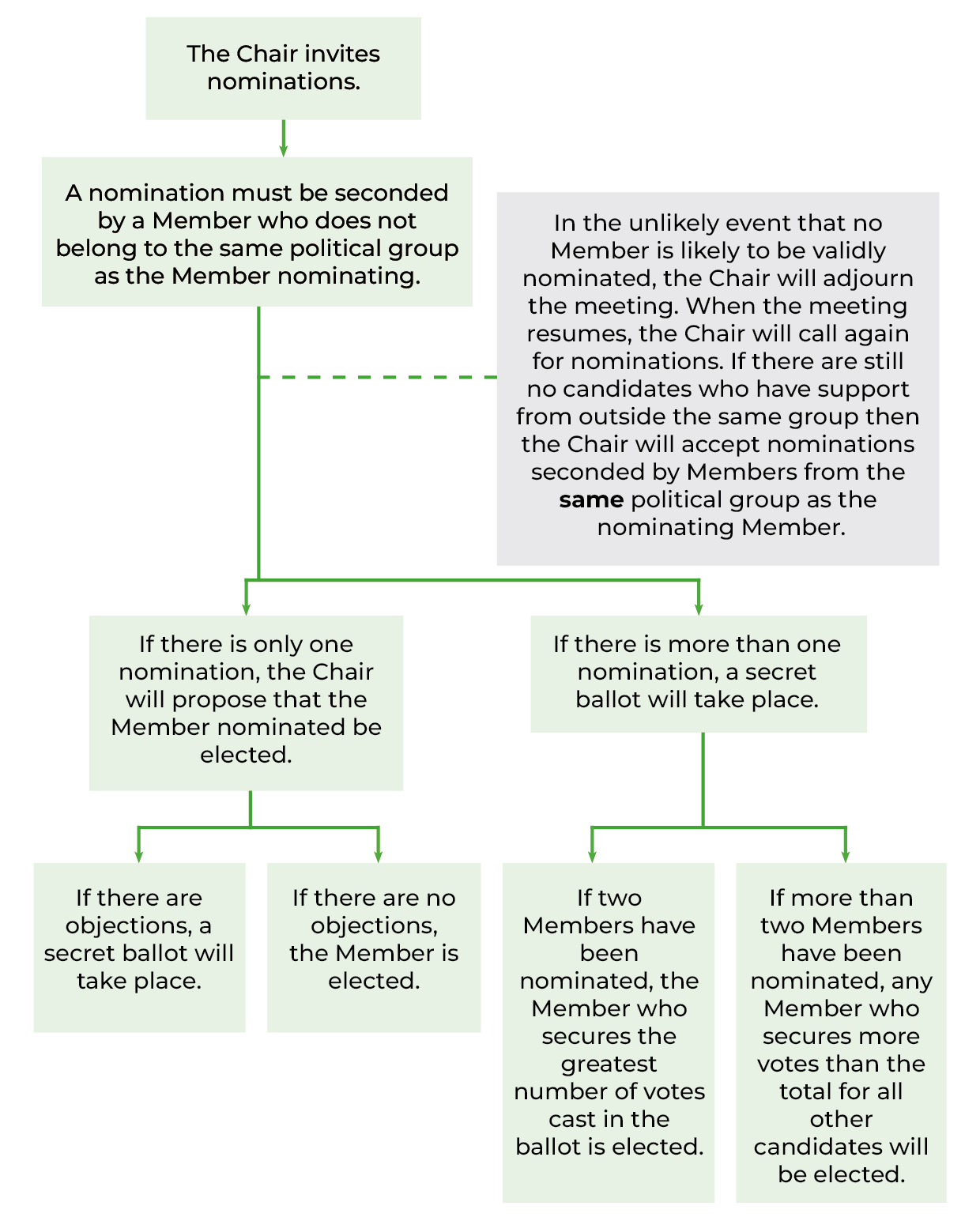
The chair of the meeting announces the result, and the new Llywydd takes their place. They will then take over the chair for the remainder of the meeting.
Electing a Dirprwy Lywydd
The election of a Dirprwy Lywydd takes place immediately after the election of the Llywydd. The process is the same as for the election of the Llywydd.
Unless two-thirds of Members vote to disapply it, Senedd Members cannot elect a Llywydd and a Dirprwy Lywydd who belong to:
- the same political group;
- different political groups both of which form part of the Welsh Government; or
- different political groups both of which do not form part of the Welsh Government.
The Senedd can, at any time, elect a second Diprwy Lywydd. This is to help with the increased demands on the Llywydd and Dirprwy Lywydd that a larger Senedd may bring. The Llywydd must consult the Business Committee on a proposal to nominate a second Dirprwy Lywydd and the Senedd’s Standing Orders set out the rules for their election.
Nominating the First Minister
The next most important job is the nomination of a First Minister.
The Senedd must nominate a new First Minister by 3 June 2026. If it does not, another Senedd election will be triggered.
The current First Minister and Welsh Ministers stay in their posts until a new First Minister is nominated.
At a plenary meeting, the Llywydd will invite nominations for First Minister. Any Member of the Senedd can nominate another to be First Minister. The process is as follows:
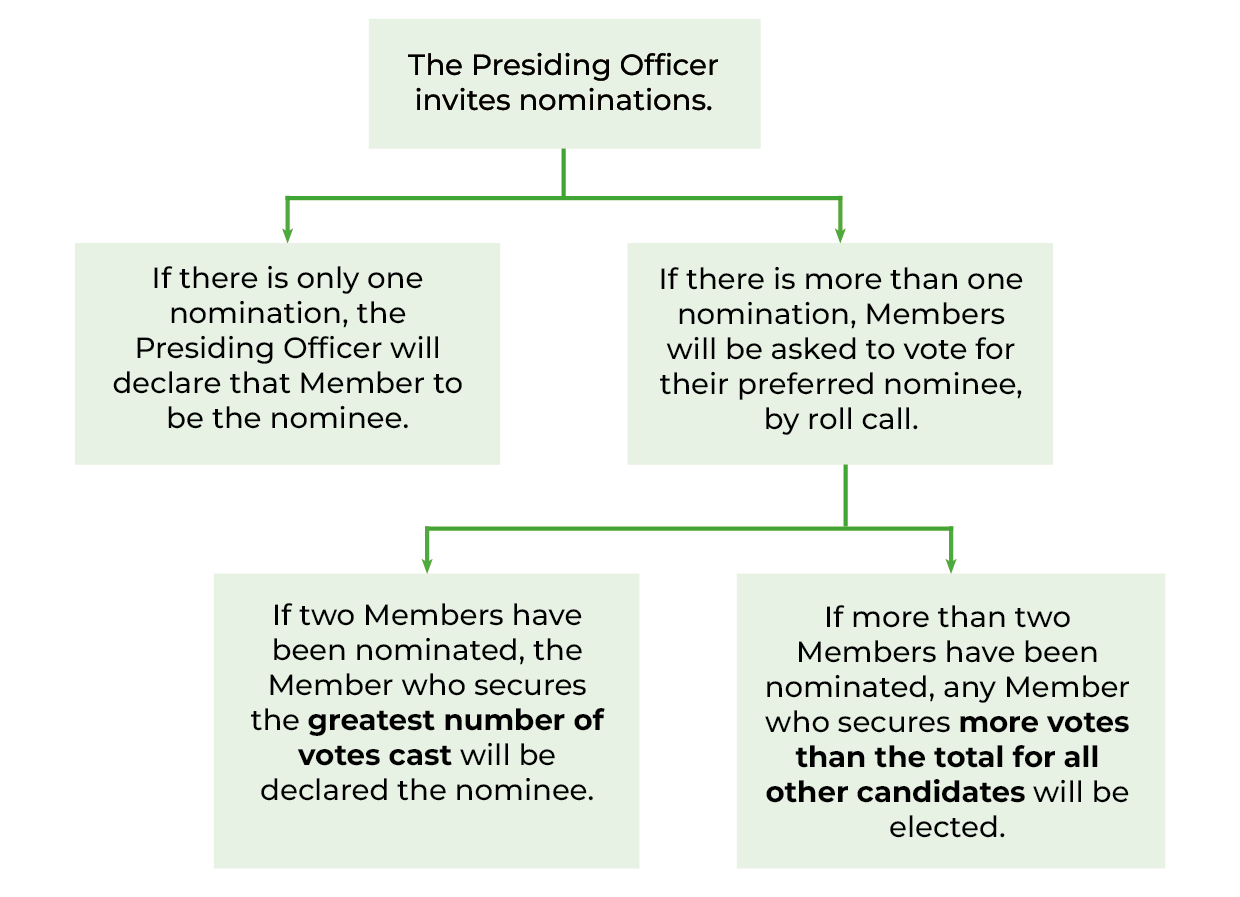
If more than one Member is put forward, the Llywydd will conduct a roll call of all Members (except for the Llywydd and Dirprwy Lywydd) in alphabetical order.
If there are two candidates put forward, the one that receives the most votes will become the nominee. If there is a tie, another vote must take place, but this doesn’t have to happen immediately. This happened once before in May 2016 when Carwyn Jones and Leanne Wood were tied on 29 votes each.
If more than two candidates are put forward and no one receives more votes than the total number cast for all the other candidates, the candidate with the fewest votes is excluded. Further votes are then taken until one candidate obtains more votes than the total number cast for other candidates.
Once a nomination is made by the Senedd, the Llywydd will recommend to the King that they are appointed as First Minister of Wales.
Once this appointment is made, the new First Minister will begin forming their new Cabinet. They can appoint up to 17 Ministers and Deputy Ministers, as well as recommending someone to be appointed as the Counsel General (the government’s chief legal adviser) subject to the approval of the Senedd.
The Business Committee
The new First Minister will appoint a Member to serve as the Minister for government business (usually referred to as the Trefnydd).
Once this Minister is in place, they must table a motion to appoint Members to the Senedd’s Business Committee. Membership must include the Llywydd (as the Chair) and one Member nominated by each political group represented in the Senedd.
The Business Committee is responsible for arranging Senedd business, including deciding on how many plenary meetings there will be in a week and when they will be held, proposing committee remits and names, dates and timings for committee meetings, and recesses. The establishment of the Business Committee is a key milestone towards the resumption of routine Senedd business.
New Senedd Commissioners
As soon as reasonably practicable after the election, the Business Committee must table a motion proposing the names of the four Members to be appointed to the Senedd Commission.
The Senedd Commission has responsibility for the provision of property (e.g., offices), staff and services required to enable the Senedd to function. Members appointed to the Commission act as the “governing board” for the Senedd. Responsibilities include setting the organisation’s strategic aims and helping to put them into effect, overseeing the delivery of those aims, and reporting and being accountable to other Senedd Members about the services they oversee.
Setting up new committees
One of the next key tasks for the Business Committee will be to propose the establishment of new committees.
There are certain committees that must be established. These include, for example, a public accounts committee, a standards of conduct committee and a committee (or committees) to consider all statutory instruments laid before the Senedd.
Committee remits must cover all areas of government and associated public body responsibility, and all matters relating to the legislative competence of the Senedd and functions of the Welsh Ministers and the Counsel General.
The Seventh Senedd may also see other specific committees established. The legislation that reformed the Senedd includes a requirement for the Llywydd to table a motion proposing to establish a committee to review the Senedd’s new electoral arrangements. If established, the committee will have to report within a year of the first meeting of the new Senedd. The Act also includes a similar requirement to table a motion to establish a committee to look at job-sharing for certain office holders.
Following the passage of the Senedd Cymru (Member Accountability and Elections) Act 2026, the Llywydd must also table a motion proposing that a new or existing committee considers how a code of conduct for Members should apply to their conduct during their time as a candidate at a Senedd election.
The establishment of committees could take some time; after the 2021 election, the Senedd agreed most committee names and remits on 23 June 2021. The membership of most committees was agreed on 7 July 2021.
You can follow proceedings on Senedd.tv.
This guide provides more information on early business.
Article by Adam Cooke and Josh Hayman, Senedd Research, Welsh Parliament