The Senedd and Pierhead buildings will be closed to the public on Thursday 15 October. Read information about the closure.








The cost of living: Ongoing pressures and recent developments
Published 22/09/2026
As with other parts of the UK, people across Wales have been hit by a living standards squeeze since the 2008 financial crisis, which has been exacerbated over recent years by cost of living pressures. As highlighted by the Institute for Fiscal Studies, median household incomes in Wales have increased by “just 0.7% per year” in real terms since the early 2010s, which includes a decrease in the first part of the 2020s.
Over recent months, we’ve seen further energy and fuel price rises as a result of the Iran conflict, with predictions of further increases in January 2027 from Money Saving Expert and Cornwall Insight. The Centre for Economic and Business Research (CEBR) predicts higher inflation and lower wages due to the Iran conflict will reduce the real value of average UK household incomes by £1,100 in 2026 and £1,300 in 2027.
The First Minister has said helping households with cost of living pressures is a “core mission” of the Welsh Government. Our article explores what the data tells us about living standards and cost of living pressures, what actions the Welsh and UK governments are taking to support households, and what further action may be needed.
How have squeezed living standards and rising costs affected Welsh households?
Households’ living standards have been squeezed since the 2008 financial crisis, with sluggish productivity growth a key factor in this.
Wales has consistently had lower wages and Gross Disposable Household Income (GDHI) then the UK average, which is closely tied to our lower productivity levels, although there are other factors. As the Welsh Government has outlined, most parts of the UK have seen a decline in GDHI per head compared to the UK average over the longer term, with the exception of London, which has seen a considerable increase.
|
The Office for National Statistics describes Gross Domestic Household Income (GDHI) as the amount of money that households and people living in communal establishments have to spend or save after paying taxes and/or receiving benefits. It also includes the business income of self-employed people. |
Figure 1: Gross Disposable Household Income per head as a % of the UK average for devolved nations and selected English regions, 1999-2024
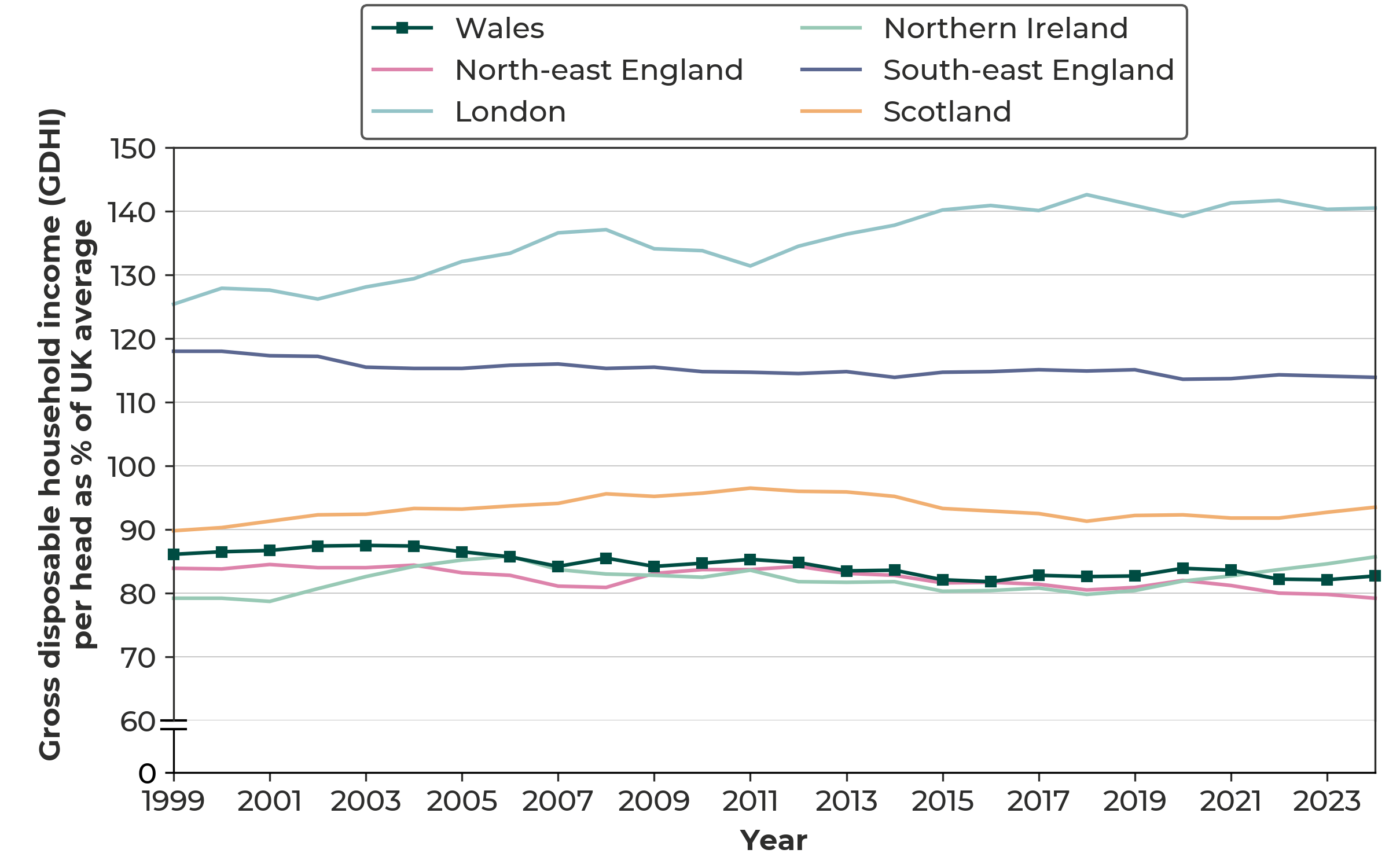
Source: Office for National Statistics, Regional gross disposable household income, UK: 1997 to 2024
Over recent years, the rising cost of living has added to the challenges Welsh households face. The Resolution Foundation says in its latest living standards outlook that, “although weak growth in wages and other sources of income are the key drivers of stagnating living standards, high inflation has compounded these pressures”. While inflation is considerably lower than its peak in 2022, UK consumer prices in 2026 are over 30% higher than at the start of 2021.
The cost of essentials has risen considerably over recent years. When the next energy price cap increase takes effect at the start of October, a typical household’s energy bill will have risen by 58% since winter 2021. The Food and Drink Federation notes food prices have increased by nearly 40% since 2020, with further predicted rises meaning that a £100 weekly shop in 2020 is likely to cost nearly £150 by summer 2027. Office for National Statistics figures show that private rents in Wales have risen by 38% since mid-2021, a greater increase than in England and Scotland.
The Resolution Foundation found that, between 2019 and 2025, inflation disproportionately affected the poorest households, who spend more of their income on essentials. This has reduced their living standards by more than 3% relative to the richest households. Recent analysis from Citizens Advice Cymru highlights the practical impacts of cost of living pressures on lower-income households. Across Wales, 30% of households sometimes don’t have enough money to pay for essentials, 31% of people have cut back on energy use, and 5% of people have a negative budget as the cost of essentials is higher than their income. Oxfam Cymru has described the impacts of cost of living pressures as “deeper poverty, growing reliance on food banks and crisis support, and rising demand on already stretched public services”.
How are the Welsh and UK governments supporting households facing cost of living pressures?
Both governments operate a range of schemes that support households with the cost of living. Key Welsh Government cost of living initiatives include emergency support such as the Discretionary Assistance Fund, emergency food aid, help through the Warm Homes Programme with energy advice and home energy efficiency improvements, and a £200 grant to help eligible off-grid households with rising energy costs.
The UK Government also provides a range of cost of living support, some of which is available to households in Wales. Shortly after taking office, the Prime Minister announced a number of new cost of living policies to “give families and business owners breathing space”, including cutting VAT on domestic electricity bills. He said that any decisions around longer-term measures will be taken in the UK Government’s Budget, on 28 October.
Given the budget constraints the Welsh Government says it faces, the National Institute of Economic and Social Research has suggested it should focus any additional cost of living support on the poorest households. Similarly, the Resolution Foundation and Energy UK have called for any additional UK Government support with energy bills this winter to be targeted at those most in need.
What longer-term solutions are the Welsh and UK governments developing to address the root causes of cost of living pressures?
Alongside universal support with energy bills, previous cost of living payments provided short-term relief for vulnerable households, however as Trussell highlights, a one-off cash payment “rarely tackles the root cause of their hardship alone”.
The Welsh Government has committed to a number of ways to support households with living costs over the longer term. These include childcare expansion, additional expenditure on home energy efficiency and retrofit measures, introducing measures to deliver fairer rents, and working to streamline grants to low-income households collectively known as the ‘Welsh Benefits System’. The Cabinet Minister for Enterprise, Connectivity and Energy has also set out his intention that the new economic development agency will “improve productivity in Wales, create better jobs for people and put money in their pockets, thereby raising living standards”.
The Prime Minister has said that, while he has announced initial measures to mitigate cost of living pressures, “in the long term, lifting growth and living standards will require much more”. Later this year, the UK Government will publish a 10-year plan for Britain, which “will set out plans for stronger public control” over essentials. We’ll need to see the detail of the plan to understand what this might look like in practice, what it means for Wales, and how it interacts with the devolution settlement.
Stagnating living standards are likely to continue to affect households throughout this Senedd term. The Office for Budget Responsibility predicts UK real disposable household income will grow by an average of 0.3% per year until 2030. When combined with the potential pressures on household income as a result of the Iran conflict, as outlined by the CEBR, there is plenty for the Welsh and UK governments to consider in terms of addressing living standards and the cost of living.
Article by Gareth Thomas and Francesca Howorth, Senedd Research, Welsh Parliament