We want to hear your views about Senedd TV. Take our short survey to help us improve the service.









On the Horizon: A look at EU research funding and Wales
Published 20/11/2026 | Reading Time minutes
The EU’s flagship programme for research is the Framework Programme for Research and Innovation(FP). The programme has been running since 1984, with nine iterations to date, each covering a seven-year funding cycle. It is currently in FP9, known as Horizon Europe, which runs from 2021-27 with a budget of €95.5bn. Its predecessor, Horizon 2020, ran from 2014-2020.
The framework programme has supported significant research activity in Wales, with figures showing it has secured over €400m as of 2022.
As part of Brexit, the UK and EU agreed that the UK could participate in some EU programmes after it left the bloc. This article explores that shift in relationship, and the implications for Wales’s research sector.
UK association and Wales
Although the UK negotiated participation in Horizon after Brexit, as part of the Trade and Cooperation Agreement, it still needed to negotiate the terms of its association to the programme.
The UK’s association was delayed between 2021-2023 while these negotiations took place. Transitional arrangements were put in place. This included a Guarantee Scheme which provided funding to those unable to receive it from Horizon Europe during the UK’s association process.
The UK and EU reached a political agreement on association in September 2023 and the UK became an associated state from January 2024. The Welsh Government at the time stated that rejoining Horizon was a priority, and so welcomed the UK Government’s announcement. Wales can only participate in Horizon through UK association and this has left Wales exposed to negotiations at the UK-EU level, with limited influence over the outcome.
Wales has consistently secured Horizon funding, and it has become a key source of funding after the loss of EU structural funds, which accounted for around 80% of EU funding for research pre-Brexit. At the time the UK’s association was agreed, Universities Wales welcomed the development citing the importance of access to international collaboration.
In July, the Cabinet Minister for Enterprise, Connectivity and Energy, Adam Price MS, announced Wales has joined the UNITE European Digital Health Valleys project. This is a Horizon-funded project, which connects European regions to support the development and scale-up of “innovative healthcare solutions”. Wales’s participation was enabled through the UK’s association to Horizon Europe. The Cabinet Minister also said it is the first EU grant that the Welsh Government has secured since Brexit.
Welsh Government Support
The Welsh Government provides support for international research and innovation activities through its Agile Cymru programme. Agile Cymru aims to support economic cooperation but also provides financial assistance “aimed at stimulating Welsh participation in Horizon Europe” and in “similar international research and innovation”, such as international UKRI competitions, Eureka and COST. The latest calls for Agile Cymru funding proposals cover projects up to March 2027..
A Sixth Senedd committee, as part of its scrutiny of Wales-Ireland relations, noted replacement EU funds have not been comparable by value and scale. One example given by former First Minister, Mark Drakeford, was that the Welsh Government had:
€100 million in the last [EU inter-territorial cooperation budget]; all of that is gone. We are providing a very modest amount of money, £150,000, through Agile Cymru.
Funding under Horizon
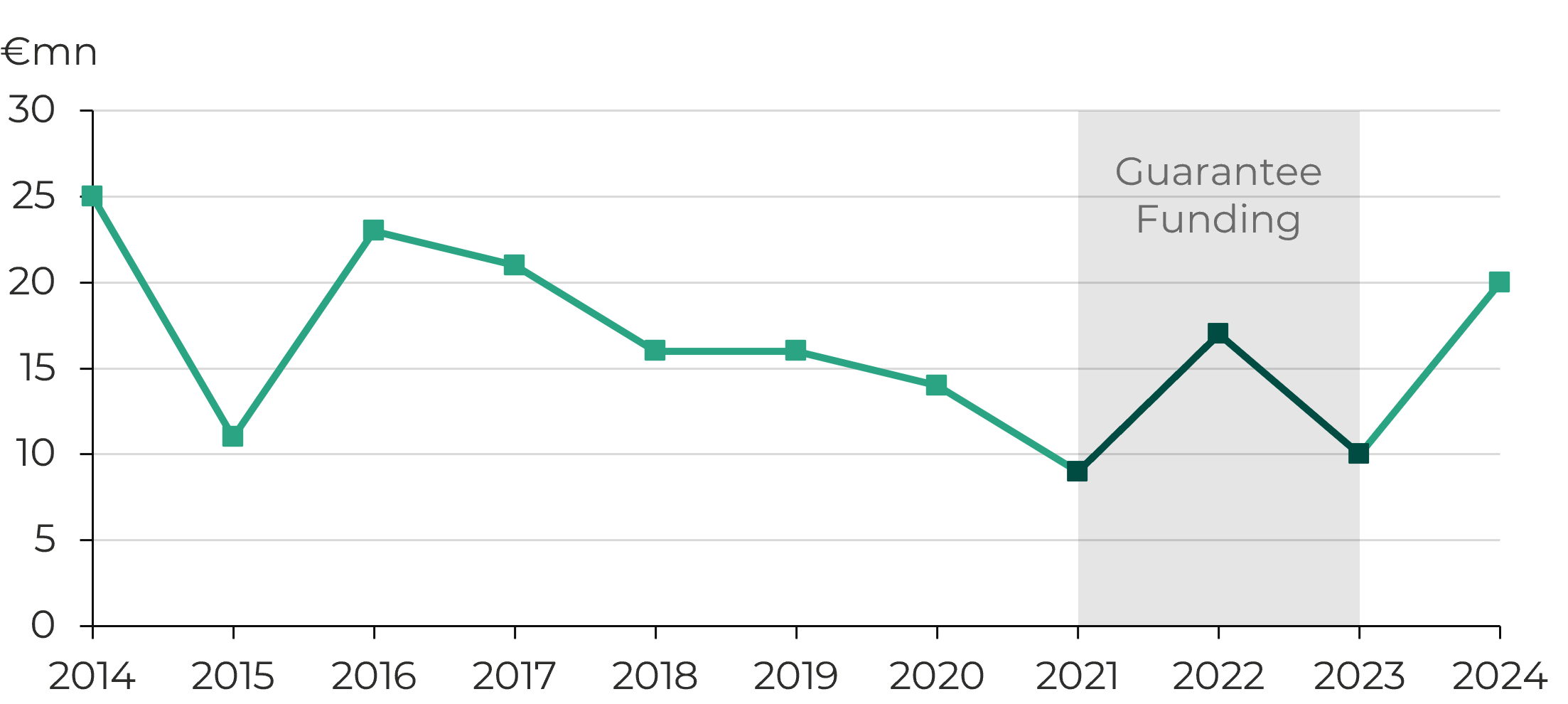
Figure one illustrates Wales’s allocated funding over a ten-year period from 2014-24. This period covers Horizon 2020, the UK Guarantee scheme, and the start of Horizon Europe. It shows how funding levels have changed over the course of the post-Brexit period up to UK association.
Figure 1: Funding allocated to Wales from the Horizon programme and UK Guarantee Scheme (by value, 2014-2024)
Source: UK participation in EU Framework Programmes (UK Government, 2026)
Over the period shown, Wales was allocated around €182m in total. Annual allocated funding peaked at €25 million in 2014 and fell to its lowest at €9 million in 2021.
Funding in Wales was on a general decline in the years following the Brexit vote in 2016, and this falls in line with a wider decline in UK Horizon funding during that period. Although, there was an uptick in 2022, which followed the launch of the UK’s Guarantee Scheme. There was a steep increase in 2024, after the UK associated to the programme but there is not yet enough data available to say whether this is the start of a sustained recovery.
Up to date figures for Horizon Europe can be found on the Horizon programme’s dashboard. It shows net EU contribution to Wales stands at €37.2m, with approximately 50 unique participating organisations since the start of Horizon Europe. The higher education sector received an 80% share, totalling €29.8m. Cardiff University is the greatest recipient, having secured €22.9m, followed by Swansea University with €4.3m.
Horizon Europe
The drop down menus below explore the structure and budget of the Horizon Europe programme. They also cover the successor programme, currently known as FP10.
Structure
The EU’s framework programme for research and innovation has operated in seven year cycles since 1984, with Horizon Europe being its ninth iteration. This programme launched in 2020, and is due to close in 2027. The current structure consists of three pillars, under which activity is organised:
The next programme, currently known as FP10, will include some significant changes, including the inclusion of a fourth pillar on the European Research Area. The intention is that this programme will also be able to develop ‘moonshot’ projects which would support real world deployment of innovative technologies.
Budget
Horizon operates under the EU’s seven-year Multiannual Financial Framework cycle. The current programme has a budget of €95.5bn. The European Commission has confirmed that FP10 will be a standalone programme with a proposed budget of €175bn. It has emphasised that FP10 will be “tightly connected” to the European Competitiveness Fund.
European Commission proposals for the 2028-34 programme are currently being negotiated. Inter-institutional disagreements have delayed agreement on the overall budget and the detail of the new programme.
Once the terms of the new programme is finalised, the UK will also have to negotiate association again, as it did in 2023.
What next?
As Horizon Europe comes to an end, the UK again faces the decision over whether or not to associate to the next programme. Speaking in 2025, the Minister of State, Department for Science, Innovation and Technology, Lord Vallance of Balham, stated that Horizon “is a very important part of our funding system and, provided it is open, excellent and value for money, we will negotiate to try and be part of FP10”.
Those negotiations will only take place once FP10 is finalised. Any uncertainty, such as that seen during the 2021-23 transition period, could have serious implications for the sustained recovery of EU research funding in Wales.
Article by Maddy Phillips, Senedd Research, Welsh Parliament