








… our ecosystems are struggling to withstand the pressures from how we manage the land in Wales. Biodiversity is in decline, natural systems are under strain, and the landscapes that sustain health, prosperity, and culture are struggling to adapt to new and existing pressures.
Natural Resources Wales (NRW)’s new 2025 State of Natural Resources Report (SoNaRR) presents stark evidence on the state of Wales’s environment.
This article explores ‘ecosystem resilience’ as a fundamental aspect of our natural world’s health, and discusses policies which aim to protect it.
Firstly, what is SoNaRR and why is it important?
SoNaRR is NRW’s assessment of the state of natural resources in Wales and must be published every five years.
It provides the evidence base for the Welsh Government and other public bodies to inform policy, planning, and wider decision-making. It is the basis for the Welsh Government’s National Natural Resources Policy.
The 2025 SoNaRR is the third version of the report, highlighting key evidence on what has changed since SoNaRR 2020, concluding that this is a “pivotal moment” for action.
SoNaRR has several connected aims which focus on stocks of natural resources, ecosystem resilience, healthy places for people and a regenerative economy.
What is ecosystem resilience, and how is Wales doing?
Resilient ecosystems underpin the Sustainable Management of Natural Resources (SMNR) providing “ecosystem services” such as clean water, carbon storage, flood regulation and food.
Ecosystem resilience is described by NRW using the DECCA Framework attributes:
- diversity between and within ecosystems;
- extent / scale of ecosystems;
- connections between and within ecosystems;
- condition of ecosystems (including their structure and functioning); and
- adaptability of ecosystems.
SoNaRR 2025 concludes that ecosystem resilience remains low across most habitats, including terrestrial, freshwater and marine ecosystems (Figure 1).
Semi-natural habitats have declined in extent and condition, and marine assessments show significant pressures from pollution, climate change, and unregulated development. NRW warns:
Without transformative change, resilience will continue to erode, threatening biodiversity, ecosystem services, and long-term well-being.
Ecosystem resilience matrix
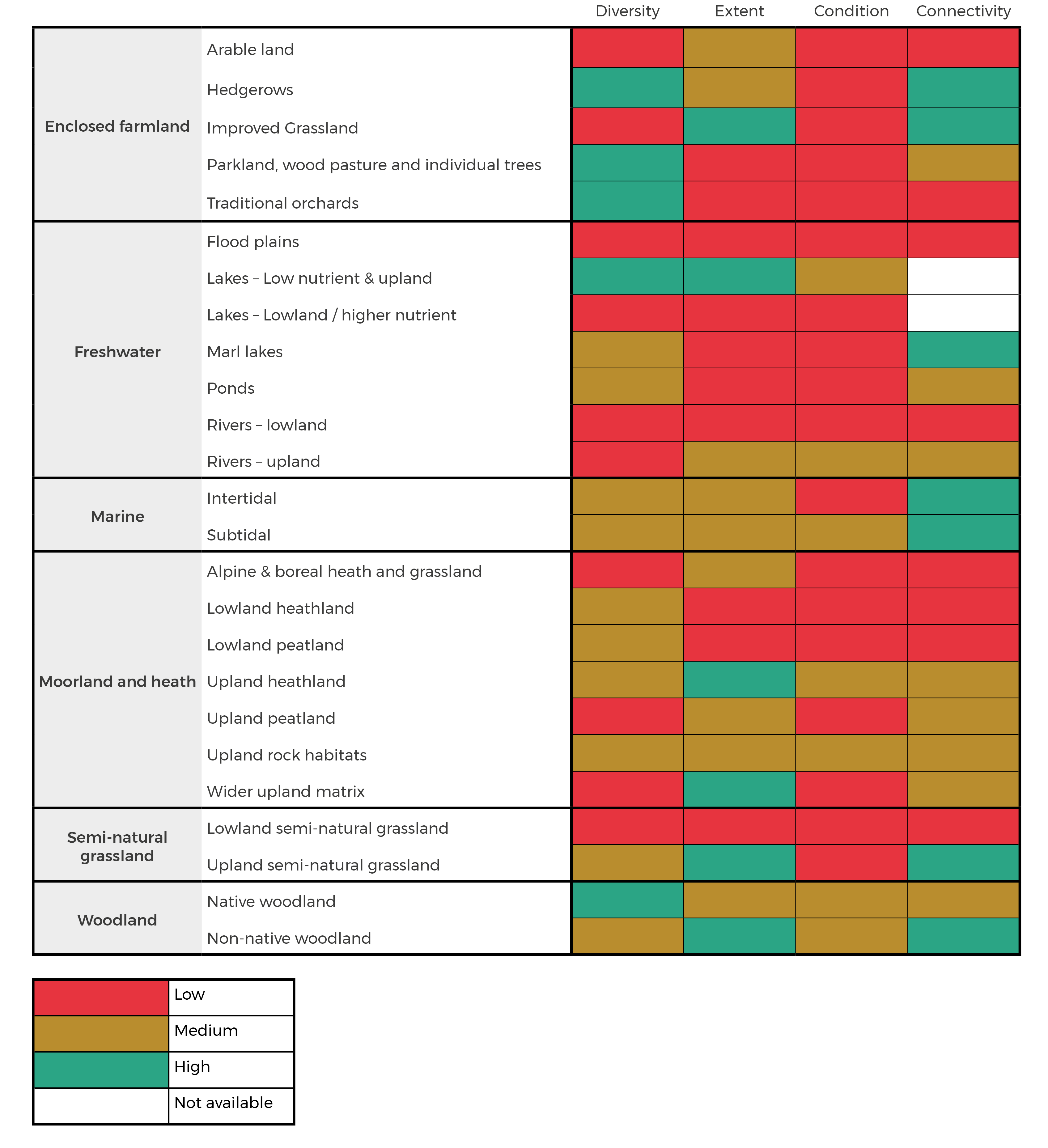
Figure 1. A matrix to indicate the resilience of ecosystems across various habitats in Wales using the resilience indicators of diversity, extent, condition and connectivity. Data source SoNaRR 2025, NRW.
While resilience is generally low, the assessment reveals some spatial variation. Upland areas tend to retain a higher proportion of semi-natural habitats and score more favourably across resilience attributes. Lowland areas, which have been more intensively modified, show consistently lower resilience.
SoNaRR identifies the drivers impacting ecosystem resilience: agricultural and woodland management, climate change, urbanisation, marine development, overexploitation, pollution, hydrological change and invasive non-native species.
What are the policy levers to improve ecosystem resilience?
Most policy areas will have an impact on ecosystem resilience, either directly or indirectly. Here we discuss a few topical areas.
Agriculture
SoNaRR identifies agricultural management as a key driver for ecosystem resilience and, since farmland makes up over 80% of Wales’s land area, it has a big part to play.
The Agriculture (Wales) Act 2023 and the Sustainable Land Management framework aim to reward land managers not just for producing food, but for mitigating and adapting to climate change and enhancing ecosystem resilience (amongst other things).
The new Sustainable Farming Scheme (SFS) aims to fulfil these principles. Having launched in January, time will tell whether this change in policy will improve ecosystem resilience.
The Welsh Government proposes that the ‘optional’ and ‘collaborative’ elements of the SFS will deliver more for the environment. However they are still being developed (only the ‘universal’ elements are currently available) and environmentalists are keen to see them introduced as a priority.
RSPB Cymru says the SFS must go further to reverse the decline of threatened species like curlew, marsh fritillary butterfly and shrill carder bee. The Welsh Government has highlighted optional elements likely to come forward in 2026, including support for farmers to create new habitats (such as reversion of improved grasslands to species rich grasslands or the creation of orchards).
SoNaRR highlights the importance of a landscape-scale approach between farmers and other partners, and in particular tackling nutrient loading and other pollutants that undermine ecosystem health. A proposed ‘collaborative’ element of the SFS includes restoring and enhancing ecosystems at a landscape-scale, such as peatlands and wetlands where managing water levels and flow may not be possible within a single farm.
Stakeholders emphasise that the ambition of the SFS will only be achieved by adequate funding, with farmers and environmentalists alike calling for a significant uplift.
Protected sites and connectivity
The network of protected sites in Wales (such as the National Site Network and Marine Protected Areas) aim to provide anchors for biodiversity which contributes to ecosystem resilience.
The Global Biodiversity Framework commits Wales (through the UK as signatory) to protect 30% of land, freshwater and sea for nature by 2030 (30 by 30).
The environment sector’s 2025 UK-wide progress report on the 30 by 30 target suggests Wales will miss the target by some way. It concludes that Wales has just 2.4% of land meeting the 30 by 30 criteria, and that a lack of data in the marine environment has made it difficult to accurately assess progress.
The Senedd’s Climate Change, Environmental and Infrastructure (CCEI) Committee made several recommendations to improve the protected site network within its Halting the loss of nature by 2030 report.
The Committee said the Welsh Government should produce an action plan setting out the actions needed to meet 30 by 30. The Welsh Government accepted this recommendation.
The Committee also described the pace of expanding the marine protected sites network as “disappointingly slow”. It recommended increased budget for the Nature Networks Fund (which is often over-subscribed) to improve the protected site network. The Welsh Government said it would increase the allocation if additional funding becomes available.
SoNaRR highlights that beyond protected sites, real resilience depends on connecting these sites, for example to allow species to disperse, requiring landscape and seascape-scale partnerships.
One approach being explored is through the Nature Recovery Exemplar Areas (NREAs) and Other Effective Area-based Conservation Measures (OECMs), which are areas of conservation potential outside of protected sites such as Local Nature Reserves. An expert group has provided further analysis of these methods, calling urgently for secure investment in nature recovery, from private as well as public sources.
Environment (Principles, Governance and Biodiversity Targets) (Wales) Bill
The Environment (Principles, Governance and Biodiversity Targets) (Wales) Bill, currently passing through the Senedd, aims to protect ecosystem resilience via:
- an environmental objective and environmental principles to underpin decision-making;
- a statutory body; the “Office of Environmental Governance Wales”, responsible for ensuring public authorities comply with their duties under environmental law; and
- a biodiversity target setting framework.
SoNaRR stresses that the statutory biodiversity targets “must be measurable, time-bound, and embedded across sectors” and that future SoNaRRs must demonstrate what has been delivered.
The CCEI Committee has pushed for the biodiversity targets to come forward through regulations as a matter of urgency following the Bill’s enactment, and the Welsh Government has agreed to shorten the proposed timeline from three years to two.
Urgent action is a theme of SoNaRR to restore ecosystem resilience. With the 2030 global biodiversity ambition looming, eyes will be on the next government and Seventh Senedd to tackle the ‘nature emergency’.
Article by Dr Katy Orford, Senedd Research, Welsh Parliament
