The Senedd and Pierhead buildings will be closed to the public on Thursday 15 October. Read information about the closure.









Is culture in crisis?
Published 10/06/2026 | Last Updated 10/06/2026
A decade of cuts have led bodies including the Arts Council for Wales, the Musicians Union and the Future Generations Commissioner to say that culture in Wales is in “crisis”. How did this happen?
It’s typical to start an article like this with a reference to Wales as the “Land of Song”: a name drawing on Wales’s long history of singing, from Eisteddfodau, to chapel choirs to rugby stadiums. But would this name be bestowed today on a country without a national concert hall (closed since 2023 for repairs), where the national opera company has described its future as “incredibly perilous”, and that spends among the least in Europe on culture and sport?
Public spending on culture higher than the UK average, but among the lowest in Europe
Between 2014-15 and 2024-25, the Welsh Government cut culture and sport revenue budgets by 17% in real-terms. Over the same period, capital budgets (which are less than half the size of revenue budgets) almost tripled in size.
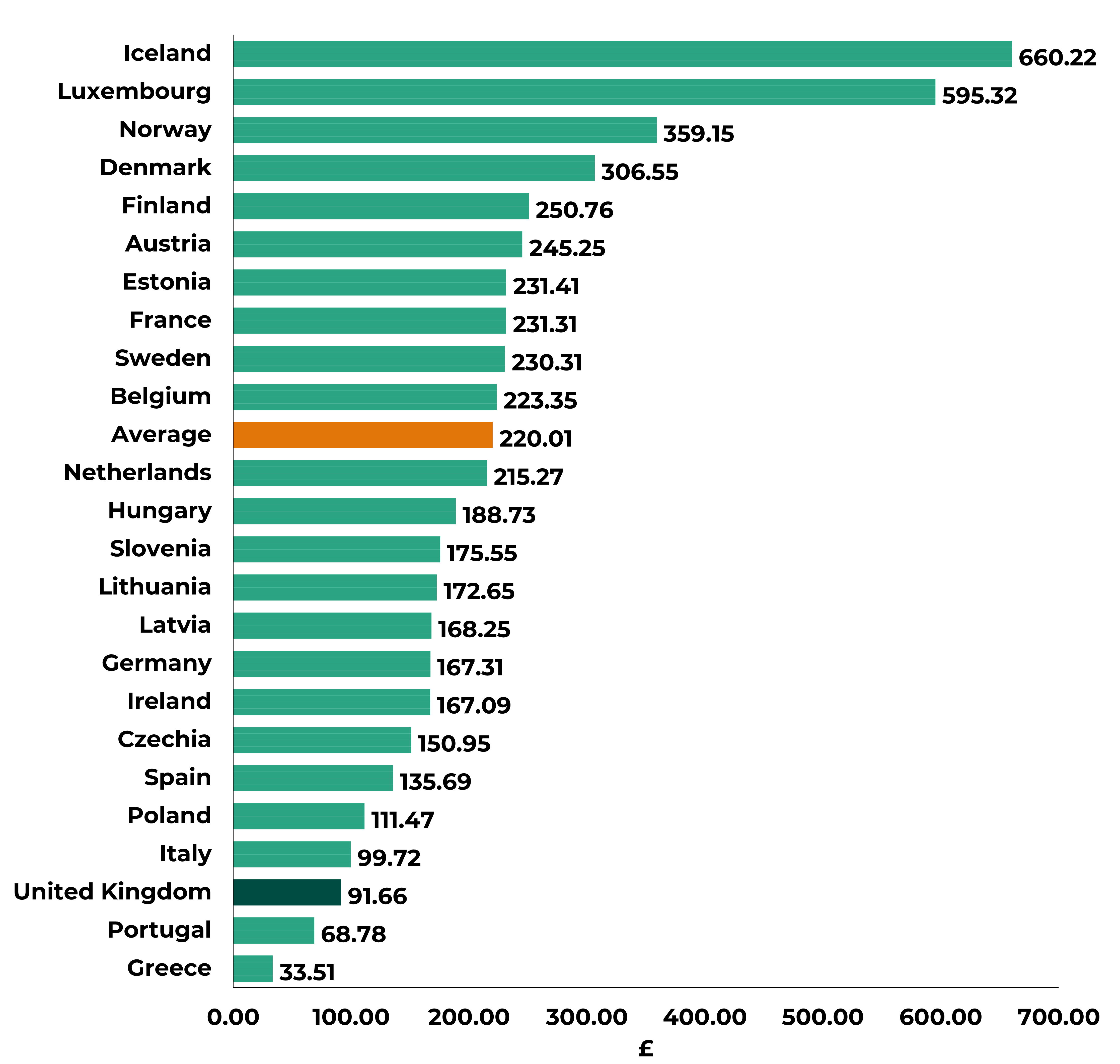
Following prolonged real-terms reductions from central and local government, public funding of culture and sport in Wales is among the lowest in Europe.
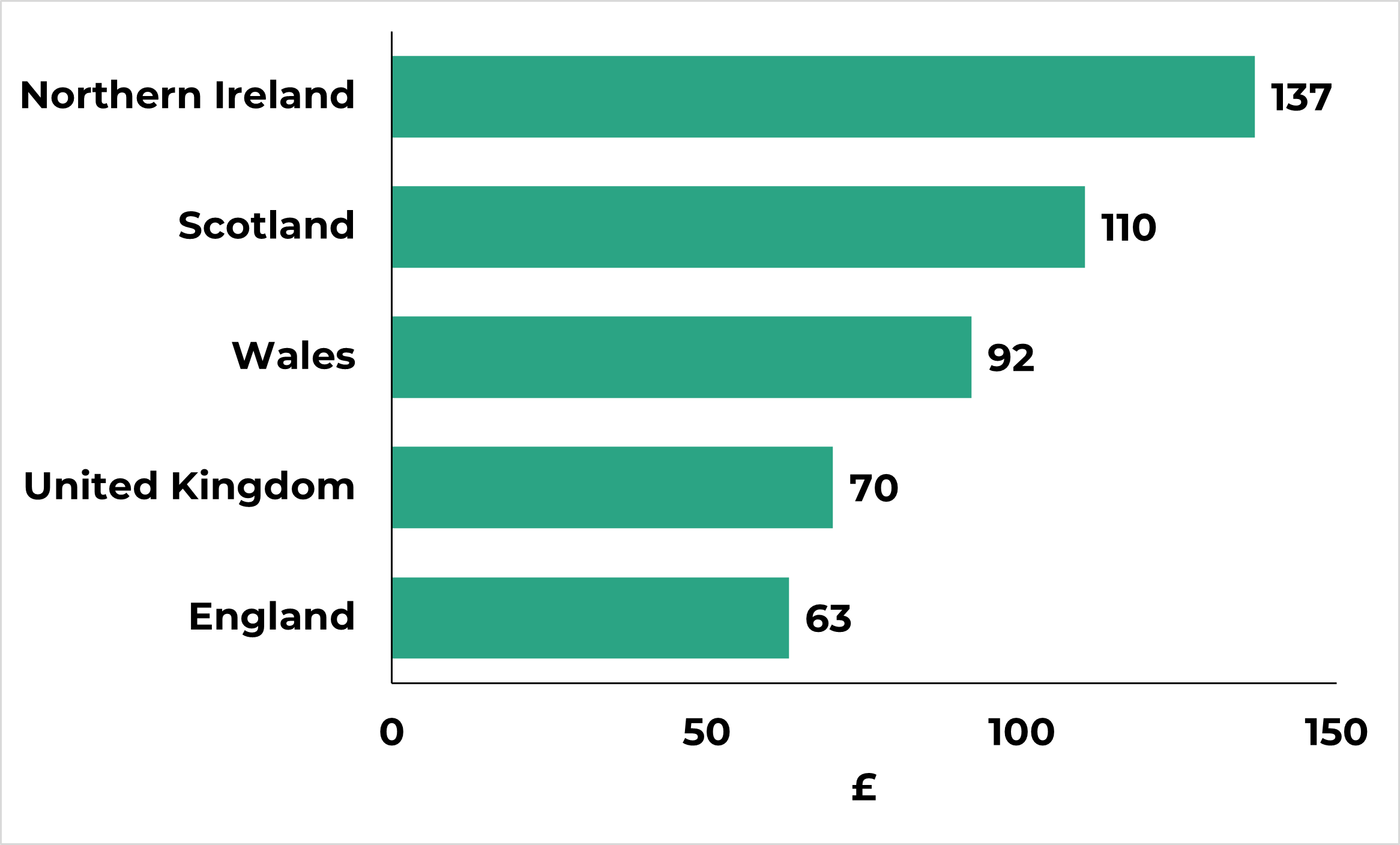
Figures compiled at a UK-level show that public spending (by national and local governments) on cultural services per head in Wales is above the UK average, but significantly lower than in Scotland and Northern Ireland.
Figure 1: Total identifiable expenditure on cultural services, £ per head, 2024-25 outturn for UK nations
Source: HM Treasury Country and Regional Analysis Table B.5, B.6, B.7, B.8
Figures compiled at a European level show that public spending per head on cultural services in the UK is among the lowest in Europe. It is likely that Wales would have to double its public spending on culture to reach the average of these 24 European countries.
Figure 2: Total government expenditure on cultural services, £ per head, for European countries year ending 2023
Source: Organisation for Economic Co-operation and Development (OECD) annual government expenditure by function and Senedd Research analysis
*The figures for the United Kingdom differ in the preceding two graphs due to different methodologies used by HM Treasury and the OECD.
Why has this happened? In short, cuts to culture at national and local levels have happened because politicians have chosen to spend money on other things.
The Welsh Government had a real-terms increase in revenue funding of about 15% between 2014-15 and 2024-25, and chose to use this to fund other areas. During this period, while Welsh Government revenue spending on culture and sport reduced by 17% in real-terms, Welsh Government health spending increased by 37%.
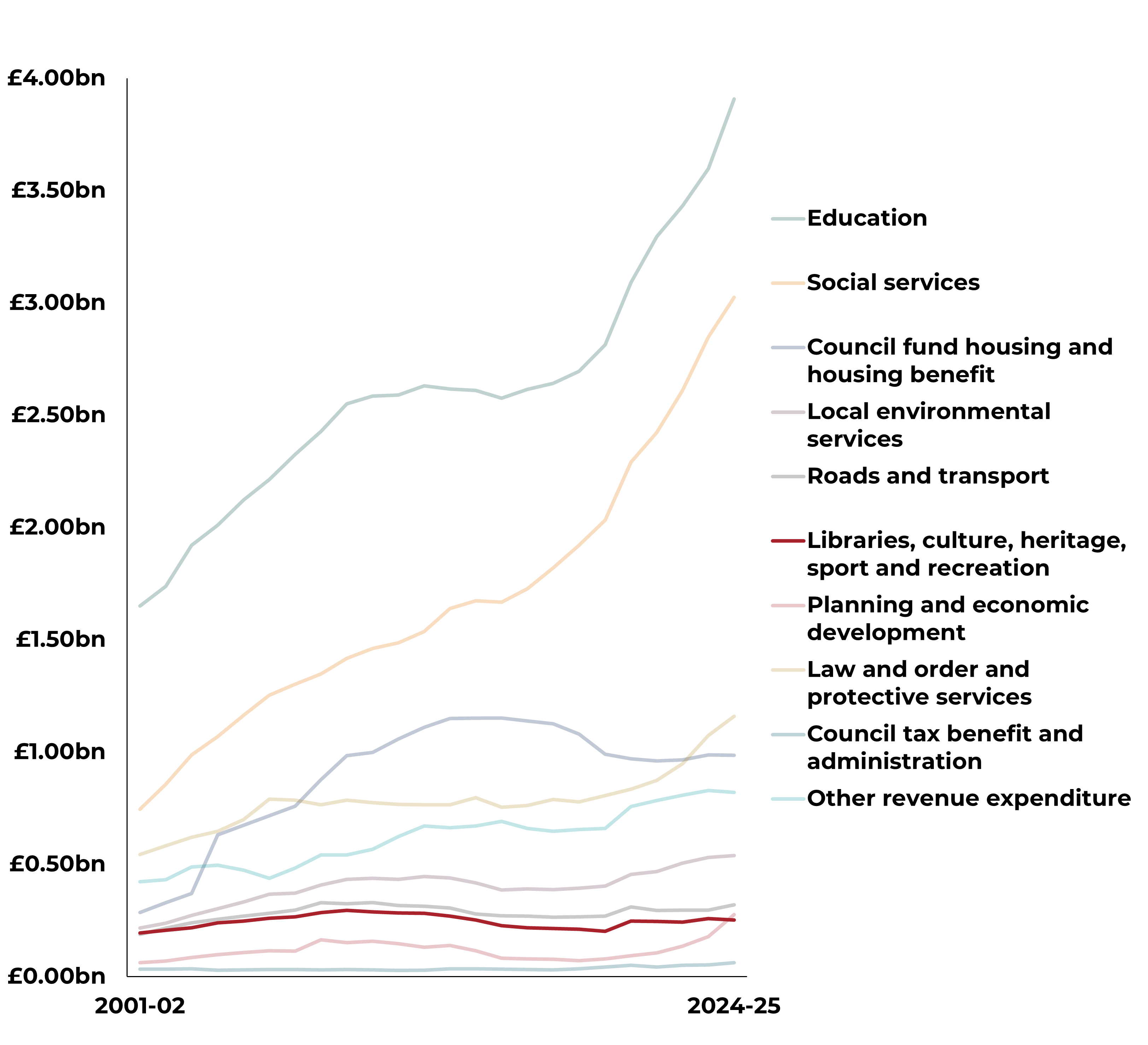
Between 2014-15 and 2024-25, local authority revenue funding for libraries, culture, heritage, sport and recreation reduced by 25% in real-terms, whilst spending on education and social services soared (see figure 3).
Figure 3: Local authority revenue outturn by service (£000s) (2001-02 to 2024-25)
Source: Welsh Government – Revenue outturn expenditure by authority and service and Senedd Research analysis
Arts organisations are increasingly pointing to the benefits of funding culture beyond its intrinsic worth: they highlight the economic and social benefits - including improved health outcomes - of cultural activity.
This analysis chimes with calls from Audit Wales (a spending watchdog) and the Future Generations Commissioner (an independent Welsh Government appointed official) to shift spending away from short-term problem solving, and towards prevention. But after years of scrutinising Welsh Government budgets, the previous Senedd’s Culture Committee said it had “yet to receive a clear answer that assures us” that the Welsh Government “has a strategic approach to this issue”.
Buckets of rain
The Culture Committee in the last Senedd said that, as a result of low government funding, culture was “brittle and under-resourced”. The Arts Council of Wales has said there is “a crisis currently facing the culture sector” and the Musicians’ Union has warned “there is a crisis developing in Welsh music”.
“I’ve never seen so many buckets as I saw catching water in the National Museum (Amgueddfa Cymru)”, said Lesley Griffiths MS when she was briefly Culture Minister in summer 2024, describing the situation as “horrific”. Museum staff say they have since had “a substantial increase in capital funding… to address some of the most urgent concerns”, yet the Museum’s maintenance backlog across its seven sites is £67m (figures provided to Senedd Research by Amgueddfa Cymru). Following “the biggest cuts to Amgueddfa Cymru’s budget ever” from the Welsh Government in 2024-25, the Museum made 144, or about 15%, of its staff redundant.
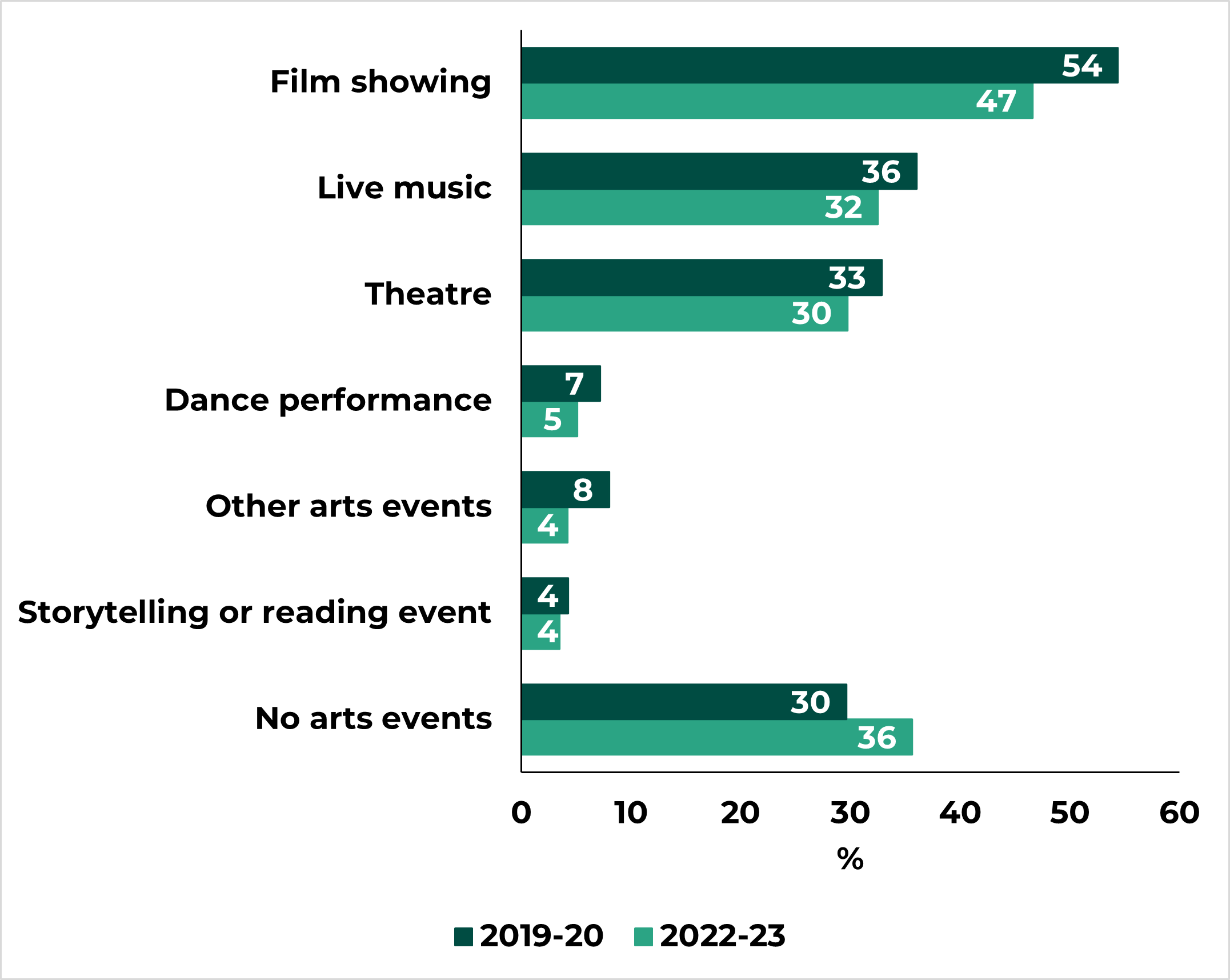
Attendance at all forms of arts events remain below pre-pandemic levels.
Figure 4: Percentage of people attending arts events, by year
Source: National Survey for Wales
The Arts Council (a charity that supports the sector) said in 2025 that there had been an increase in arts organisations most at risk, and that there is “no slack” in the system. An ageing arts infrastructure – largely from the 1970s and beset with leaky roofs - faces a capital maintenance backlog of £50-100 million.
The problem with a bill is someone’s got to pay it
Echoing calls from the sector, the Future Generations Commissioner has said that funding cuts have pushed culture into crisis, “threatening the cultural life that underpins Welsh identity, language and community cohesion”. He has urged the next Welsh Government to introduce a culture bill, without providing a clear picture of what this bill would do. He has called for “the same kind of legal protection already afforded to the Welsh language and active travel”: two policy areas with very different legal frameworks.
The Arts Council and Amgueddfa Cymru would also like to see a law to protect culture. But the Welsh Local Government Association has previously opposed statutory protection, unless this is accompanied by increased funding from central government. The previous Culture Committee felt that the Commissioner had not made “a compelling argument for why legislation is the appropriate means of addressing” the well-documented problems facing the sector.
No “meaningful programme”
After a four-year wait, the previous Welsh Government published its Priorities for Culture in May 2025, following a commitment to “Engage with the arts, culture and heritage sectors to develop a new culture strategy.” This document could have provided a map for tackling the many challenges facing the sector.
Instead, it is a series of broad statements of intent (e.g. “Culture is inclusive, accessible and diverse”) rather than tangible commitments of what the Welsh Government will do. References to structural shocks such as the pandemic, Brexit, the cost-of-living crisis and long-term funding cuts are conspicuous by their absence.
In the words of the previous Senedd’s Culture Committee, this document “contains no analysis of the challenges facing the sector, nor a meaningful programme for tackling them”.
Asked about his long-term plans for culture funding, the then Minister, Jack Sargeant MS, said in May 2025, “I’m not in a position to announce future budgets”. The Scottish Government has taken a different approach, outlining a path in 2024 to investing “at least £100 million more annually” in culture by 2028-29.
A new chapter?
The last big government intervention in Welsh culture was the construction of the Wales Millenium Centre in a wave of post-devolution projects in the early 2000s. Since then, the Welsh Government’s approach to the sector has largely been to fund the structures it inherited – such as the Arts Council and Amgueddfa Cymru – from the pre-devolution era.
The previous Welsh Government said it would establish a National Contemporary Art Gallery: Wales does not have a national gallery dedicated to either contemporary or Welsh art.
But this ended up being a series of upgrades to existing galleries, with capital costs of less than a quarter of the projected £35m, reflecting what the Welsh Government called a “lean operating model.” The previous Culture Minister didn’t commit to providing ongoing revenue funding: instead expecting the sector to find the estimated £400,000 a year itself. For context, Scotland’s design museum, V&A Dundee – which opened in 2018 – cost £80m to build and receives £3.8m per year from the Scottish Government.
Will the incoming Welsh Government write a new chapter in the story of Welsh culture?
Article by Robin Wilkinson, Senedd Research, Welsh Parliament