








This page explores Wales’s international trade with the rest of the world, and includes information on:
- Devolution and trade;
- How much Wales trades;
- What Wales trades;
- Who Wales trades with; and
- UK trade deals and negotiations.
This page focuses on trade in goods which is measured by value and/or volume. Trade in value is a measure of the monetary worth of goods traded, and can be influenced by price changes, exchange rates and inflation. Trade in volume captures the physical quantity of goods traded. As such, changes in trade value do not necessarily indicate a change in the quantity of goods traded.
This page will be updated quarterly to reflect the latest trade position. Full-year statistics are usually published every March.
Trade in services are reported separately. The latest release showed that services made up 30% of total exports from Wales, and 20% of total imports in 2023.
Only the UK Government can enter into legally binding trade deals and it does so on behalf of the four nations. While international trade is generally considered a reserved matter, important aspects of it are devolved. For example, biosecurity, food safety and sanitary and phytosanitary (SPS) controls to protect animal, plant and public health are all devolved trade controls. Trade deals can also include devolved responsibilities., like the environment. According to the Centre for Inclusive Trade Policy, as of 2024, 91% of existing trade deals had some degree of overlap with devolved areas.
Welsh Ministers and the Senedd are responsible for putting the devolved parts of trade deals in place and must ensure compliance with the UK’s international obligations.
The governments of the four nations’ work together on international trade. The Welsh Government can make representations to the UK Government on trade policy and priorities either directly or through the UK Government’s Interministerial Groups on Trade and on UK-EU relations. The previous Welsh Government also had its own internal Trade Policy Advisory Group, comprising of 19 organisations including Cardiff University, the Federation of Small Businesses Wales and Public Health Wales.
How much does Wales trade internationally?
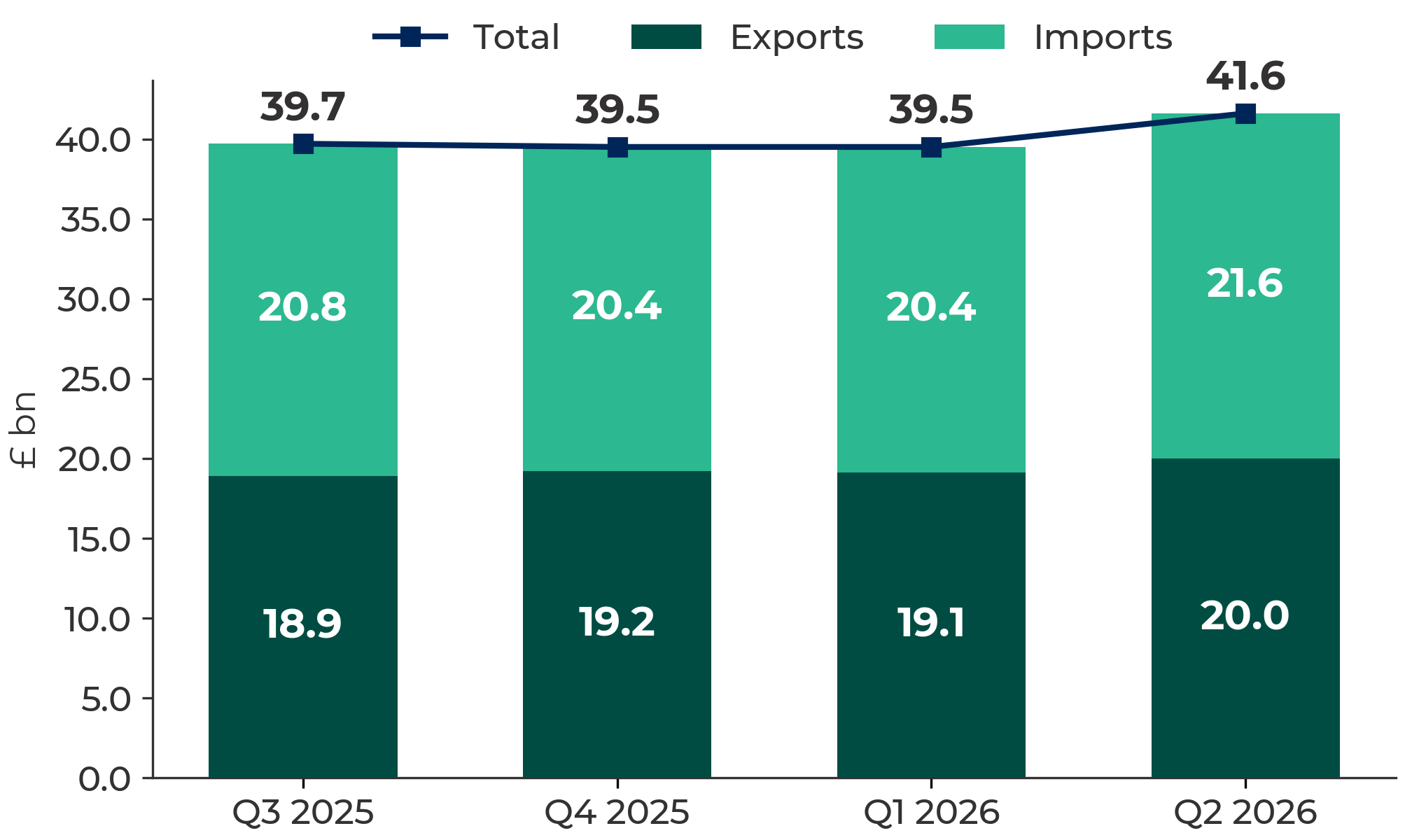
Figure 1 shows the value of Welsh trade in goods for the latest four quarters. The total value currently stands at £41.6bn, with the preceding four quarters showing a small increase in Welsh trade.
Figure 1: Current value of Welsh trade in goods (by value; for year ending Q2 2026)
Source: International goods trade: interactive dashboard (Welsh Government, 2026)
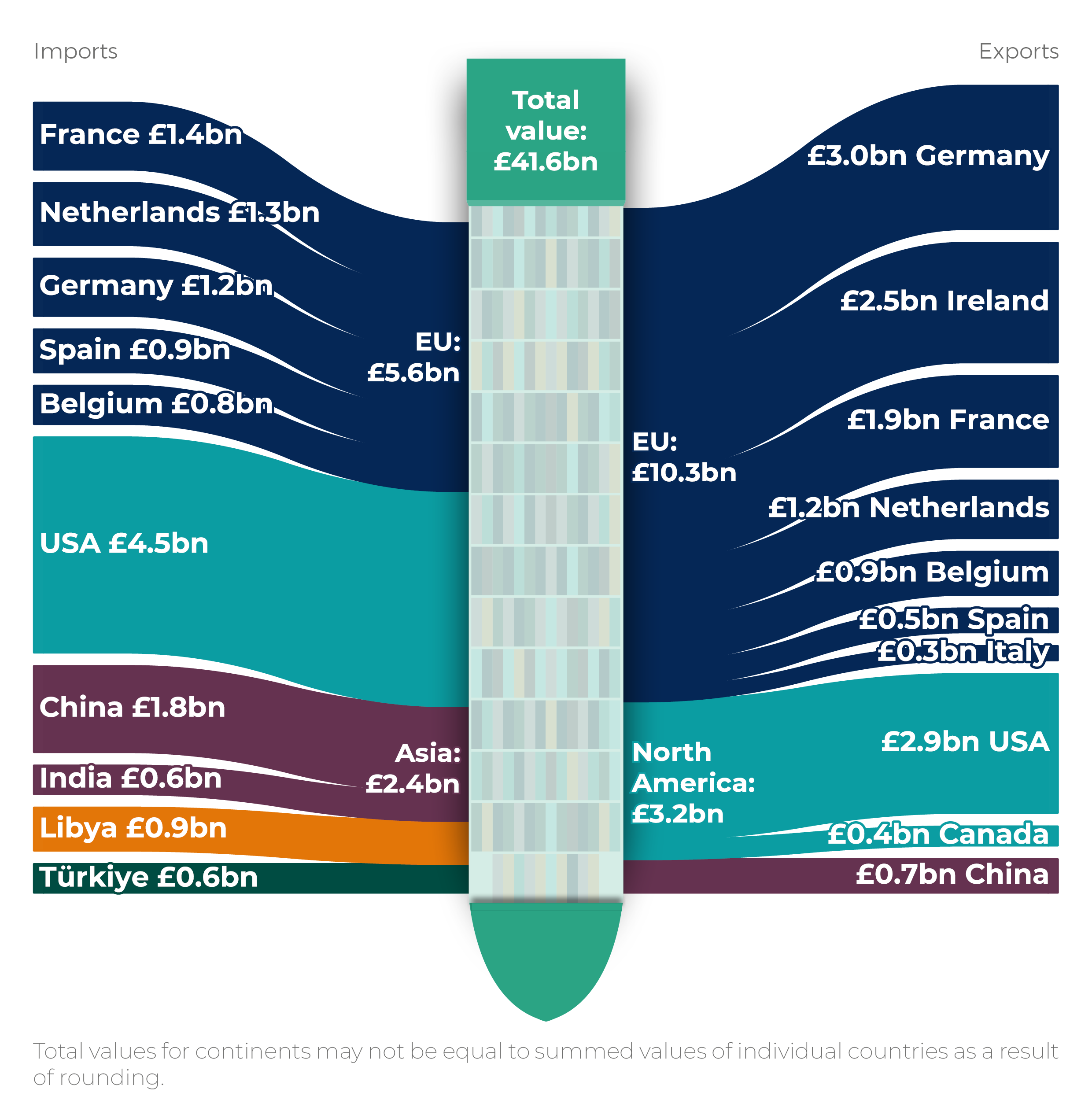
Figure 2 shows trade flows between Wales and its top ten trading partners by global region and value. This trade accounts for approximately 68% of the overall value of goods traded in the last four quarters.
Figure 2: Wales’ top 10 trading partners (by value; for year ending Q2 2026)
Source: International goods trade: interactive dashboard (Welsh Government, 2026)
What does Wales trade?
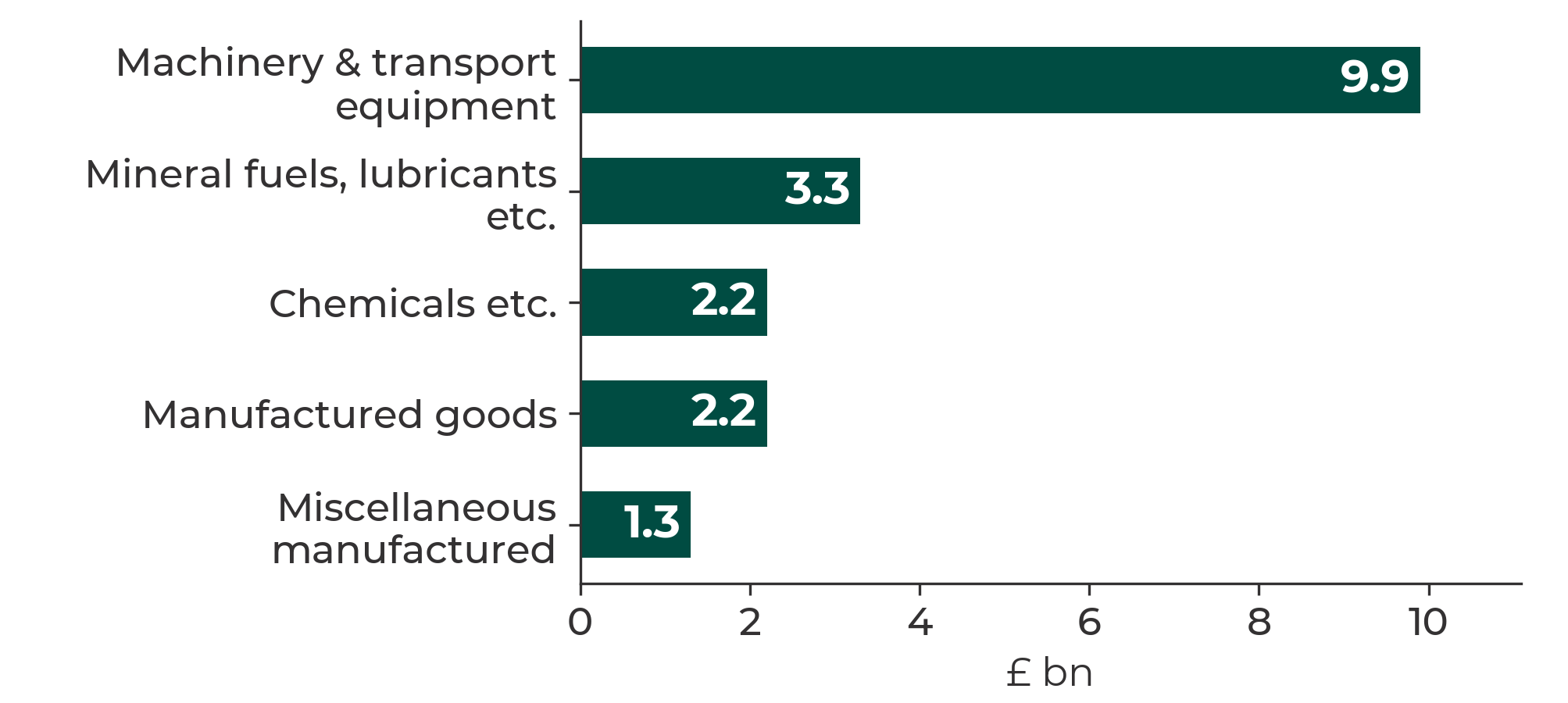
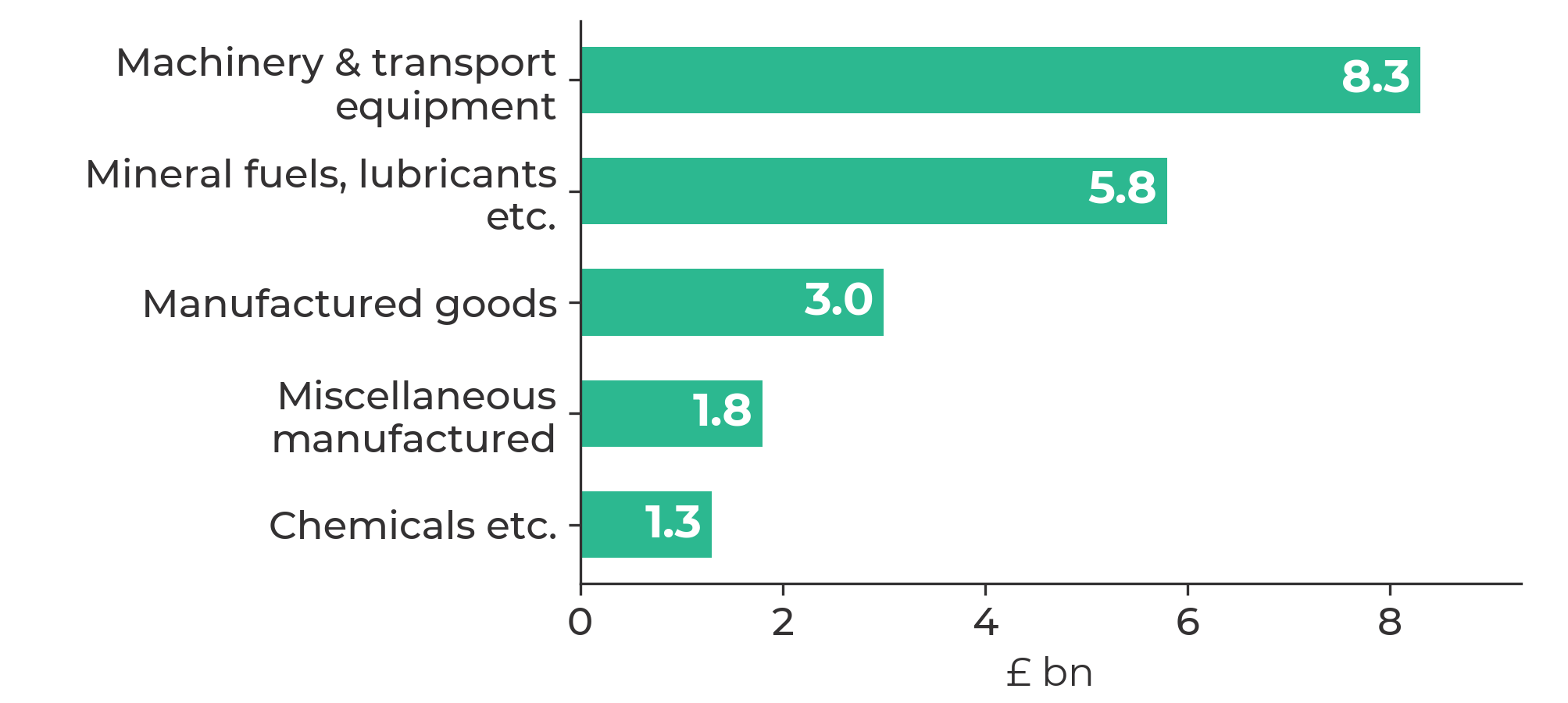
Figures 3 and 4 show the top five products that Wales exported and imported in the last four quarters by category and value.
Figure 3: Wales’s top five exports (by category and value; for year ending Q2 2026)
Source: International goods trade: interactive dashboard (Welsh Government, 2026)
Wales’s biggest single export is ‘power generating machinery and equipment’. This is a product group which sits under the broader ‘machinery and transport equipment’ category. Examples of products which fall under this group include turbines and generators. These products account for £4.3bn of the £9.9bn.
Figure 4: Wales’s top five imports (by category and value; for year ending Q2 2026)
Source: International goods trade: interactive dashboard (Welsh Government, 2026)
Wales’s biggest single import sits under the ‘mineral fuels, lubricants etc’ category and is ‘petroleum, petroleum products and related materials’. These products account for £5.5bn of the £5.8bn.
Who does Wales trade with?
The EU remains Wales’s largest trading partner overall, accounting for 47% of its international trade in goods by value and 60% by volume in 2025.
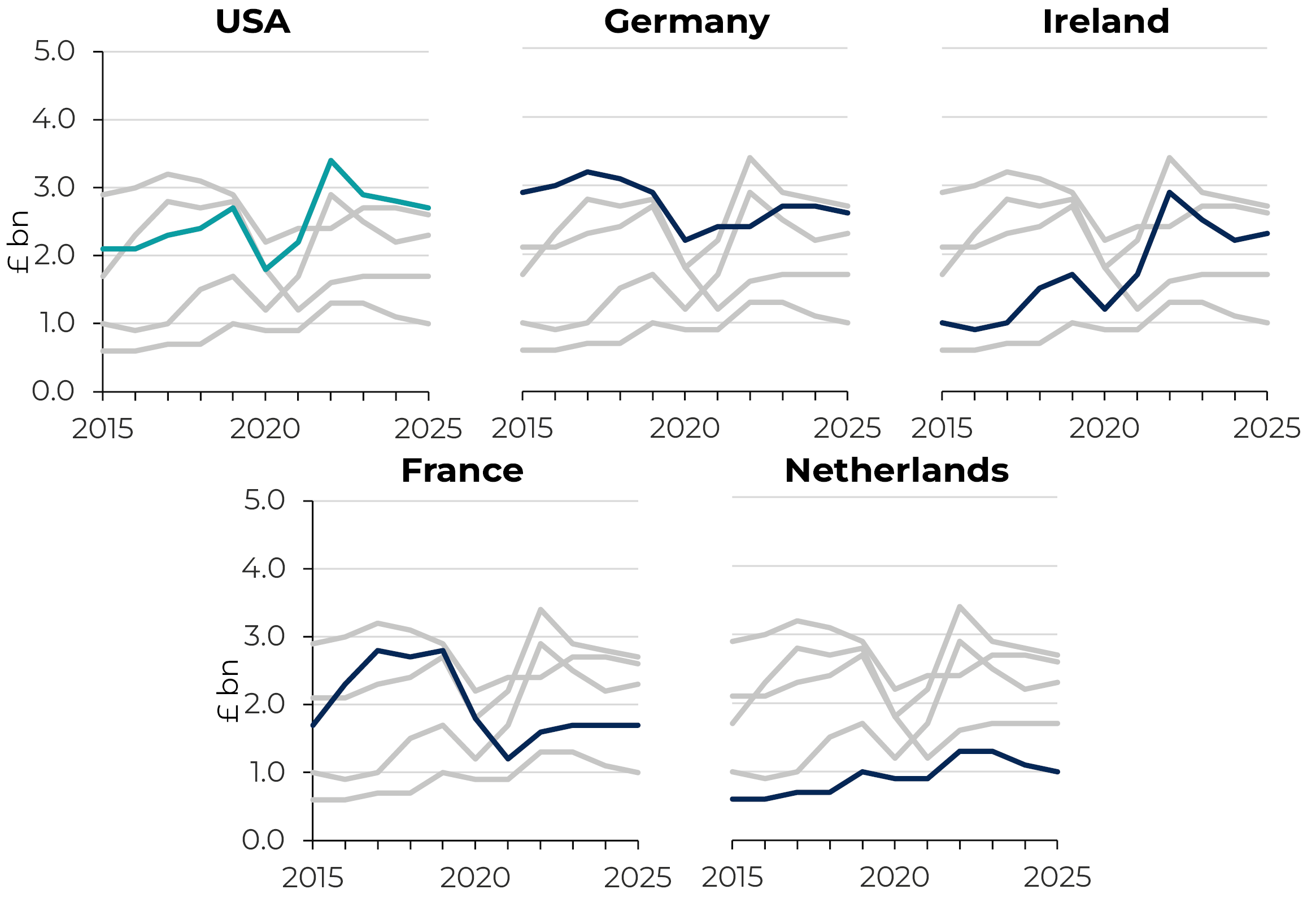
Figure 5 shows Wales’s top five individual export partners for 2025 and their trading relationship over time.
Broadly, Wales has had the same top five export partners over the last ten years. The exception (not indicated on the charts) was in 2021, when Belgium was its fifth biggest export partner, replacing the Netherlands.
Figure 5: Wales’s top five export partners (by value; 2015-2025)
Source: International goods trade: interactive dashboard (Welsh Government, 2026)
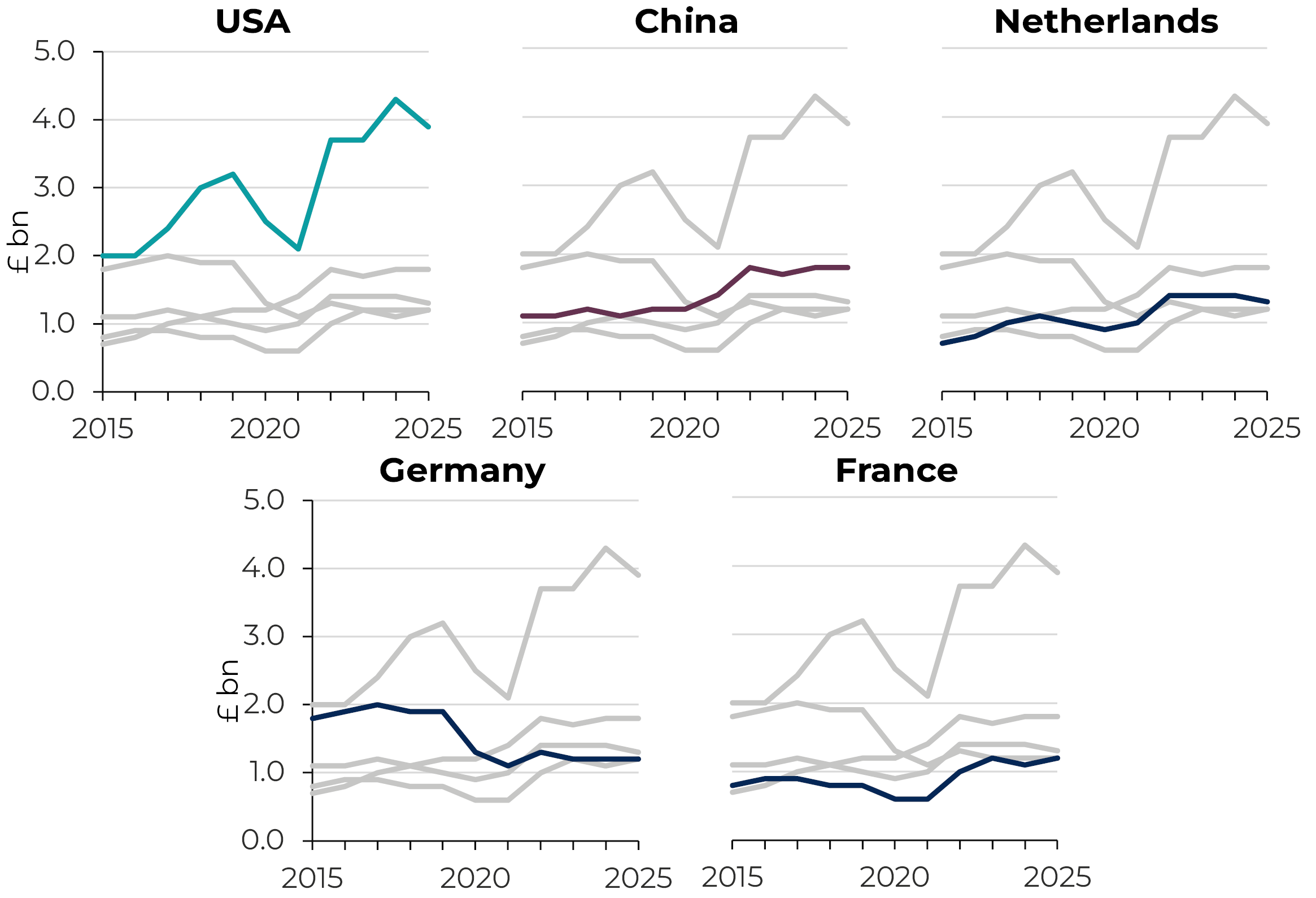
Figure 6 shows Wales’s top five import partners for 2025 and their trading relationship over time. Unlike export partners, its top five import partners have changed frequently over the same ten years.
France was not always in the top five, being replaced in 2022 by Norway, 2021 by Spain, 2020 by Ireland and 2017 by Norway. The Netherlands was not a top five partner in 2015, being replaced by Algeria. These changes are not indicated on the charts.
Figure 6: Wales’s top five import partners (by value; 2015-2025)
Source: International goods trade: interactive dashboard (Welsh Government, 2026)
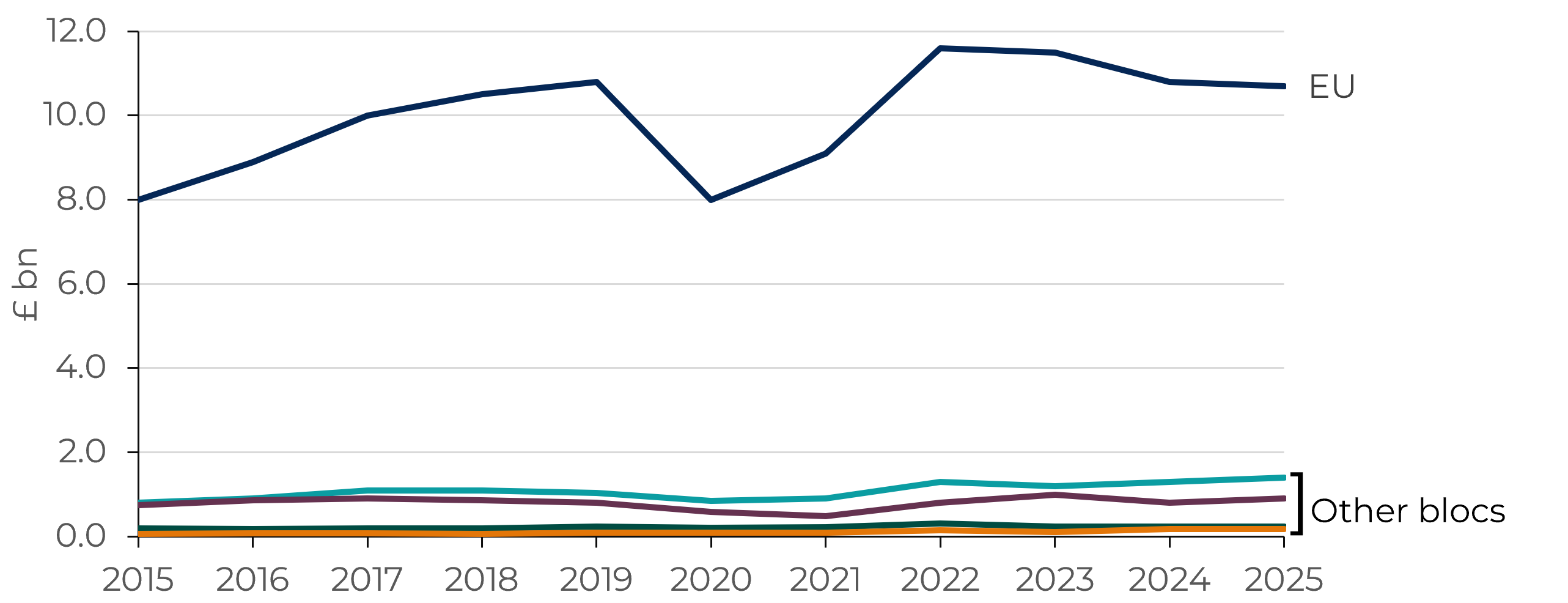
Whilst the UK is a member of one trade bloc, the Comprehensive and Progressive Agreement for Trans-Pacific Partnership (CPTPP), it trades with others like the EU. The UK Government also recently negotiated a trade deal with the Gulf Cooperation Council (GCC).
Figure 7 shows the value of exports between Wales and key trading blocs over a 10-year period.
Figure 7: Exports to key trade blocs (by value; 2015-2025)
Source: International goods trade: interactive dashboard (Welsh Government, 2026)
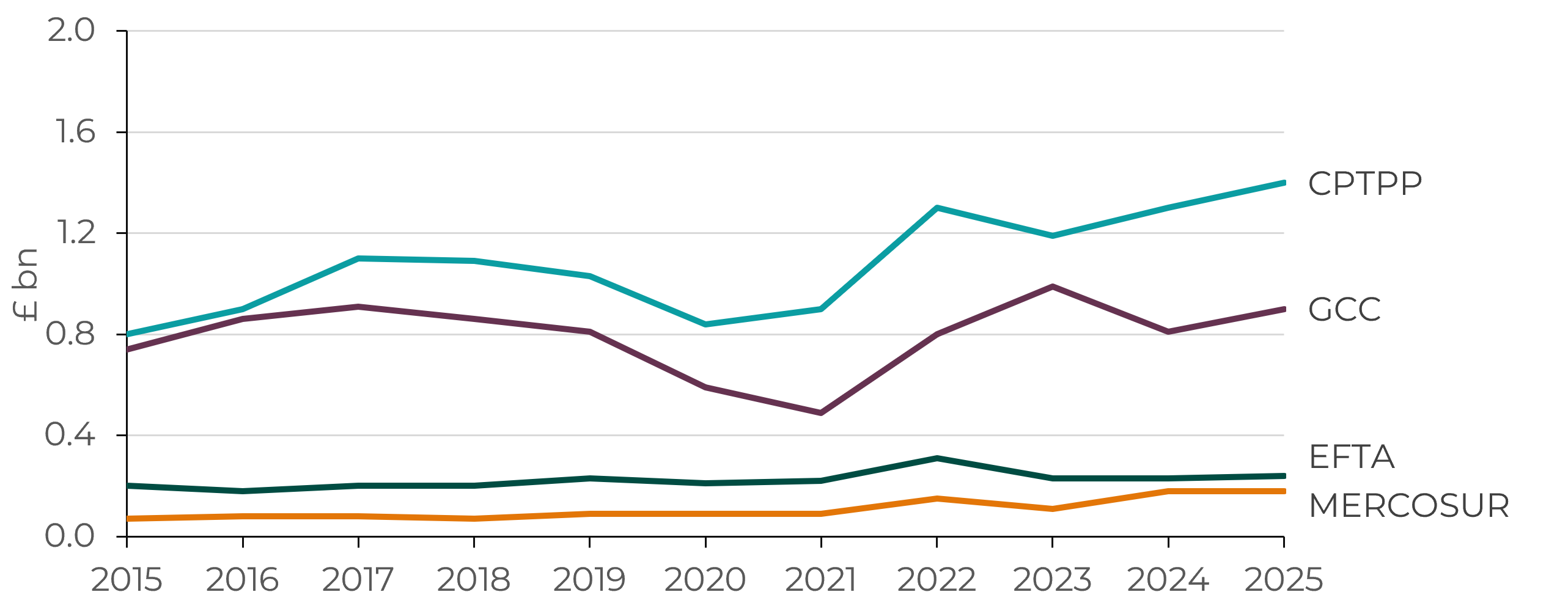
Due to the gap in value between the EU and the other trade blocs, Figure 8 shows the non-EU blocs in greater detail. It shows a modest increase in the value of exports to the CPTPP, following the ascension of the UK to the bloc in 2024.
Figure 8: Exports to key non-EU trade blocs, (by value; 2015-2025)
Source: International goods trade: interactive dashboard (Welsh Government, 2026)
Figure 9 shows the value of imports between Wales and key trading blocs over a 10-year period.
Figure 9: Imports by value to key trade blocs (2015-2025)
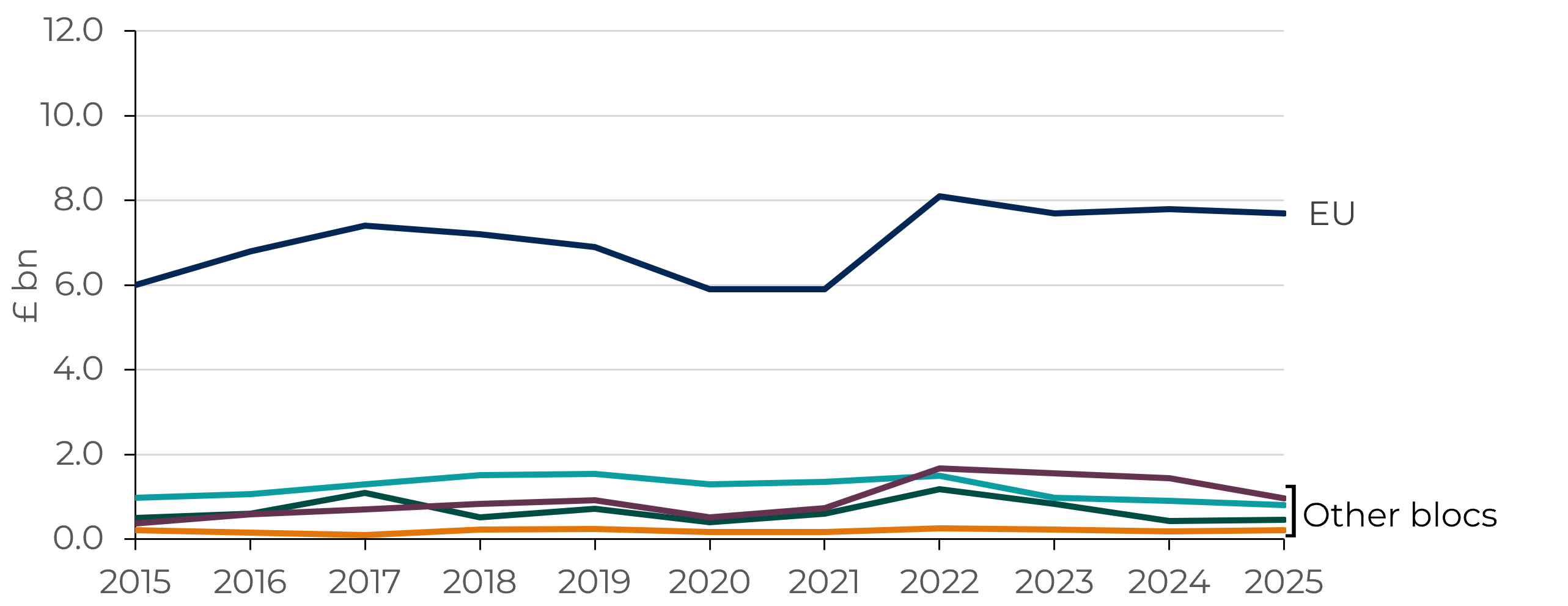
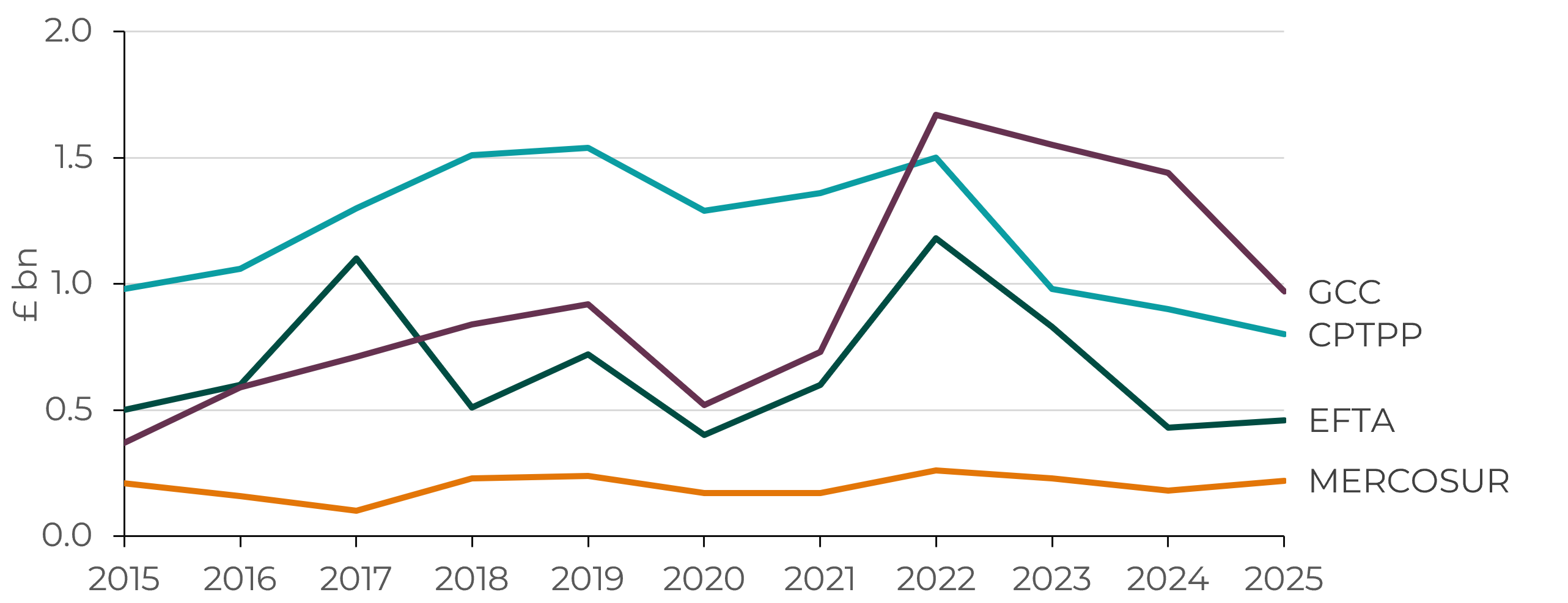
As above, Figure 10 offers a closer inspection of non-EU trade blocs. Imports from the CPTPP have decreased since UK ascension.
Source: International goods trade: interactive dashboard (Welsh Government, 2026)
Figure 10: Imports by value to non-EU trade blocs (2015-2025)
Source: International goods trade: interactive dashboard (Welsh Government, 2026)
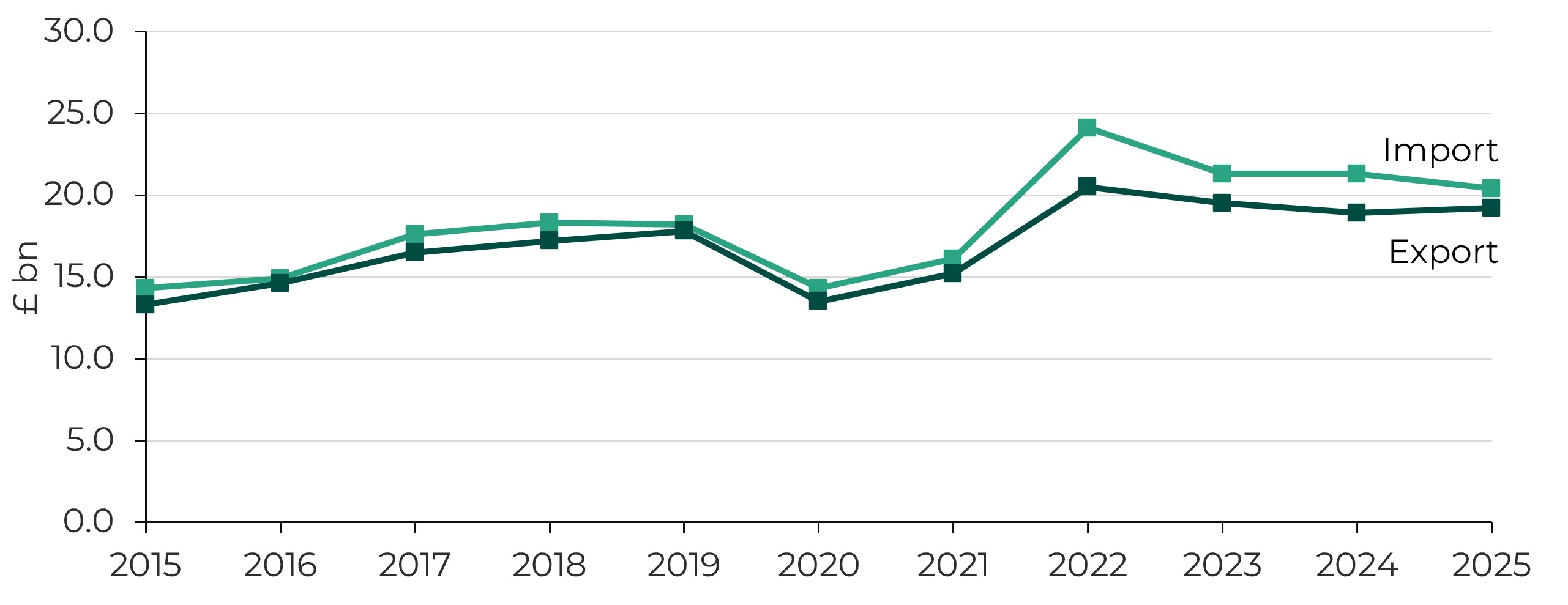
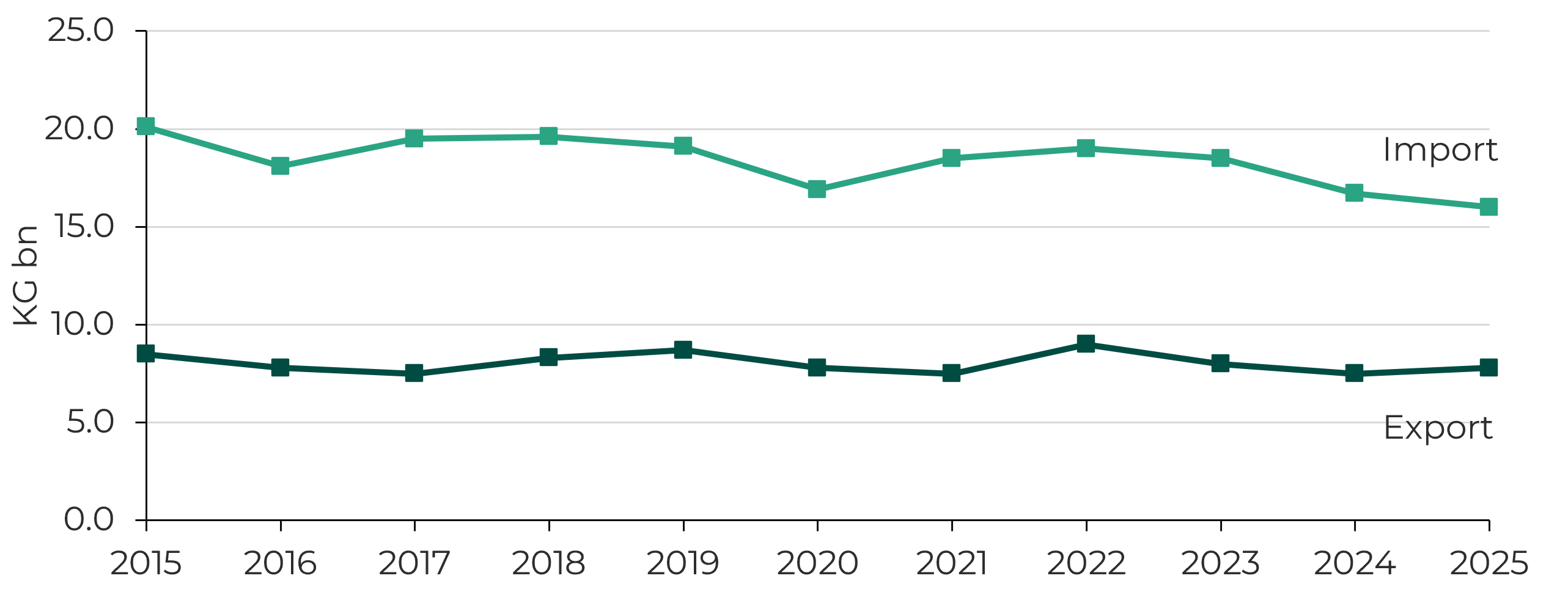
Welsh trade in goods, by value and volume, over the last 10-year period is captured in Figure 11 and Figure 12.
Figure 11: Trade in goods by value (2015-2025)
Source: International goods trade: interactive dashboard (Welsh Government, 2026)
The charts (both above and below) indicate that Wales consistently imports more than it exports, by both volume and value, and so runs a trade deficit with most countries . A trade deficit happens when a country imports more than it exports, while a trade surplus happens when it exports more than it imports. However, the EU is an important exception where Wales does run a trade surplus.
Figure 12: Trade in goods by volume over 10-year period (2015-2025)
Source: International goods trade: interactive dashboard (Welsh Government, 2026)
The table below shows the current status of UK trade negotiations, as well as the corresponding Welsh Government response where one exists.
|
Country |
Update |
Welsh Government Response |
|
Türkiye |
Fifth negotiation round: 15 - 23 June 2026.
|
No Welsh Government statement |
|
Greenland |
Trade talks resumed: October 2025
|
No Welsh Government statement |
|
Israel |
Trade talks suspended: May 2025
|
Previous Welsh Government statement (July 2022) |
The UK Government has concluded nine new trade deals since Brexit, and these are listed in the table below. The previous Welsh Government often published ‘perspective’ documents on negotiated deals and these are shown on the table below, where available.
|
Country |
Date signed |
Entry into force |
Welsh Government Response |
|
Not yet signed |
Not yet in force |
||
|
May 2026 |
Not yet in force |
Welsh Government written statement (May 2026) |
|
|
July 2024 |
July 2026 |
Previous Welsh Government perspective document (February 2026) |
|
|
December 2025 |
Not yet in force |
No Welsh Government perspective document |
|
|
July 2023 |
December 2024 |
Previous Welsh Government perspective document (October 2023) |
|
|
May 2025 |
Ongoing |
||
|
February 2022 |
May 2023 |
Previous Welsh Government perspective document (July 2022) |
|
|
December 2021 |
May 2023 |
||
|
December 2020
|
January 2021
|
Previous Welsh Government analysis of the TCA (February 2021) |
|
|
October 2020 |
January 2021 |
Previous Welsh Government assessment document (December 2020) |
Article by Maddy Phillips, Sara Moran, and Josh Jenkins, Senedd Research, Welsh Parliament