








Wales’ educational performance in three core areas has deteriorated further in relation to the rest of the UK, as indicated by the results of an established international education programme. Wales’ scores are however, closer to the average of countries taking part, although this is predominantly a result of the international average going down.
What is PISA?
The Programme for International Student Assessment (PISA) evaluates the education systems of countries based on the performance of a sample of 15-year-olds in standard tests. It is organised by the Organisational for Economic Co-operation and Development (OECD) and held every three years.
The previous cycle was due in 2021 but was delayed a year to 2022 because of the COVID-19 pandemic. More than 760,000 students across 91 countries took part in 2025.
There are three core domains in PISA: reading, mathematics and dcience, with science being the lead domain in 2025. The OECD says PISA assesses the extent to which 15-year-olds “have acquired key knowledge and skills essential for full participation in social and economic life” and how they “apply their … knowledge and skills to real-world challenges”.
Both globally and domestically, there is a lot of attention on countries' top-line PISA scores and rankings, but the programme also provides a range of other information and analysis. The overall purpose of PISA is to help governments improve the education of their young people.
The 2025 results in summary
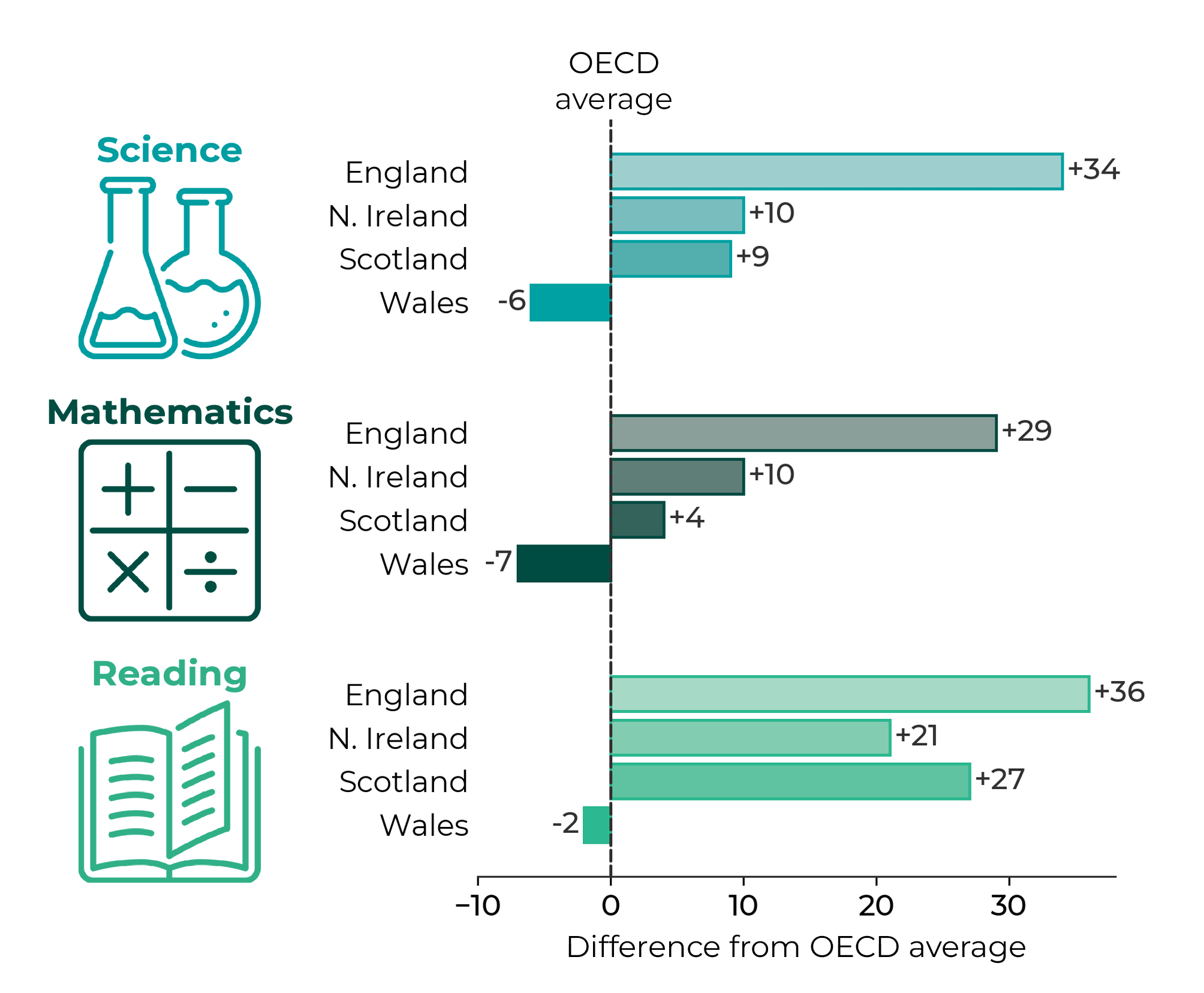
Wales’ PISA scores have been the lowest in the UK for many years. They are ‘significantly’ lower than the other UK nations in all three domains, and significantly lower than the OECD average in mathematics and science. However, there is no significant difference compared to the OECD average in reading.
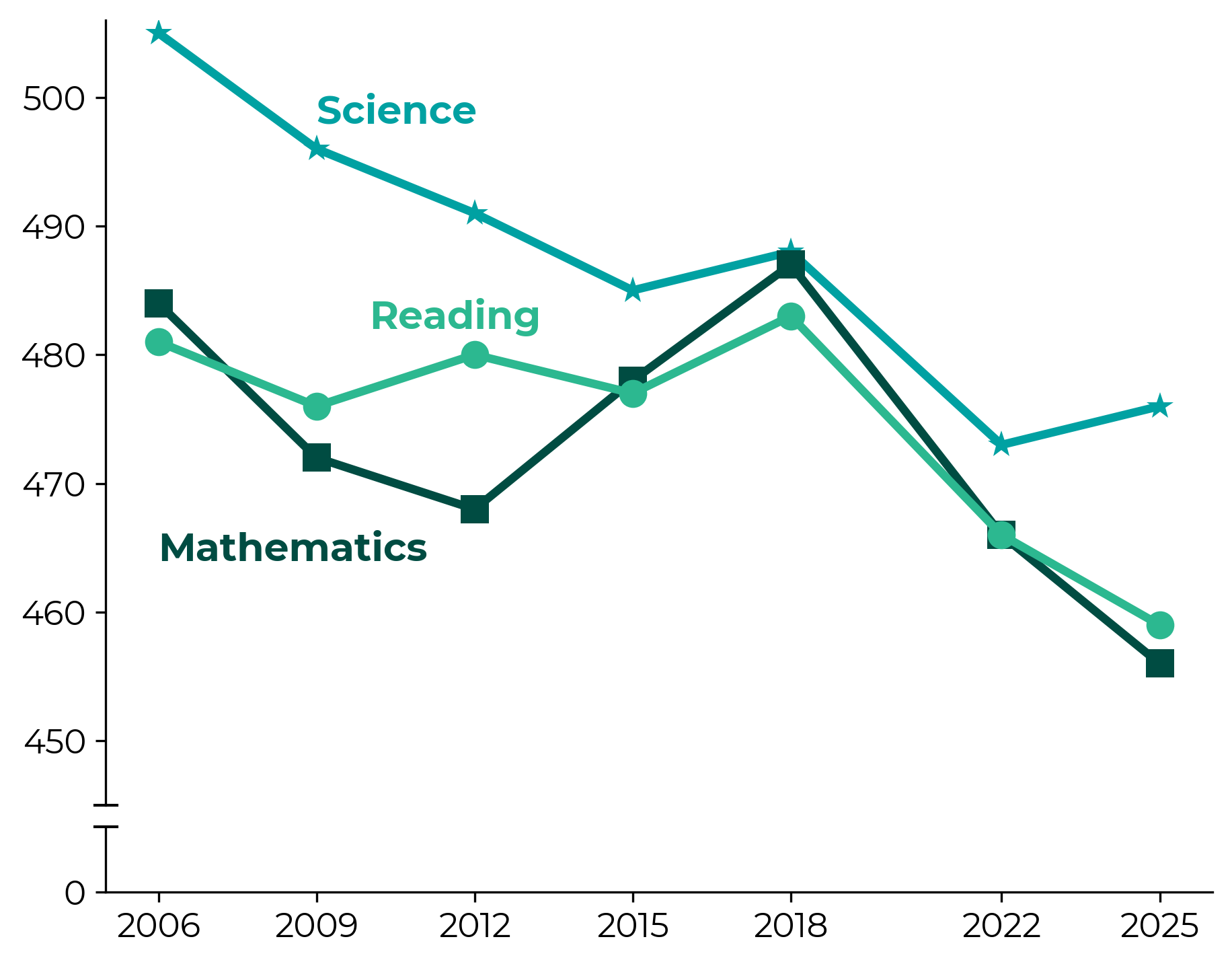
- Other than in relation to science in 2022, Wales’ scores in all three domains are the lowest they have ever been since first participating in PISA in 2006.
- Wales’ scores in mathematics and reading have decreased since 2022 by 10 and 7 points respectively, while its score in science has risen by 3 points.
- In 2022, Wales’ scores were 10 points lower than the next lowest UK nation in science, 5 points lower in mathematics and 19 points lower in reading. In 2025, the difference is 15 points in science, 11 points in mathematics and 23 points in reading.
- Back in 2018, Wales’ performance had improved relative to the OECD average such that there was no significant difference. In 2022, Wales’ scores were again significantly lower than the OECD average and this is also the case in 2025 for science and mathematics, although not for reading.
The Cabinet Minister for Education and the Welsh Language, Anna Brychan MS, says the latest results largely “reinforce what we knew already and highlight our need to improve standards of reading and maths, as a priority”. She also says “there will be no knee-jerk response to the results and that plans are in place to support schools to raise standards”. While acknowledging that the results “are not where anyone in education would want them to be”, the Welsh Government highlights Wales’ comparative effectiveness in supporting the most disadvantaged learners.
The official report on Wales’ results, produced by UCL Institute of Education and the University of Oxford, provides further information and analysis on a range of aspects of PISA.
Table 1: Wales' mean scores in PISA over time
| Science | Mathematics | Reading | |
| 2025 | 476 | 456 | 459 |
| 2022 | 473 | 466 | 466 |
| 2018 | 488 | 487 | 483 |
| 2015 | 485 | 478 | 477 |
| 2012 | 491 | 468 | 480 |
| 2009 | 496 | 472 | 476 |
| 2006 | 505 | 484 | 481 |
Source: Welsh Government, PISA national reports, (several editions)
Table 2: UK nations' mean scores in PISA 2025
| Science | Mathematics | Reading | |
| Wales | 476 | 456 | 459 |
| England | 516 | 492 | 497 |
| Northern Ireland | 492 | 473 | 482 |
| Scotland | 491 | 467 | 488 |
| OECD | 482 | 463 | 461 |
Source: Welsh Government, PISA 2025: national report for Wales, September 2026
Wales’ PISA scores over time
Wales’ PISA scores compared
What is PISA’s influence in Wales?
Wales has participated in PISA since 2006. PISA and the OECD have had a considerable influence on Welsh education policy for over a decade and a half, since the 2009 results delivered what the Education Minister at the time called a “wake up call to a complacent system” and "evidence of systemic failure”. Previous Welsh Governments asked the OECD to help steer their approach to school improvement, with OECD reports in 2014 and 2017 informing previous education action plans and a 2020 report on the introduction of the Curriculum for Wales.
In the past, the Welsh Government had stated ambitions to increase Wales’ position in the international rankings and increase scores in each of the three domains. However, such quantifiable targets were discontinued and the previous Welsh Government’s objective, as set out following the last cycle of results in December 2023 was to “see continuous improvement in all three domains”.
In June, the Cabinet Minister for Education and the Welsh Language, Anna Brychan MS, outlined her priorities upon coming into post. In relation to the upcoming PISA results, she said:
I will very deliberately take the most meaningful information from that. It's about more than just numbers. There’s a lot of data that we can use there, and we can use that meaningfully in order to inform our numeracy and literacy plans.
How many pupils took the PISA tests and how were they selected?
3,406 pupils aged 15, in 113 schools across Wales, took the PISA 2025 tests in September and October 2025, during a two hour computer-based exercise. These pupils were in Year 11 and due to complete their GCSEs in summer 2026. This is the last cohort that did not study the Curriculum for Wales, which was phased in between 2022 and 2025. For context, there are around 33,000 pupils in Year 11 in 173 secondary and 31 middle schools across Wales.
Sampling details for PISA 2025 are given at section 1.3.4 of the national report for Wales.
Do schools and pupils prepare for PISA tests?
Answering a written Senedd question in autumn 2025, the then Cabinet Secretary for Education, Lynne Neagle MS, said schools and pupils weren’t expected to prepare for the PISA tests. Schools were offered optional pre-recorded lessons to give information about the programme and the question format but pupils were told that no preparation or revision was needed.
Based on a sample, the programme is intended to be a snapshot of the skills of 15-year-olds across the country, rather than a test of any pupil individually. The then Cabinet Minister added that PISA is not used for school accountability.
PISA isn’t the only measure
Other measures of educational performance, such as GCSEs, A Levels, vocational qualifications and personalised assessments taken by pupils in Years 2 to 9 in reading and numeracy are arguably more important to the people undertaking them and the professionals teaching them. Indeed, some people, both internationally and in Wales, have highlighted PISA’s shortcomings.
We published articles last month regarding GCSE and A level results, and the Welsh Government publishes annual data on reading and numeracy personalised assessments.
Another important measure of standards is provided by the education inspectorate, Estyn, which inspects and reports on the quality of provision and outcomes in schools and other settings. Estyn’s Chief Inspector published his latest annual report (for 2024/25) in February 2026 and is expected to issue an early insight on 2025/26 over next couple of months.
The Welsh Government’s school improvement agenda
We’ve written previously about the ‘national mission’ of successive Welsh Governments to improve schools and raise standards. This imperative has been brought about, or at least brought into sharper focus, by disappointing PISA results. In its scrutiny of this area, the Sixth Senedd’s Children, Young People and Education Committee wrote to the then Cabinet Secretary in January 2026 with its observations and recommendations and received a response in March. Issues raised included national age-related expectations for literacy and numeracy, as well as approaches to teaching children how to read.
Many will be concerned at the scale of the challenges these PISA results indicate still need to be overcome, despite many initiatives over many years. The new Welsh Government has “Raising standards in our schools and ensuring the best conditions for learning” as one of its six priorities for government. Commitments include developing a new ‘Foundational Literacy and Numeracy Plan', which is due to be published this autumn.
Article by Michael Dauncey, Senedd Research, Welsh Parliament