








Soil plays an important role in food production, flood prevention and carbon storage, but it is not a renewable resource. Only 10-15% of Welsh land has high quality soil for growing and much of this is vulnerable to degradation. Whilst there have been some actions by the Welsh Government to safeguard Welsh soils, many stakeholders are asking for further protections.
The Economy Trade and Rural Affairs (ETRA) Committee explored some of these issues in its inquiry into soil health in agriculture. Its report, to which the government has responded, will be debated in Plenary next week.
Why are soils important?
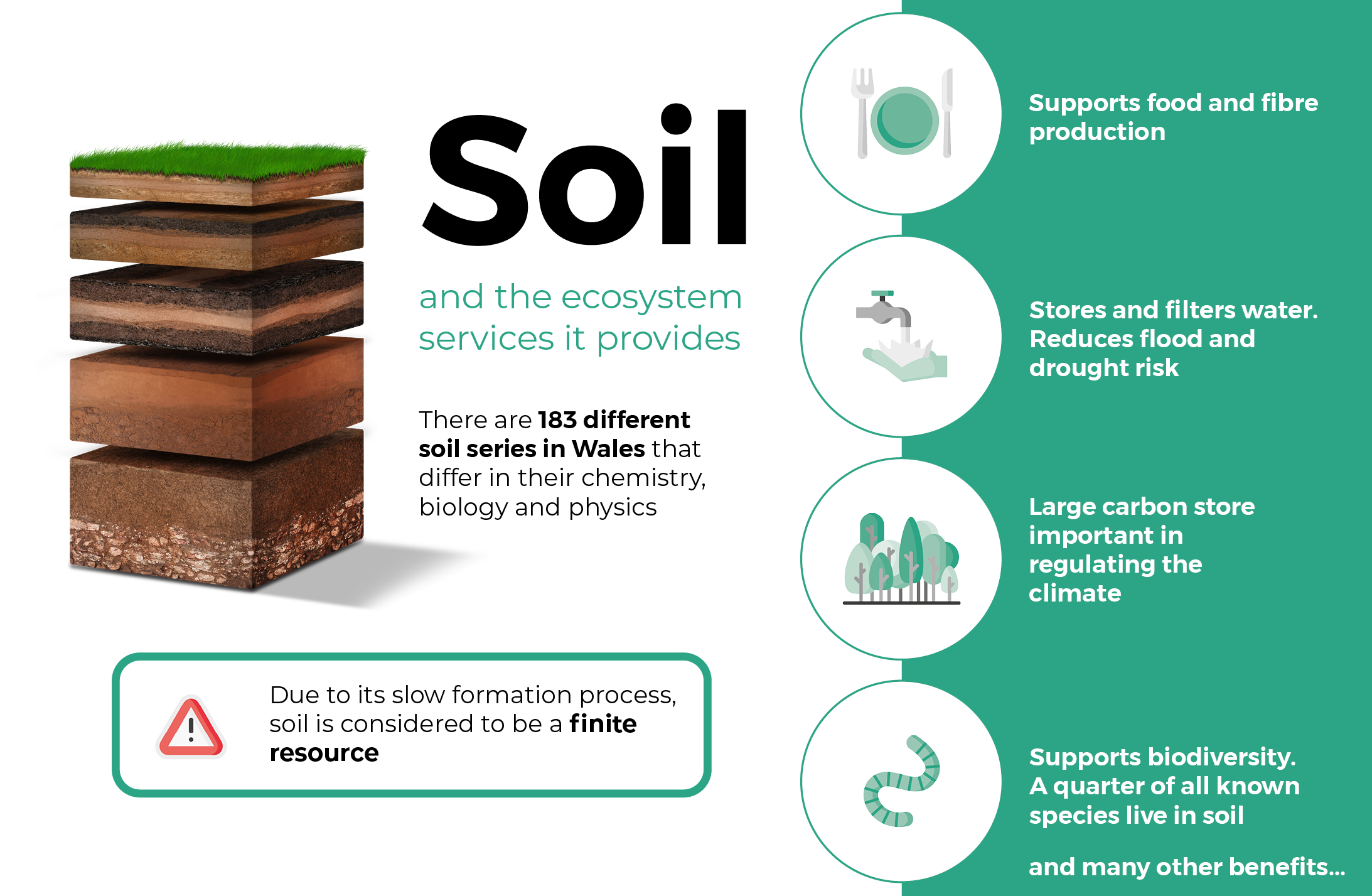
Soils represent at least 80% of the land area in Wales and have an important role in food/fibre production, water quality, flood prevention, biodiversity restoration and carbon storage. Evidence shows healthy soils are key in ensuring agricultural systems are resilient to the impacts of climate change, such as increased flooding and drought.
Figure 1 - Soil and the ecosystem services it provides
Source: Welsh Government
Soil is not a renewable resource. Professor Bridget Emmett, a principal scientist at the UK Centre for Ecology and Hydrology, told members of the ETRA Committee that soil forms so slowly that “every bit of soil out there has been formed in the last 11,000 years”.
In the UK, soil - including peatlands - store about 94% of land-based carbon. This means soils, especially grasslands, can play a role in carbon storage. Increasing the soil carbon pool through land management change is considered one option to help balance emissions to achieve Net Zero.
Some evidence shows the potential for additional carbon storage within Welsh soils is limited due to carbon ‘saturation’. However the Carbon Sequestration Panel (informing the Sustainable Farming Scheme (SFS)’s development) found a mixture of opinions and research on the carbon saturation point of soils.
Regardless of the potential for additional carbon sequestration (storage), research suggests that stores of carbon in our soils are often easier to protect than rebuild.
The Synthesis of Welsh Soil Evidence in 2022 emphasised the importance of soil, and the Welsh Government’s Agricultural Soil Policy Statement (2025) highlights the emerging threats facing Welsh soils: climate change and agricultural management change.
The state of soils in Wales
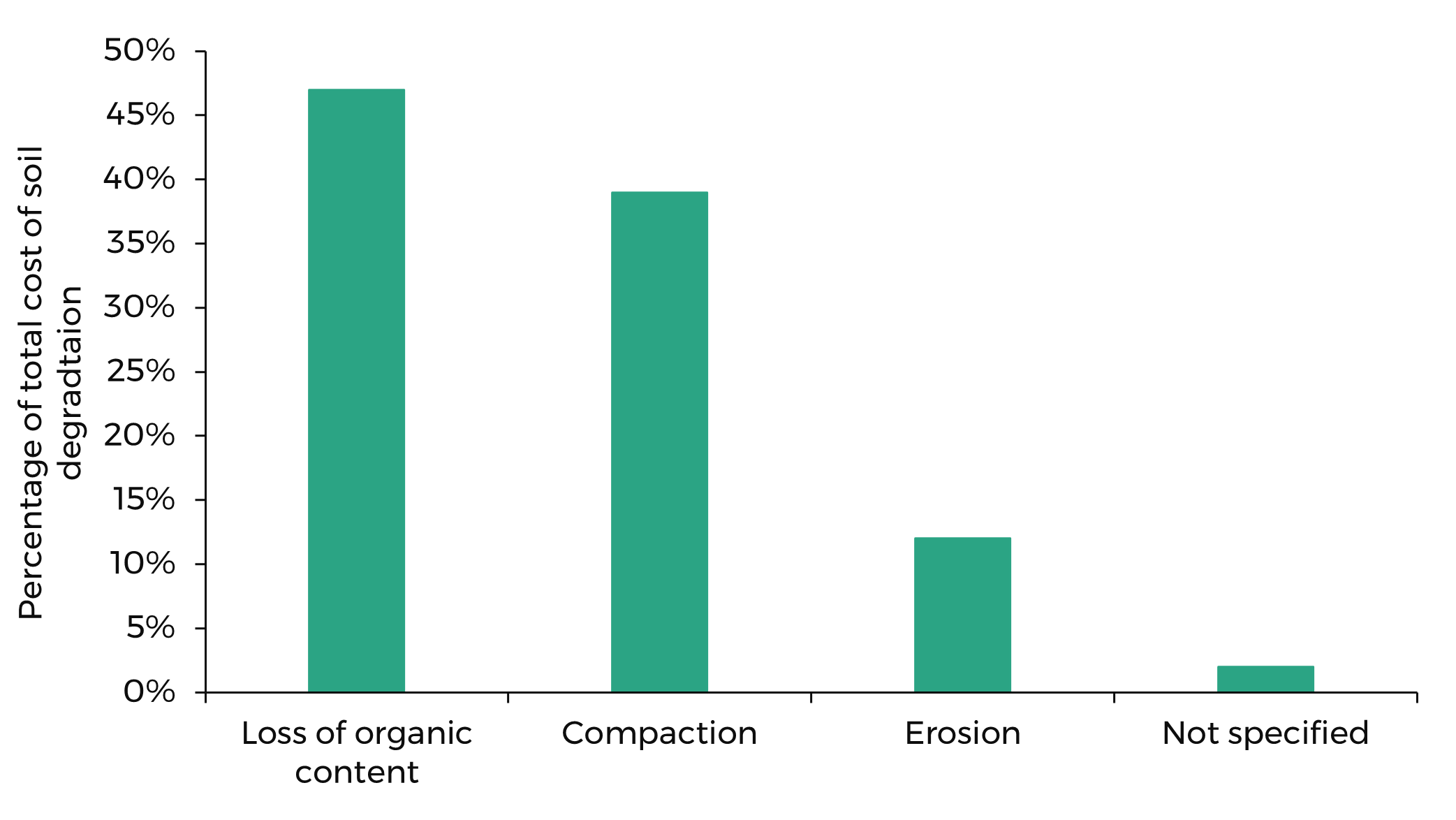
The annual cost of soil degradation (declining quality) across Wales and England is estimated to be £1.2bn. In the UK, the main soil degradation processes of concern are the loss of soil organic matter and compaction. Compaction can occur from livestock and machinery compressing the soil, which reduces the movement of water, air and nutrients.
Without soil organic matter decomposition, soils will be less nutrient-rich and as a result, less fertile, threatening crop growth and the provision of other ecosystem services.
Figure 2 – Percentage of total cost (£1.2bn) of soil degradation across categories, UK wide data
Source: Natural Resources Wales
In Wales, most agricultural land is grassland, with permanent grassland making up 63%, rough grazing 15% and new grazing 9% of land use on agricultural holdings in 2020. Grassland is to be at a lower risk of soil degradation, but even so, the intensity of management within grassland systems can affect the soil degradation risk.
Currently, data indicates that about 7% of land in Wales is susceptible to high erosion rates and around 40% of Welsh soils are considered potentially vulnerable to compaction.
The Environment and Rural Affairs Monitoring and Modelling Programme (ERAMMP), funded by the Welsh Government, provides scientific evidence to support the development and evaluation of land use policies.
Three common soil health indicators, measured by ERAMMP and set out below, have seen an increase since records began (1978) but have declined in more recent surveys (2013-2016 and 2021-2023).
Figure 3 – Change in three different soil health indicators, 1970-2023, Wales data
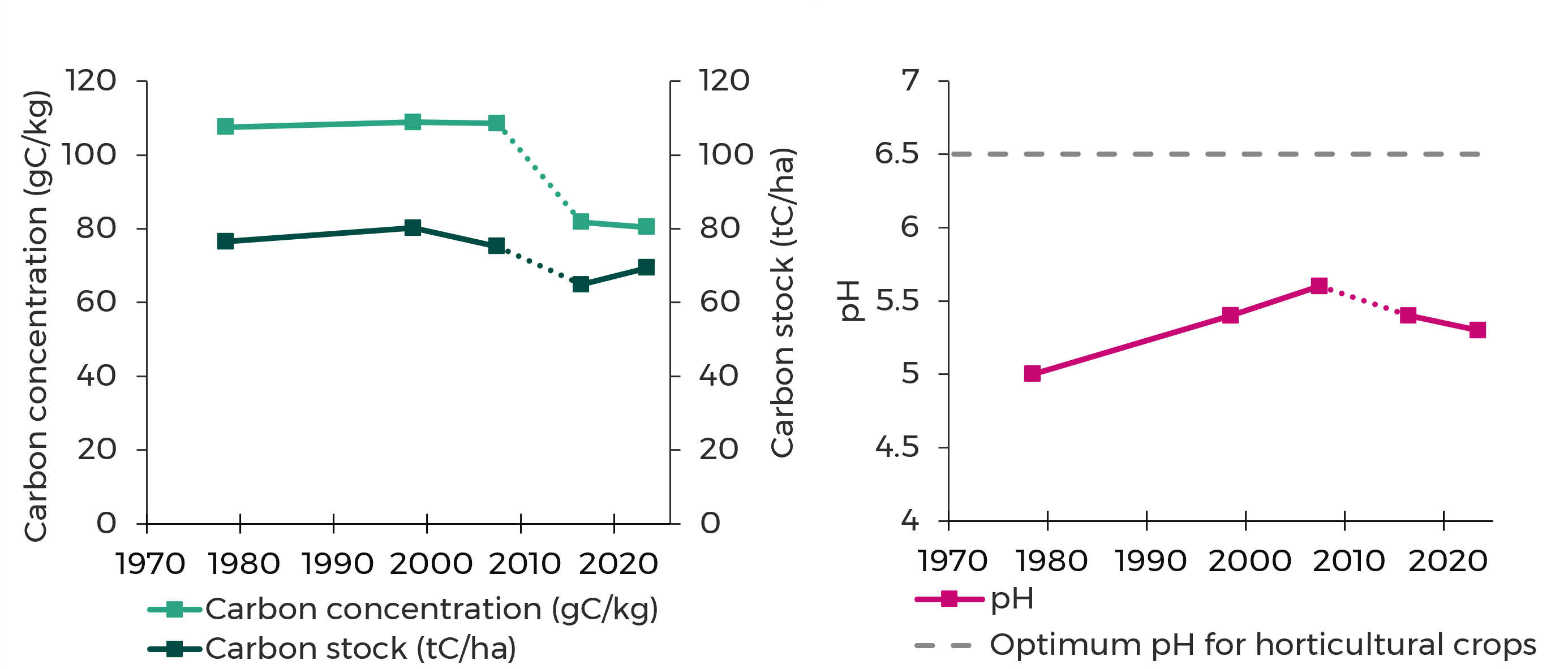
Source: ERAMMP, note that points from 1978-2007 were recorded as part of the Countryside Survey for Wales, the point at 2015 is the average from the Glastir Monitoring and Evaluation Programme (GMEP) (2013-2016) and the last point at 2023 is the average for each indicator from ERAMMP’s own monitoring (2021-2023). The dashed line shows potential trend based on existing data for periods of time where data gaps occur. Due to similar programme designs, results from the last 10 years (GMEP and ERAMMP) can be compared with those from the historic Countryside Survey
Soil health indicators
|
The Sustainable Farming Scheme (SFS)
The SFS is expected to be a key policy mechanism for protecting soils. Universal Action 1 is based around soil testing. However, there are calls for more to be done for soil health as part of the scheme.
The question of what happens as a result of the data collected during soil testing was raised in the ETRA Committee inquiry. The Nature Friendly Farming Network cautioned that soil testing alone will not deliver healthier soils, and the Soil Association mentioned potential issues with the logistics of sampling and interpreting the results.
NFU Cymru and Farmers’ Union of Wales (FUW) told the Committee that tenant farmers with short contracts are less likely to undertake soil testing because they may not have time to react it, and may not see the benefits if they do.
The Committee recommended that statutory standards for soils be placed on all farmers, with the aim of ensuring farmers who choose not to join the SFS still protect their soil’s health. This included putting standards for soil cover and soil erosion on a statutory footing.
The protection of soils through planning
The Agricultural Land Classification (ALC) system provides a method for assessing the quality (including soil quality) of farmland in England and Wales. The ALC grades land from Grade 1 - top quality food-growing, to Grade 5 - very poor quality, rough ground.
Only 10-15% of the land area in Wales is classified as ‘Best and Most Versatile’ (BMV) land. BMV land is defined by ALC grades 1, 2 and 3a.
Figure 4 – Agricultural Land Classification grades, Wales
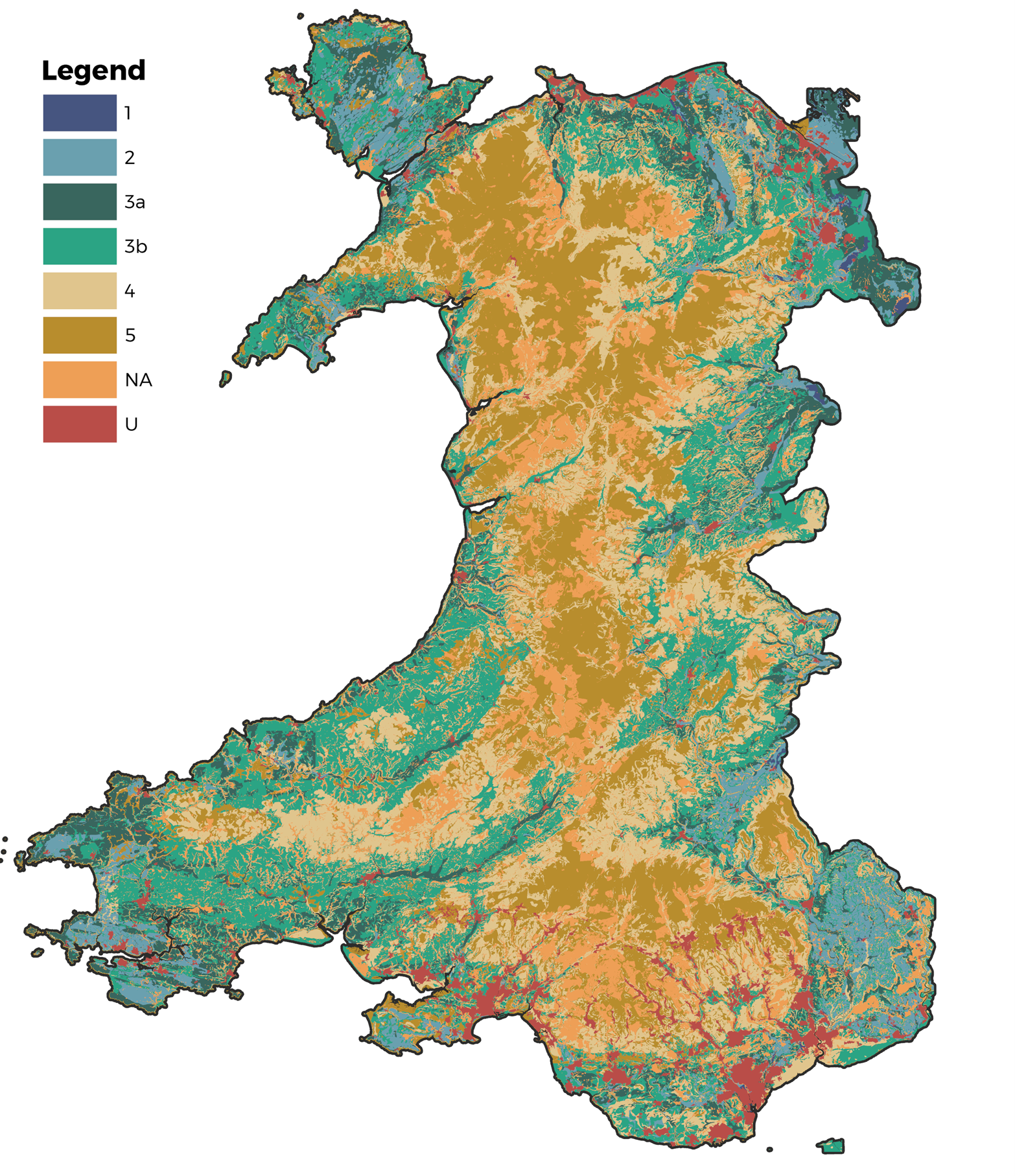
Source: DataMapWales, legend shows ALC grades. NA shows non-agricultural land and U shows urban land.
Planning Policy Wales states that BMV agricultural land is:
… the best and most versatile, and should be conserved as a finite resource for the future
and that:
… considerable weight should be given to protecting such land from development, because of its special importance
In written evidence submitted to the ETRA Committee, Professor Bridget Emmett discussed how urban development is encroaching on improved agricultural land.
FUW’s evidence paper stated that grades of land other than BMV land should not be disregarded or left unprotected for food production.
The Welsh Government is considering the development of a soil functions and services map of Wales. Its soil function maps review in July 2024 stated:
… the aim of the map will be to provide best available information to support and balance land use decisions where trade-offs between soil functions and land use demands compete….The map will allow specialists and non-specialists to understand and quantify the impact of land use and policy decisions on a range of soil functions and services.
The ETRA Committee has recommended that the Welsh Government develops a framework to support planning officers when making decisions to protect the best soils for agricultural use. The Senedd is due to debate the issue of soil health next week. You can watch the debate on Senedd TV.
Article by Liesl van de Vyver Blackman and Dr Katy Orford, Senedd Research, Welsh Parliament
Senedd Research acknowledges the parliamentary fellowship provided to Liesl van de Vyver Blackman by the Natural Environment Research Council (NERC) which enabled this research article to be completed.
