








Maternity and neonatal services support pregnant women, babies and families through pregnancy, birth and the first weeks of life. While many families receive safe and compassionate care, there is widespread recognition across the UK that improvements are needed.
Recent reviews and inquiries across the UK have raised serious concerns about the safety and quality of maternity care. In February 2026, a national assurance assessment identified key vulnerabilities and weaknesses within maternity services in Wales.
Ahead of a Plenary debate on stillbirth and neonatal mortality on 24 June, this article explores the key trends contributing to pressures on maternity services, issues identified from recent reviews in Wales, and recent actions and developments.
Please note, this article refers to baby loss.
A changing context
Maternity and neonatal services have had to adapt in recent decades to changing demands for care and shifting demographics.
The number of babies born in Wales decreased by 20% between 2014 and 2024, mirroring trends seen elsewhere in the UK. However, fewer births have not necessarily meant reduced pressure on services. The profile of pregnant women and the care being provided have changed significantly. In particular:
- Women are generally giving birth at older ages. Around 55% of women giving birth in Wales are aged 30 or over, compared with 42% in 2011.
- Some health risk factors are becoming more prevalent. A third of pregnant women (32%) are classed as being obese based on a calculation of Body Mass Index (BMI), and around a third (32%) report having a mental health condition.
- Medical interventions during birth have increased rapidly. The proportion of deliveries by caesarean section in Wales has risen by 12% since 2016, in line with trends in other parts of the UK. Just over half of caesarean births are emergencies.
Figure 1: Percentage of births by mode of delivery, 2016 – 2024
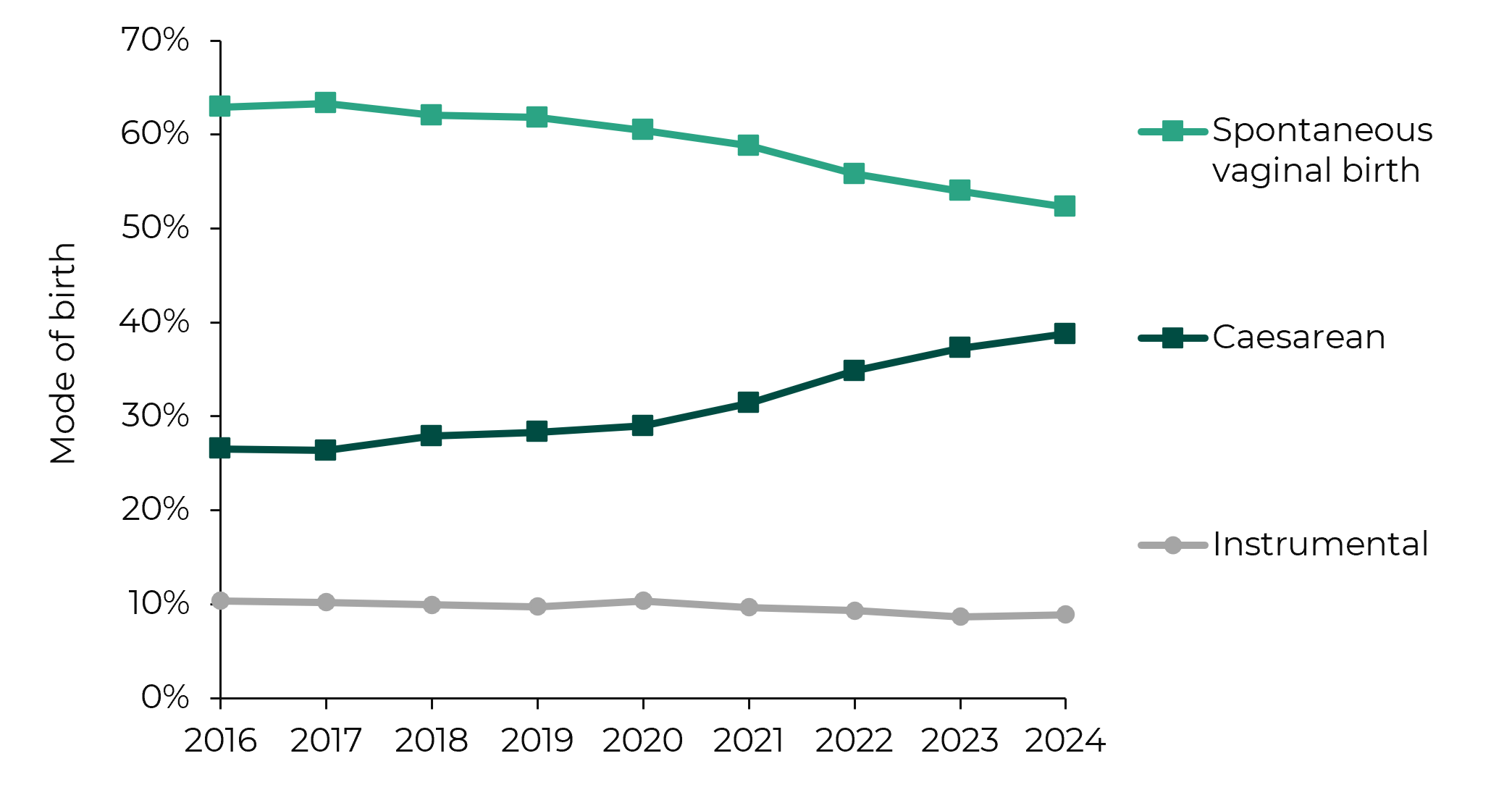
Source: Live and still births by mode of birth and local health board, StatsWales. Percentages are based on records with valid data for mode of birth reported by the 6 health boards (see quality report). Instrumental delivery refers to deliveries which are assisted through the use of forceps or ventouse.
These factors can lead to more complex care needs, either due to a higher likelihood of developing complications during pregnancy or birth, increasing the need for specialist input, or because they can contribute to longer hospital stays and require greater support from healthcare staff.
Progress and persistent inequalities
There has been a slight decline in the number of stillbirths and neonatal deaths in Wales since 2010. However, rates of stillbirth are still higher than in the other UK nations, and there has been limited progress in reducing neonatal mortality rates.
Figure 2: Rates of stillbirth and neonatal mortality in Wales, 2010 - 2024
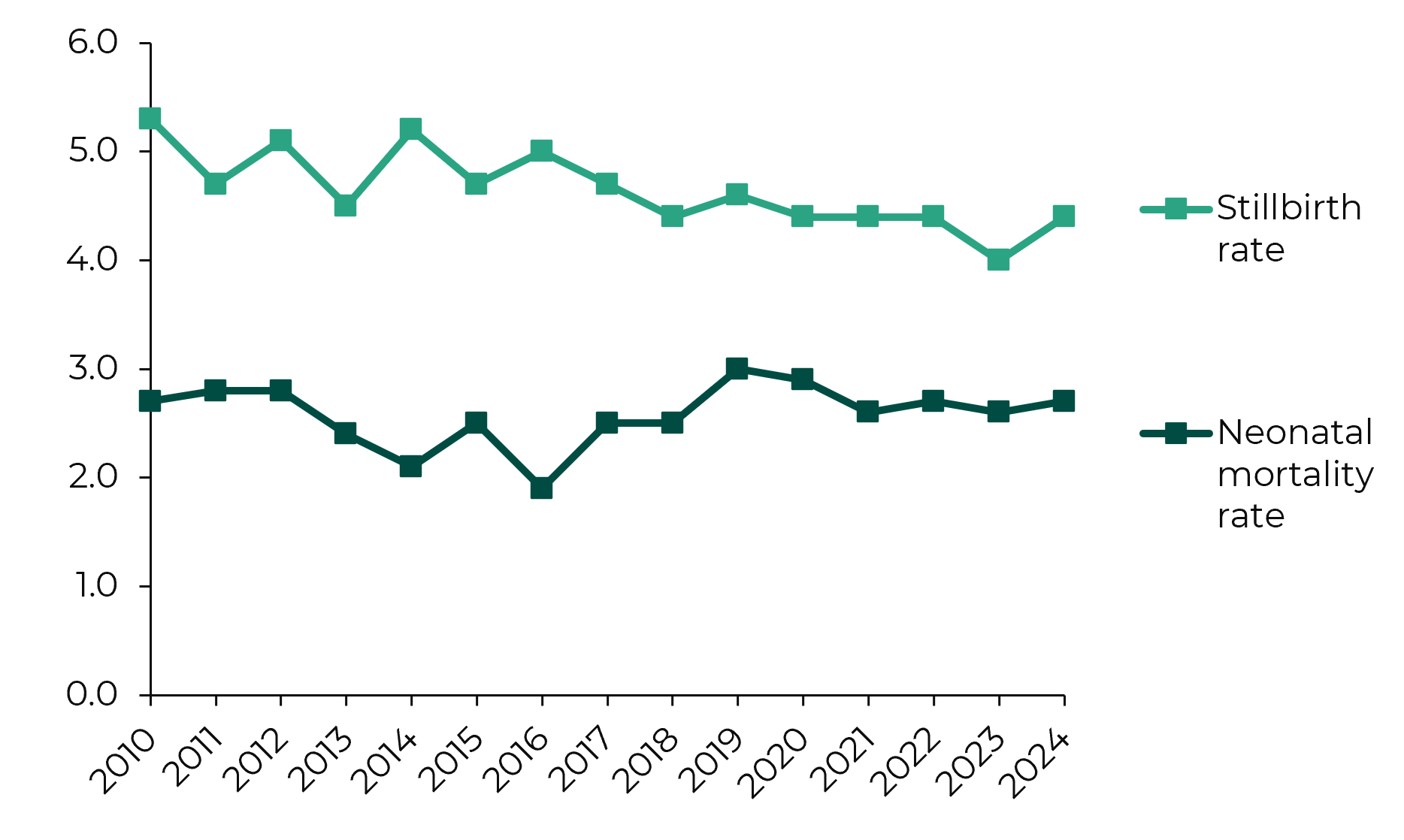
Source: Child and infant mortality (by year of death,) England and Wales, ONS.
Neonatal mortality rates refer to deaths within the first 28 days of life, per 1,000 live births. Stillbirth rates refer to the death of a baby after 24 weeks of pregnancy (before or during birth), per 1,000 total births.
There are stark inequalities in birth outcomes. Mortality rates are much higher for babies born to mothers living in the most deprived areas, compared with the least deprived. Babies of Black and Asian ethnicity experience higher mortality rates than babies of White ethnicity, and Black women experience the highest rates of maternal mortality. There is also a growing recognition of the significant physical and psychological impacts of traumatic birth experiences.
Pregnancy and baby loss charities such as Tommy’s and Sands have called for the Welsh Government to adopt ambitious targets to save more babies’ lives, and to tackle inequalities in birth experiences and outcomes.
Quality and safety concerns
In Wales, concerns about the quality and safety of maternity and neonatal services have been highlighted repeatedly in national and local reviews. Key reports include:
- An independent national assurance assessment commissioned by the previous Welsh Government (published in February 2026);
- An improvement discovery phase report from Public Health Wales and Improvement Cymru (published in July 2023); and
- A national review of maternity services by Healthcare Inspectorate Wales (published in November 2020)
Reports from Llais and Healthcare Inspectorate Wales (HIW) have also highlighted challenges within particular health boards, as well as some evidence of improvements being made.
These reviews have frequently noted positive feedback from expectant mothers and new parents, and identified a strong commitment among staff to providing high-quality care. However, they also identify a wide range of areas for improvement. Some key themes include:
- Providing respectful and individualised care – issues raised include limited capacity for postnatal care, unmet mental health needs, a lack of consistency in providing continuity of care, and examples of disrespectful treatment, women not being listened to, or distressing experiences for bereaved families.
- Ensuring safe and effective care – staffing pressures are a key concern, but reviews have also identified issues with equipment and working environments, processes for reporting and learning from safety incidents, and the organisation and staffing of triage and other time-critical pathways.
- Building a safe and supportive work culture – the assurance assessment found staff do not consistently feel safe to speak up, identified examples of an unsupportive or undermining culture, and suggested more work was needed to build trust and foster a climate of learning.
- Strengthening national leadership and oversight – the assurance assessment found that national governance structures “are widely seen and experienced as disjointed and unclear”. It recommended strengthened national oversight to drive improvements and ensure consistency in standards of care.
The challenges faced by maternity and neonatal services in Wales largely reflect those identified in other parts of the UK. In England, the National Maternity and Neonatal Investigation is due to publish recommendations aimed at driving improvements in care in June 2026. Both the Northern Ireland Executive and the Scottish Government have taken steps to review maternity service standards and oversee improvements in recent years.
Staffing levels and workforce challenges
Staffing pressures are a major theme in reports from across the UK. In Wales, the national assurance assessment found that:
“…the workforce is increasingly constrained by pressures that affect wellbeing, hinder professional development, and pose risks to their health and well-being, service sustainability, and the quality of care.”
Health boards use a workforce planning tool called Birthrate Plus, alongside local data, to estimate the number of midwives needed to provide safe and appropriate care. However, the assurance assessment found there was limited confidence in the tool within the sector, with concerns it underestimates current postnatal workload, and does not sufficiently recognise the need for the right skill mix across the midwifery workforce. The review also found high rates of sickness and maternity leave among staff were not fully factored into workforce calculations.
The previous Welsh Government had been in discussions with the UK Government on the development of a new multi-disciplinary workforce planning tool to be used across the UK.
However, the sector also faces broader challenges in attracting, recruiting and retaining staff, particularly given workload pressures. Between 2015 and 2023, 22.1% of midwives left NHS Wales within their first four years of service. At the same time, there have been gaps this year between the number of newly qualified graduates and the roles offered by NHS Wales, meaning new midwives have faced uncertainty over whether there are jobs available.
Next steps
In February 2026, the previous Welsh Government accepted all the recommendations made by the national assurance assessment in whole or in part. It published a new quality statement for maternity and neonatal services, and set out actions over a three-year period to drive improvements. Immediate steps included:
- Establishing a National Strategic Oversight Board, and a national forum to share best practice and key learnings;
- Scoping a national maternity triage line, with a report due to be provided to the Welsh Government in March 2026;
- Developing a perinatal workforce service specification, which had been due to be published in April 2026; and
- Establishing a task and finish group to review the best model of continuity of care, with a plan due in December 2026;
Health Education and Improvement Wales (HEIW) has also developed a Strategic Perinatal Workforce Plan for 2025 – 2028 which sets out actions to be taken in the coming years.
Given growing pressures and ongoing efforts across the UK to deliver improvements, maternity and neonatal care services are likely to remain high on the agenda. The focus is likely to be on whether planned actions lead to measurable improvements in safety, experiences and outcomes.
Article by Gwennan Hardy, Senedd Research, Welsh Parliament