








Today, every email sent, online search made, or webpage scrolled is processed in data centres: physical buildings that house computational equipment for storing, processing and sharing data.
Wales is already a significant location for data centres. The UK Government’s Department for Science, Innovation and Technology (DSIT) estimated that Wales had the highest data centre capacity outside London in Great Britain in 2024, with 154 megawatts (MW) capacity in Wales and 1,048 MW in London.
The data centre industry in Wales is undergoing a period of considerable expansion. Wales has multiple planned developments and two Artificial Intelligence Growth Zones (AIGZs), a UK Government initiative to accelerate the development of AI infrastructure including data centres, in North and South Wales.
Figures from planned developments suggest significant growth in data centre capacity, with two developments in Cardiff proposing 148 MW and 150 MW, one in Newport 200 MW, one in Bridgend around 600 MW and another on Anglesey 349 MW.
Analysis from the Department for Energy Security and Net Zero (DESNZ) found that data centre electricity consumption in south-west England and Wales doubled between 2020 and 2024.
Our briefing covers the economic opportunities emerging from data centres, sustainability challenges, planning, and potential impacts on communities.
Map of Data Centres in Wales
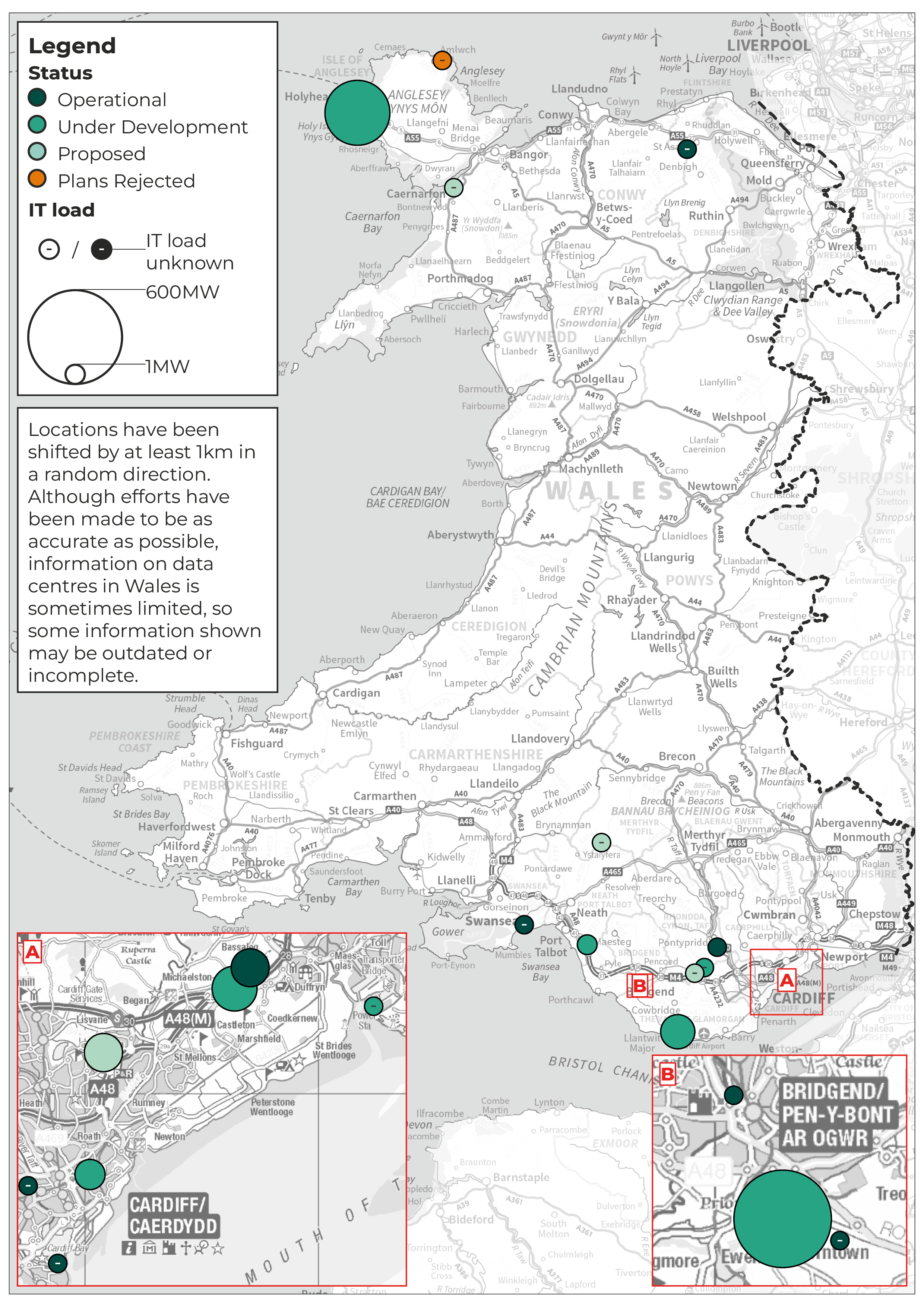
Data centres in Wales are mainly clustered in North and South Wales, where there are AIGZs. The map displays planned and operational data centres scaled by capacity.
Economic opportunities
Data centres can bring investment, temporary construction jobs, specialist career pathways, opportunities for skills development, and enhanced research support. The Wales Economic and Fiscal Report 2025 suggests data centres will become increasingly important to the Welsh economy by facilitating businesses’ digital operations, including AI adoption. The UK Government expects £10 billion of investment in the South Wales AIGZ and up to £100 billion overall from all AIGZs.
Once operational, data centres are highly automated and have a permanent on-site workforce which is smaller than might be expected given the significant amounts of land and resources they require.
The UK Government has said that the Welsh AIGZs could support around 3,400 jobs in North Wales and at least 5,000 in South Wales, which includes both temporary and permanent positions. It has also set aside £5 million in support of each AIGZ for business adoption and skills at a local level.
However, a report from Action to Protect Rural Scotland (APRS) published in March 2026 suggests that the UK Government is not estimating potential job creation from data centres accurately. Evidence from the US implies that data centres do create local jobs but less than is claimed by industry advocates.
Energy, water and infrastructure pressures
The scale of proposed development in Wales raises major questions around electricity demand, water consumption and grid capacity.
DSIT estimated Wales’s 2024 data centre capacity to be 154 megawatts (MW). Individual planned developments include proposals of 148 MW, 150 MW, 200 MW, 349 MW and around 600 MW, far exceeding the average “hyperscale” data centre capacity of 20 to 100 MW.
The UK Government has said that the South Wales AIGZ “has the potential to harness over 1 GW by early 2030s”, which is 13% of Wales’s total electricity capacity in 2024 (7.9 GW).
Data centres will need to be considered in Wales’s carbon budgets, which cap maximum permitted emissions across five-year periods. They could account for between 0.9% to 3.4% of the UK’s greenhouse gas emissions between 2025 and 2035, primarily due to the use of non-renewable electricity sources.
Industry experts suggest building data centres in regions of Wales with high availability of wind, hydro, nuclear and other low-carbon energy sources.
The UK Government lists lengthy connection queues to the electricity grid for AIGZs as the biggest roadblock for establishing AIGZs. In May 2026, the National Energy Systems Operator (NESO) had around 173 grid connection requests for new data centres equating to over 100 GW in the UK grid connection queue. Ofgem has said that there are too many data centres in the queue to connect to the grid.
Water is another important resource for data centres. Data centres consume water indirectly, through electricity generation and manufacturing, and directly, through liquid cooling. Liquid cooling is more efficient than air cooling because liquids are better at absorbing heat. It is used for AI equipment which includes high-density chips that get more hot than other computational equipment.
As more AI data centre developments get underway in Wales and projects grow larger in size, the use and scale of liquid cooling is likely to increase.
Land use and impacts on local communities
Data centres need access to suitable land and digital connectivity. They tend to be clustered around places that have access to existing internet connectivity infrastructure, such as cities like Bridgend, Cardiff and Newport. Many sites in Wales have been built on former industrial sites where developments can leverage existing land and grid assets.
Developments will also need to balance the benefits of proximity to resources such as water and renewable energy sources with impacts to biodiversity, given the Welsh Government’s targets to reverse biodiversity decline.
Local communities in Wales have been voicing concerns, and social acceptability of data centres is a growing issue globally. Internationally, some residents have criticised the “sheer scale” of data centres not being taken into account in planning processes. Data centres can also be a source of noise pollution, which has impacts on health and the environment.
Planning and policy outlook
Welsh planning policy does not currently explicitly mention data centres, unlike planning frameworks in England and Scotland. This means that planning authorities are not required to give specific weight to data centre needs when preparing policies or deciding applications.
As developments become increasingly large and nationally significant, questions arise about whether existing planning and infrastructure systems are equipped to balance economic benefits alongside energy, water, land, biodiversity, and community impacts.
The Cabinet Minister Adam Price MS says that it’s crucial Wales benefits from hosting data centre infrastructure. The extent to which this happens will impact on job creation, communities and whether data centres become locally accepted.
Article by Jessica Woodgate, Senedd Research, Welsh Parliament
Senedd Research acknowledges the parliamentary fellowship provided to Jessica Woodgate by PolicyBristol and the Research England Policy Support Fund, which enabled this Research Briefing to be completed.