








Many parts of Wales are affected by land contamination, often related to historical industrial activity. The contaminants can include a wide range of hazardous substances, from ‘forever chemicals’ to heavy metals. The potential impacts of land contamination on communities in Wales has recently been put into the spotlight.
This article provides an overview of potentially contaminated land in Wales, including how this land is remediated, key challenges involved, and potential solutions.
Contaminated land in Wales
There isn’t currently a clear picture of the number of potentially contaminated sites across the whole of Wales. Local authorities are primarily responsible for recording and managing sites and there is no central record.
Natural Resources Wales (NRW) published a survey of local authorities in 2016, which is the most recent national overview of contaminated land. This report identified 10,130 potentially contaminated sites in the 17 local authorities who responded. 800 of these sites had been subject to a detailed inspection, leaving over 9,000 sites awaiting inspection at the time of the report’s publication.
A 2025 Friends of the Earth Cymru analysis estimated that the number of potentially contaminated sites could be more than four times higher than the NRW estimate. It also found most local authorities had not updated their inspection strategies in the 10 years prior to the analysis.
Figure 1. Total number of registered contaminated land sites by local authority
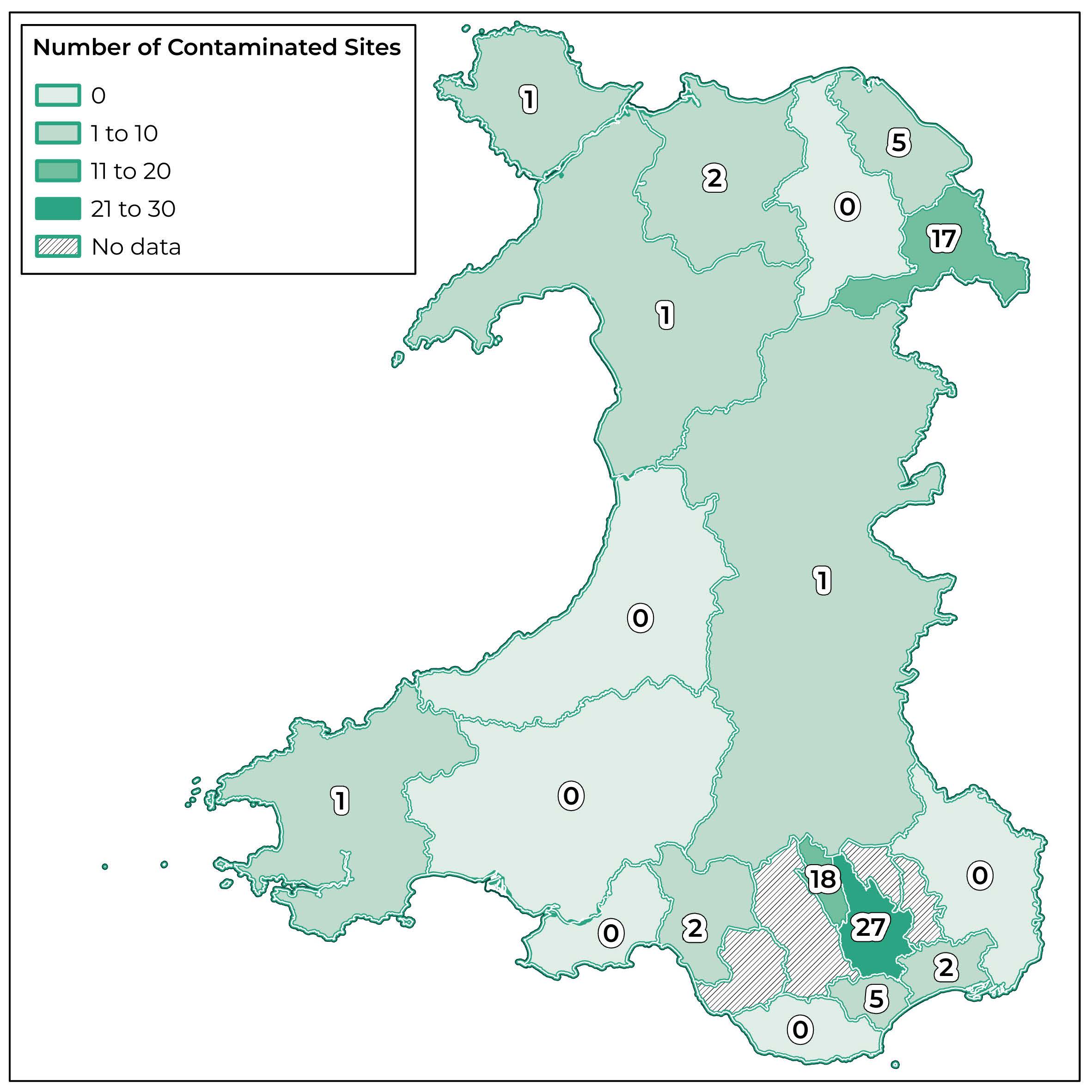
Source: Friends of the Earth Cymru freedom of information requests
A 2013 Welsh Government consultation on contaminated land found respondents considered the lack of Wales-level data, inconsistency between local authorities, and insufficient guidance to be amongst the biggest challenges to dealing with land contamination in Wales.
Various pollutants can make land contaminated. NRW’s 2016 survey identified the most common pollutants found in confirmed contaminated land sites, which are shown in the dropdown table below:
Table 1: Most commonly identified pollutants in contaminated land sites
|
Contaminant |
Type; example source(s) |
Potential health effects of chronic exposure |
|
Benzo(a)pyrene and other polycyclic aromatic hydrocarbons (PAHs) |
Organic (carbon-based) chemicals; By-products of gas- and metalworks. |
Varied depending on exact chemical nature, but include: respiratory and skin conditions including cancers, ischemic heart disease, depressed immune system. |
|
Lead |
Heavy metal; Mining and petroleum industries. |
|
|
Arsenic |
Metalloid; By-product of the metal industry. |
|
|
Total petroleum hydrocarbons |
Organic (carbon-based) chemicals; Petroleum industry. |
|
|
Monoaromatic hydrocarbons |
Organic (carbon-based) chemicals; Gasworks and petroleum industry. |
Varied depending on exact chemical nature, but include: anaemia, leukaemia, potential cancers, liver and kidney damage, mild neurotoxicity. |
|
Cyanide |
Inorganic chemicals; Gasworks and coal-processing industry. |
|
|
Polychlorinated biphenyls (PCBs)/Dioxins/Furans |
Aromatic chemicals; Chemical and electrical manufacturing. |
Varied depending on exact chemical nature, but include: nervous, immune and endocrine system effects, impair reproductive functions, potential cancers. |
|
Copper |
Heavy metal; Mining industry. |
|
|
Zinc |
Heavy metal; Mining industry. |
Source: Natural Resources Wales
Polychlorinated biphenyls (PCBs)
Polychlorinated biphenyls (PCBs) are a class of carbon-based chemicals that were used widely in industry, for example in electrical equipment. PCBs were later discovered to be harmful to human and environmental health, and they were banned in the UK, and internationally under the Stockholm Convention.
The recent documentary series, Buried, particularly highlighted PCB-related risks in Wales. Some groups have subsequently asked for blood testing. Public Health Wales (PHW) has recommended against this, saying:
…it does not provide a reliable means of assessing an individual’s exposure to contamination or the potential health impact.
PCBs are classified as definite cancer-causing chemicals by the International Agency for Research on Cancer. However, PCBs appear to be one of the less common causes of land contamination in Wales. NRW’s 2016 survey found that PCBs or other similar groups of chemicals were identified as contaminants in only 4 out of 175 sites. For comparison, benzo(a)pyrene, lead, and arsenic were found in over 100 sites each.
Who is responsible for remediating land affected by contamination?
Environmental protection and planning is mainly devolved to Wales. Part 2A of the Environmental Protection Act 1990 defines ‘contaminated land’, and places a duty on the local authority to oversee the land being remediated.
In certain circumstances, detailed in the Contaminated Land (Wales) Regulations 2006, land is deemed to be a ‘special site’, which transfers responsibility from the local authority to NRW. This can include certain sites affecting controlled waters or land associated with particular industrial activities. Only two special sites have been transferred to NRW control between 2001 and 2013.
In 2012, the Welsh Government published statutory guidance to support local authorities in carrying out their legal duties in dealing with contaminated land.
How is land remediated?
There are three main pathways of remediating land affected by contamination:
- Planning system – where the land is remediated and the site is developed into something new. This accounted for 93% of analysed sites remediated between 2001 and 2013.
- Voluntary action – where the party responsible for the land undertakes the remediation. This accounted for only 3% of sites remediated between 2001 and 2013.
- Local authorities – where the land is legally deemed ‘contaminated land’ and the local authority ensures its remediation. Welsh Government guidance states this should only be used “where no appropriate alternative solution exists”. This accounted for only 3% of sites remediated between 2001 and 2013.
Who pays for contaminated land inspection and remediation?
Under Part 2A of the Environmental Protection Act 1990, remediation costs should be reclaimed from the responsible party (such as the polluter or landowner).
The 2016 NRW survey found 10% of inspection costs came from local authority funding, while 90% of inspection costs were provided by central funding, broadly referring to the Welsh Government’s Contaminated Land Capital Grant.
This Grant operated between 2006 and 2011. It provided funding to local authorities for inspections and remediation of potentially contaminated land. There is no current dedicated Welsh Government scheme for contaminated land remediation, but some funding has been allocated to deal with specific sites after 2011.
The survey also found that although the polluter was pursued for fund recovery in the vast majority of cases, only 21% of the remediation projects undertaken ended up being paid for by the polluter. Similarly, just 1% were funded by the current landowners or occupiers. The majority (71%) of remediation projects were paid for by central funding from the Contaminated Land Capital Grant.
Policy issues/approaches
Responses to the 2013 Welsh Government consultation highlighted a lack of funding as a major issue with contaminated land remediation, especially following the withdrawal of the Welsh Government’s Contaminated Land Capital Grant in 2011.
While environmental protection is a devolved issue, the majority of industrial waste sites pre-date devolution. The Cabinet Minister for Rural Resilience and Sustainability, Llyr Gruffydd MS, says the Welsh Government is committed to:
…strengthening the “polluters pay principle” and ensuring the UK Government makes a fair contribution to remediating the impacts of industrial pollution that pre-dates devolution.
He also drew comparisons between the remediation of contaminated land and coal tips in a recent debate, saying:
…we are continuing to press the UK Treasury on the importance of providing funding to support our joint efforts to address this legacy, through both the restoration of coal tips, yes, but also the remediation of contaminated land…
The UK Government has contributed £25m funding for Welsh coal tip remediation in 2025-26 and committed to provide further funding.
What lies ahead for contaminated land remediation in Wales?
A recent Senedd motion, which was agreed unanimously after debate, called on the Welsh Government to:
- uphold the polluter pays principle, alongside the UK Government;
- call on the UK Government to introduce a remediation fund for cases where the polluter can’t pay;
- establish a national testing and assessment framework; and
- support local authorities to fulfil their duties.
The Welsh Government’s 2026-2030 Programme for Government commits to:
Establish a Wales‑wide strategy on remediating contaminated land to map, prioritise and progressively restore post‑industrial land…
The Cabinet Minister for Rural Resilience and Sustainability reiterated this in a recent Senedd debate, saying:
I am supportive of exploring a possible all-Wales approach to site prioritisation. For example, I understand that individual local authorities may actually use different parameters and different tools to risk-assess a site.
Whether a Wales-wide strategy is developed and implemented will shape Wales' ongoing approach to contaminated land arising from its industrial legacy.
Article by Chris Oliwa and Dr Matthew Sutton, Senedd Research, Welsh Parliament.
Senedd Research acknowledges the parliamentary fellowship provided to Chris Oliwa by the EPSRC which enabled this article to be completed.