








The previous Welsh Government’s flagship Welsh language policy, ‘Cymraeg 2050: a million Welsh speakers’, shifted the approach to Welsh language planning and policy in Wales, setting a target and a pathway to turn a century of Welsh language decline on its head. The education system will be pivotal if this ambition is to be realised.
The Welsh Language and Education (Wales) Act 2025 (‘the 2025 Act’) was passed unanimously by the Senedd in May 2025. It seeks to underpin Cymraeg 2050 by improving school pupils’ Welsh language skills.
The previous Welsh Government’s aim, as reflected by the goals the 2025 Act sets for schools, was for all pupils to become at least ‘basic’ Welsh speakers by the end of compulsory education. The intention was to upgrade that minimum goal to ‘independent’ Welsh speakers in the future. Implementing the 2025 Act will be a significant undertaking for the new Welsh Government, if it chooses to do so. If it does, it will require investment, planning and support for local authorities, schools and teachers.
Implementing the 2025 Act amidst challenges in the education sector
There are several challenges facing the new Welsh Government and their partners responsible for delivering the aims of the 2025 Act. As identified during scrutiny of the legislation, chief among them is building a sufficiently strong bilingual teaching workforce to support all pupils to become at least basic, and potentially independent, Welsh speakers.
But implementing the 2025 Act is set against a backdrop of considerable financial and workload pressures in the education sector.
As the former Welsh Government’s Cabinet Secretary for Education, Lynne Neagle MS, acknowledged, a lot is being asked of schools. They have been implementing major reforms to the curriculum and additional learning needs system, tasked with improving standards amidst changes to school improvement services, and recovering from the COVID-19 pandemic. All of this at a time when school budgets are stretched and there are also big challenges around teacher recruitment and retention.
Schools are also dealing with the impact of wider societal factors, supporting pupils with their mental health and wellbeing, tackling deteriorating behaviour, and attendance rates that remain lower than pre-pandemic levels.
The push to increase the number of teachers able to teach in Welsh is faltering
School workforce census data shows that, as of November 2024, 39% of teachers reported having intermediate Welsh skills or higher, while only a quarter were currently teaching Welsh or through the medium of Welsh. That figure drops significantly among teaching support staff, with only around 1 in 5 (21%) having intermediate skills or above.
Cymraeg 2050 set challenging targets to increase the number of primary and secondary teachers able to teach through the medium of Welsh. But the Welsh Government’s most recent figures suggest a downward trend in the number of teachers able to teach through the medium of Welsh.
If the aims of Cymraeg 2050 and the 2025 Act are to be realised, reversing this trend is critical. As the Sixth Senedd’s Children, Young People and Education (CYPE) Committee noted at the time, “it could not be clearer that the success of the Bill is dependent on having the education workforce to deliver it”.
|
Two aspects of the 2025 Act that are key to driving change are:
|
Workforce plans seek to boost Welsh language teaching
In 2022, the Welsh Government published its 10-year Welsh in education workforce plan. It aims to support delivery of Cymraeg 2050 by increasing the number of teachers who can teach through the medium of Welsh. It also had the aim of developing “all practitioners’ Welsh language skills and expertise”.
In addition to the 10-year plan, the previous Welsh Government recently introduced a Strategic Education Workforce Plan, developed partly in response to the former CYPE Committee’s scrutiny of the Welsh Language and Education Bill and inquiry into teacher recruitment and retention. It will support the delivery of the 10-year Welsh in education workforce plan and the work of the newly established National Institute. The Plan sets out actions to be taken with partners to “support the continued development of our schools” and those who work within them.
|
The Strategic Education Workforce Plan aims to develop and deliver the following within the next one to two years:
|
Progress in delivering those plans has the potential to not only develop effective teaching and learning of Welsh, but could also aid the progression of schools along the language continuum as capacity increases.
Expanding Welsh-medium education and the number of pupils learning through Welsh
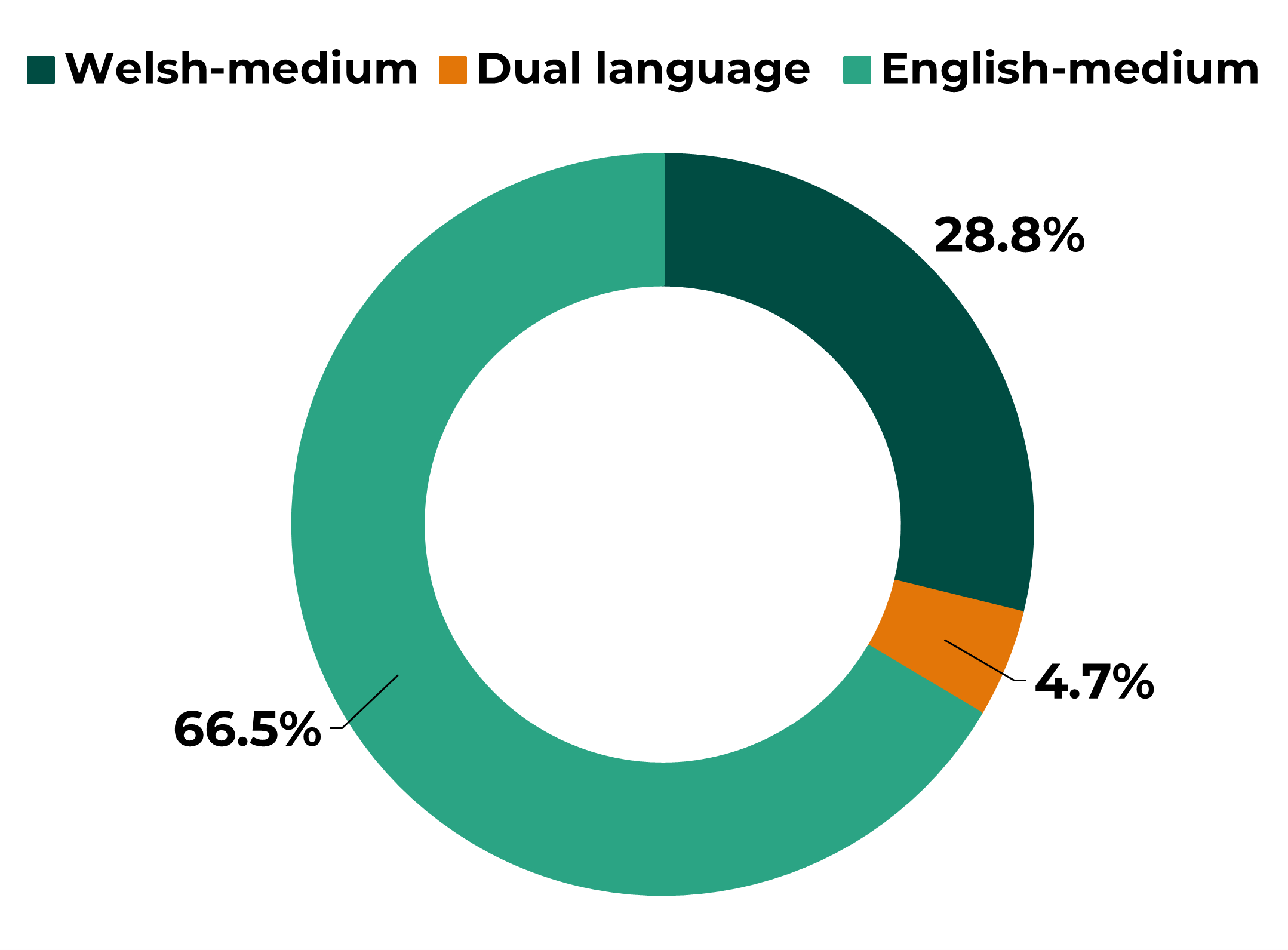
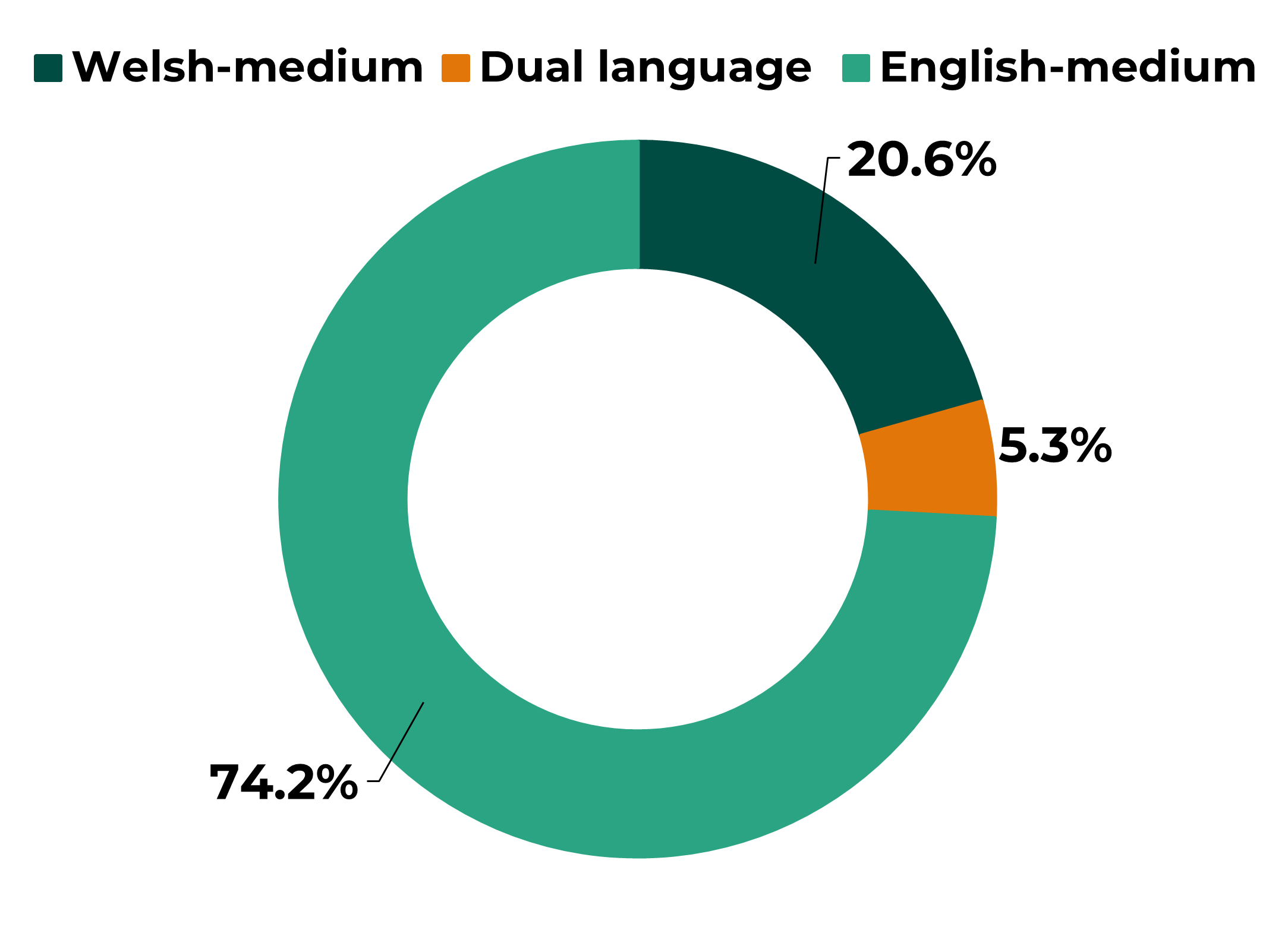
It is widely recognised that expanding Welsh-medium education (in addition to transmission of the language at home) is integral to producing fluent Welsh speakers. As of 2024/25, 29% of schools in Wales are categorised as Welsh-medium, and a further 5% dual language (English and Welsh). 21% and 5% of pupils attend these schools, respectively.
Figure 1: Proportion of maintained schools (excluding special schools) by language category (January 2025)
Source: Welsh Government, School census results: January 2025, Table 2, July 2025
Figure 2: Proportion of pupils attending maintained schools (excluding special schools) by language category (January 2025)
Source: Welsh Government, School census results: January 2025, Table 2, July 2025
In 2021, the Welsh Government said 8 local authorities had committed to move up to 42 schools along the language continuum, for example, changing the language category of the school from a dual language school to a Welsh-medium school. However, since 2022, only 8 schools across Wales have been the subject of a consultation to change their language category, and there’s little evidence of many schools moving along that pathway during that time.
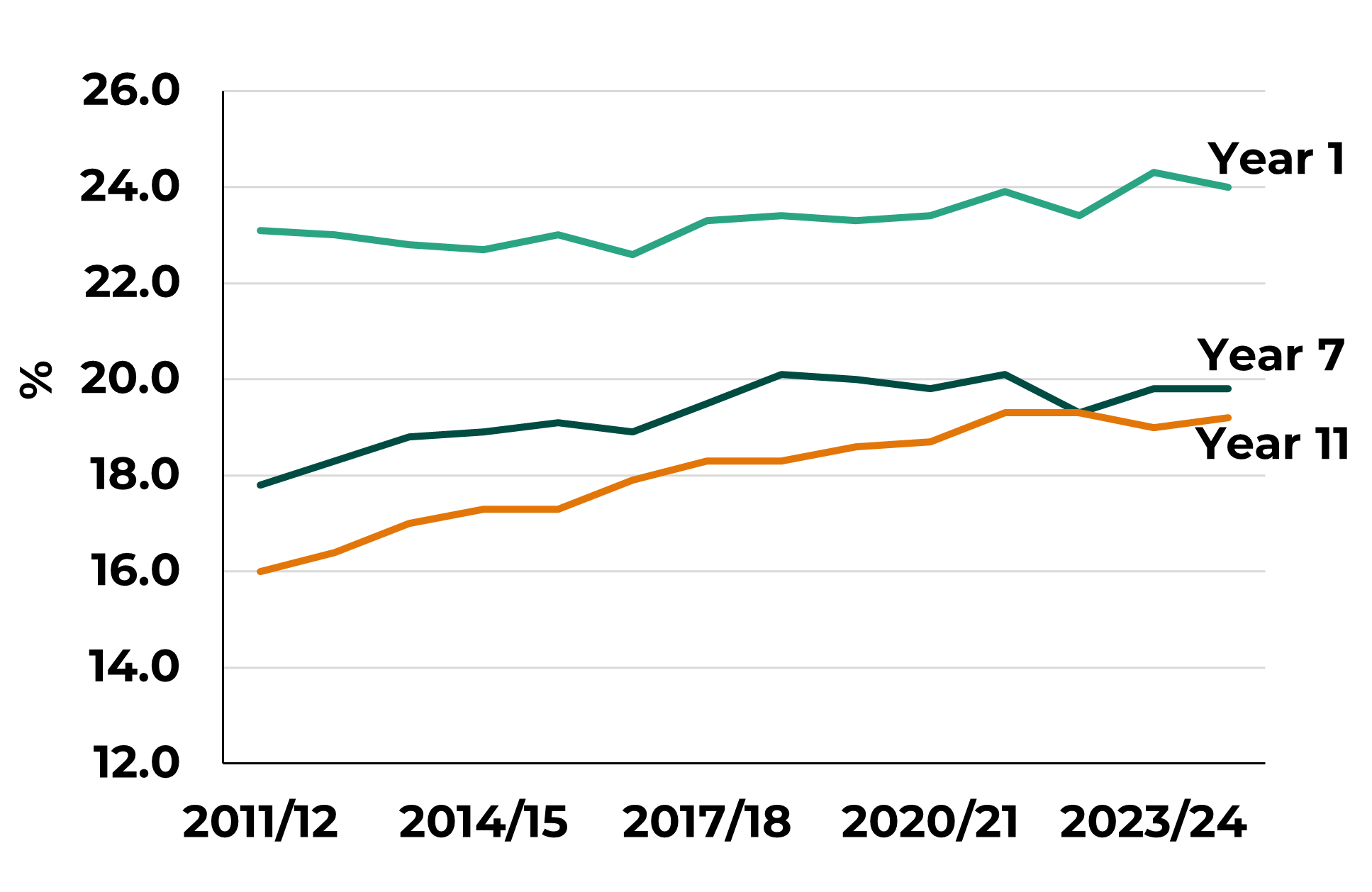
Cymraeg 2050 set targets to increase the proportion of pupils receiving Welsh-medium education to 30% by 2031 and 40% by 2050. This is from a baseline of 22% of Year 2 pupils (age 6 at the start of the year) receiving Welsh-medium education in 2015/16. Figure 3 shows how far there is to go.
Figure 3: Proportion of pupils taught Welsh as a first language
Source: Welsh Government (StatsWales), Pupils taught Welsh as a first language by local authority, year group and year
The 2025 Act attempts to shift this pattern by changing the way schools are categorised and the amount of Welsh taught. These changes aim to ensure every child in Wales becomes initially a basic, and in future an independent, Welsh speaker by the age of 16. The Act requires schools to have a ‘Welsh Language Education Delivery Plan’, and to deliver an amount of Welsh language education as required by their specific category. These amounts will be set out in future regulations. The Act stipulates that in the case of a ‘Primarily English Language, partly Welsh’ school, the amount of Welsh language provision must not be less than 10% of curriculum time.
Will the investment match the ambition?
The Cymraeg 2050 strategy and the 2025 Act benefitted from cross-party support during the last Senedd - a shared ambition to increase the use of the language. But can such a consensus be maintained in the Seventh Senedd?
How best to secure the future of the language will be an issue debated long into the future, but as the Commission for Welsh-speaking Communities stated in its recent report, the prosperity of the language “depends on creating the conditions in which people can easily use it as part of everyday life”.
The Welsh Language Commissioner’s Manifesto 2026 states that the next Welsh Government may need to consider whether the current level of investment is likely to change the language’s trajectory. The Commissioner asserts that “continuing to invest and operate in line with recent decades cannot be expected to lead to different outcomes”. Plenty therefore for the new Welsh Government to consider if it wants to achieve the step change envisaged by Cymraeg 2050.
Article by Osian Bowyer and Michael Dauncey, Senedd Research, Welsh Parliament