






The Welsh Government published its Second Supplementary Budget 2025-26 on 24 February 2026. It shows changes since last Summer’s First Supplementary Budget for 2025-26 and includes almost £3.2bn of additional revenue and capital for departments, raising the overall funding allocated to departments from £26.3bn to £29.5bn. However, almost £2.8bn of these are non-cash allocations, which cannot be allocated to resource spending.
In this article we take a look at some of the allocations across departments and how funding has changed. The Senedd will debate the Second Supplementary Budget on 18 March.
“Managing the budget to the very end”
The Cabinet Secretary for Finance and Welsh Language, Mark Drakeford MS, told the Finance Committee, that this Supplementary Budget continues to “reflect the priorities of the Government as a whole”.
Key allocations to Welsh Government departments
Key allocations in the Second Supplementary Budget include:
- £125.8m for public sector pay awards allocated across departments.
- £200m revenue for health and social care.
- £72.2m capital for transport.
- £60.5m capital for education.
- £150.8m of allocations to and from Reserves.
The Welsh Government has £46.8m of resource (£42.2m of fiscal resource) and £45m of capital (£14.8m of financial transactions capital) in its unallocated reserves following the Supplementary Budget.
Looking ahead, the Cabinet Secretary told the Finance Committee that the Government was “managing the budget to the very end” and noted there will be enough in reserves to the final week of the financial year should anything unexpected to happen.
Overall, the Welsh Government’s allocations for revenue plus capital (excluding Annually Managed Expenditure or ‘AME’) increase by £3.2bn, or 12.1% compared with the First Supplementary Budget 2025-26.
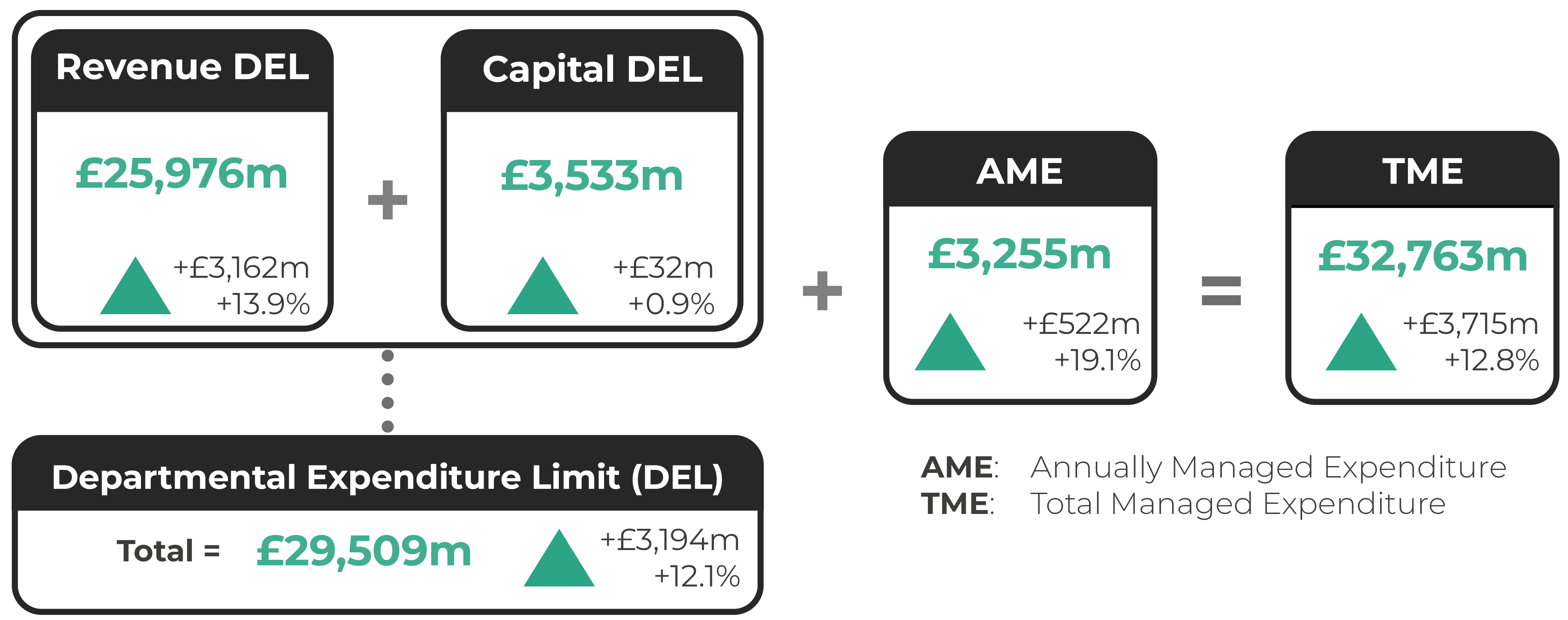
Departmental Expenditure Limit (DEL) includes the discretionary part of the budget that the Welsh Government chooses how to spend.
Annually Managed Expenditure (AME) is the non-discretionary part of the budget.
Source: Welsh Government and Senedd Research
Health board overspends account for the majority of revenue allocated to health and social care
The Second Supplementary Budget allocates an additional £200m of revenue funding “to support front line NHS services with in-year pressures and continue to support the NHS to maintain progress against its priority of reducing waiting times in 2025-26”.
When asked by the Finance Committee how much of that £200m is going to providing additional healthcare provision, the Cabinet Secretary said:
We made an allocation at the start of the year, which was in the first supplementary budget, of £120 million, and that is the money that has been used to bring down waiting times and waiting lists in this financial year.
The Cabinet Secretary told the Finance Committee that the majority of the additional £200m, about £140m, was going towards “recognising health board overspends”.
Student loans in line with the UK
The Second Supplementary Budget includes almost £2.6bn for the education department as non-cash to the student loan ringfenced budget. This follows a change to the student loans valuation model in Wales bringing it in line with the model used by the UK Government’s Department for Education.
In 2025, the Welsh Government valued the student loan asset, which is the estimate of the amount the Welsh Government expected students to repay, at £8.9bn.
However, this calculation was done using an older statistical model compared to that used by the Department of Education, which uses a different technique and newer data. The Auditor General for Wales said the evidence indicates that the model and data used by the Welsh Government are “likely to materially overstate career earnings and repayments and therefore the asset value”.
When asked about why the £2.6bn isn’t being given to schools, the Cabinet Secretary told the Finance Committee that this is because it is a “non-cash” allocation:
This is not money that we can spend. So, if people say, 'Why aren't you spending that on schools?', the answer is, 'It's not that sort of money.' It is a very large sum of money, but it's not money that comes to the Welsh Government that we can choose to use it for those other sorts of purposes.
Mike Hedges MS highlighted the importance of making it “absolutely clear” to stakeholders that “this is not money that’s being stolen off schools; it is something entirely different”.
To date, HM Treasury has fully funded the student loans schemes on the basis that costs are broadly comparable across the four nations. The Cabinet Secretary told the Finance Committee that as long as the Welsh Government’s scheme doesn’t cost more than schemes elsewhere in the United Kingdom, the Treasury will continue to cover it.
Capital funding for repairs and maintenance in education
£60.5m has been allocated from general capital reserves to support capital programmes in schools, Further Education and Higher Education establishments. This includes:
- £35m to support essential capital repairs and maintenance across schools and colleges in Wales.
- £25.5m to support the Higher Education and Further Education sectors with invest to save capital transformation and capital maintenance.
When asked by the Finance Committee how this additional capital funding will address the backlog in maintenance of schools, the Cabinet Secretary said:
[…] there's a lot of our estate that is very modern and in a very good state of repair, and, since 2018, we've invested over £300 million in the running maintenance of other buildings. So, the extra £60 million, particularly in the schools context, continues to make an inroad into any backlogs.
What next?
This will be the final Supplementary Budget for 2025-26 and as dissolution approaches, one of the final debates to be held during the Sixth Senedd.
You can follow the debate on SeneddTV.
Article by Božo Lugonja, Senedd Research, Welsh Parliament