








The introduction of a default 20mph speed limit on restricted roads in Wales in September 2023 generated significant public debate. The policy increased the share of roads with a 20mph limit from 2% to 37% as of September 2023.
Although its aims extend beyond road safety, the central objective is to reduce injuries, enhance safety, and promote healthier travel choices such as walking and cycling.
Transport for Wales (TfW) is monitoring the policy through of Key Performance Indicators, with several reports and data releases published so far.
TfW notes that at least three years of collision data are needed to assess the policy’s effects robustly. The Welsh Government in February that “the evaluation will report in stages: an initial report this year, an interim report next year, and a final report in 2029.”
However, with widespread media discussion on the policy’s impact on road safety, this article examines trends in collisions and casualties in Wales compared with England and Scotland, where introduction of 20mph remains a matter for individual highway authorities, rather than a default on restricted roads.
How is road collision data reported?
UK Government Department for Transport (DfT) road safety data is reported by police forces via the STATS19 data collection system. These do not record all collisions, only those resulting in injury.
The numbers of collisions and casualties on roads in Wales, England and Scotland have generally decreased since police forces began collecting STATS19 road collision data in 1979. Although more recent data is available from StatsWales, DfT data has been used for the analysis in this article in order to be able to compare trends across Great Britain. Provisional data is available from DfT for the first half of 2025, but this has not been utilised as it may be subject to change.
Collision data is seasonal, meaning quarterly data can be volatile. For comparison across quarters, a four-quarterly rolling average has been applied to the data. Figures described in this article refer to this rolling average.
The data has been grouped into nations based on the police force that recorded the collision. Collisions where speed limit data has not been recorded have been excluded.
To ensure the same set of roads are being compared before and after the change in the default speed limit, collisions on 20mph and 30mph roads have been grouped. For comparison across speed limits, those occurring on all other roads have also been grouped.
How do collisions on Welsh roads compare to those of England and Scotland since the implementation of the default 20mph limit?
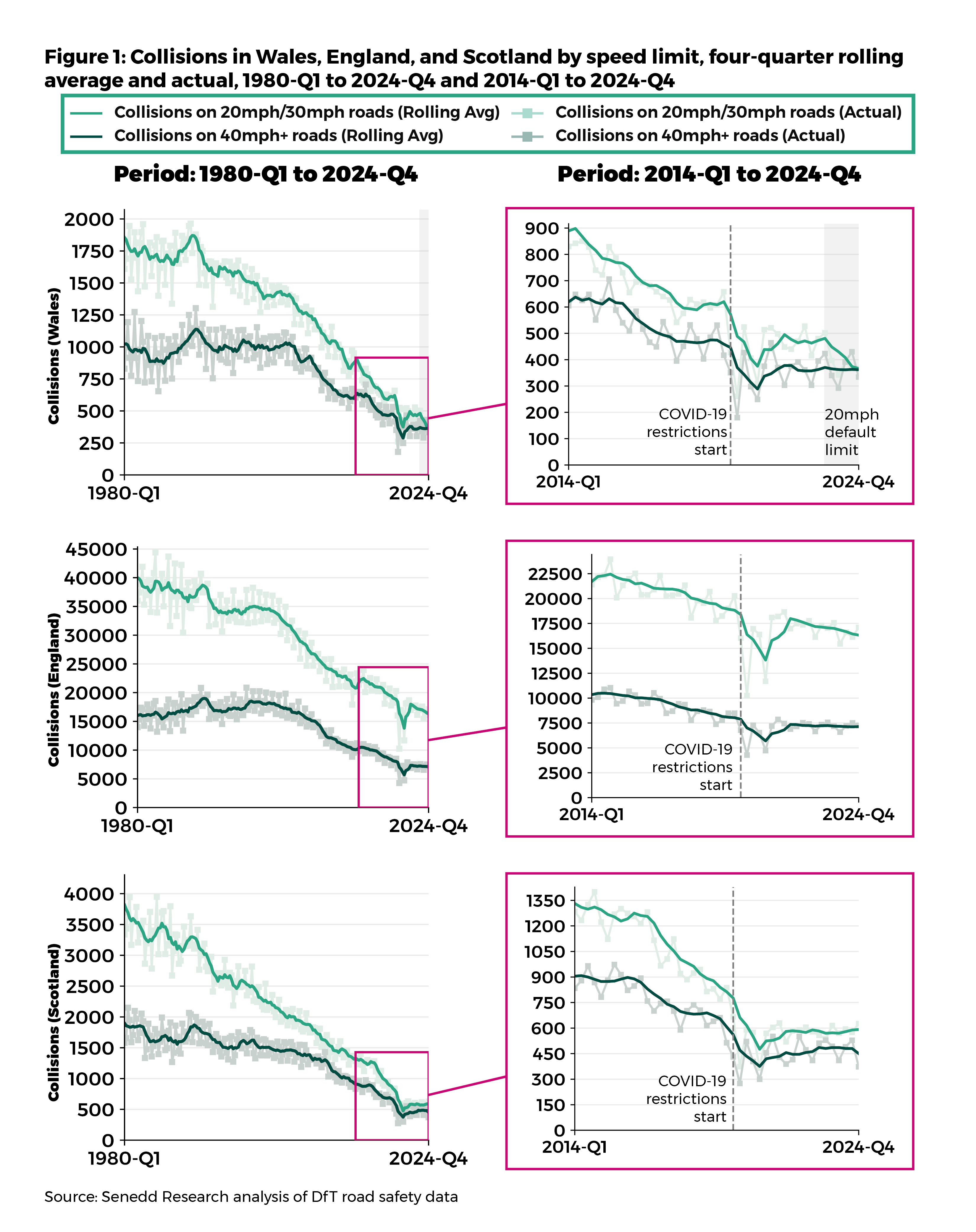
Data shows that the number of collisions recorded on 20mph/30mph roads in Wales has fallen faster than in England and Scotland while those on other roads remained stable.
Following the introduction of the 20mph default speed limit on Welsh restricted roads, the number of collisions on 20mph/30mph roads fell by 22.5% from 2023 Q2 to 2024 Q4. Collisions on other roads in Wales decreased slightly by 0.2%.
During the same period in England, collisions on 20mph/30mph roads and other roads fell by 4.7% and 1.3% respectively. Scotland saw a slight increase of 1.5% on 20mph/30mph roads and a decrease of 7.4% on other roads.
How do casualties on Welsh roads compare to those of England and Scotland since the implementation of the default 20mph limit?
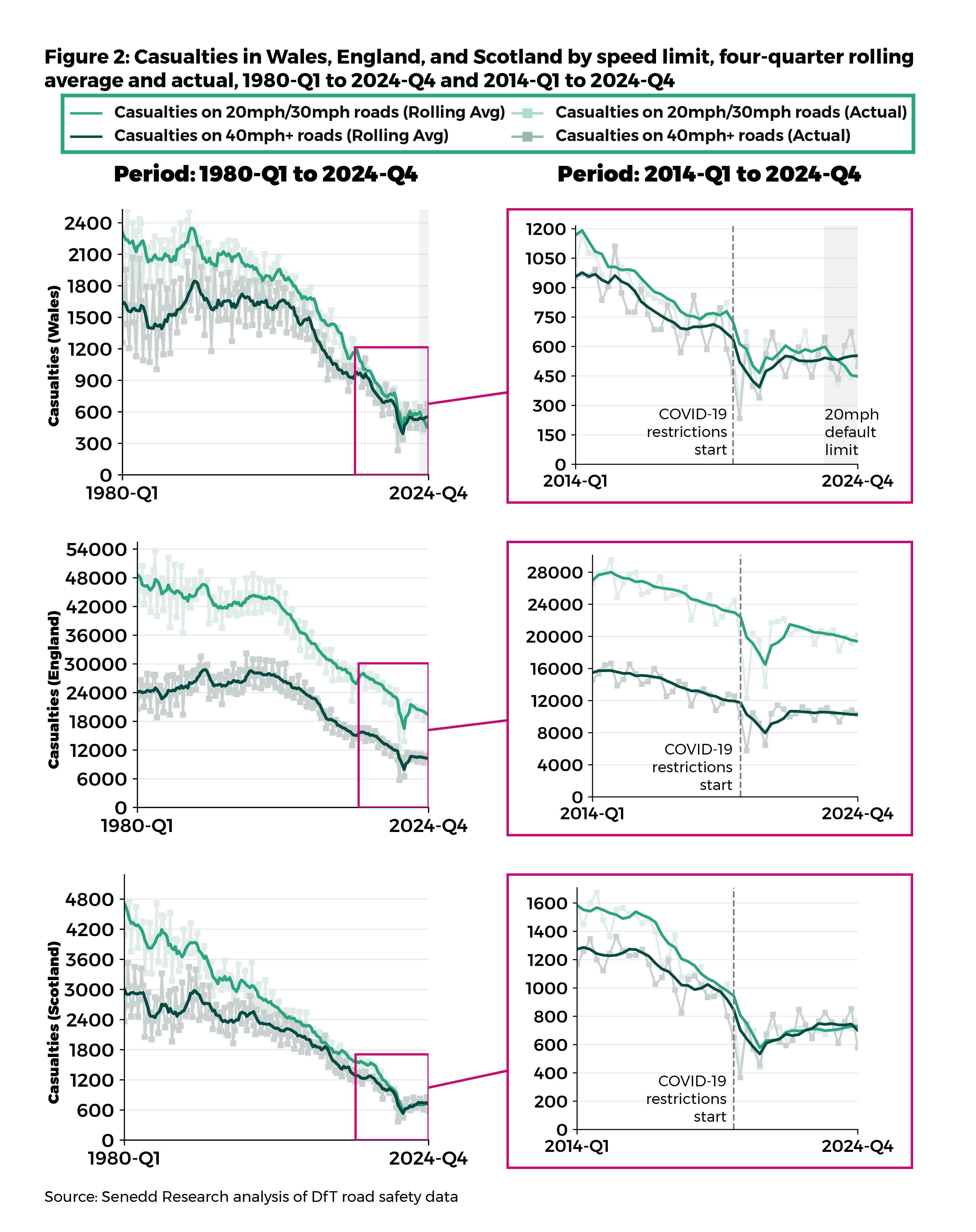
Looking at slight, serious and fatal casualties together, numbers on 20mph/30mph roads in Wales have also fallen at a faster rate than in England and Scotland. A slight increase was seen on other Welsh roads.
In Wales, the number of all casualties on 20mph/30mph roads fell by 23.8% from 2023 Q2 to 2024 Q4. On other roads, there was a slight increase of 4.4%. In the same period, England saw decreases of 5.2% and 3.1% on 20mph/30mph roads and other roads respectively, whilst Scotland saw an increase of 3.1% on 20mph/30mph roads and a decrease of 6.4% on other roads.
There have been more casualties recorded historically on 20mph/30mph roads than on other roads. By 2024 Q4, this was no longer the case in Wales, following a similar trend seen previously in Scotland.
How do KSI (killed or seriously injured) casualties on Welsh roads compare to those of England and Scotland since the implementation of the 20mph default limit?
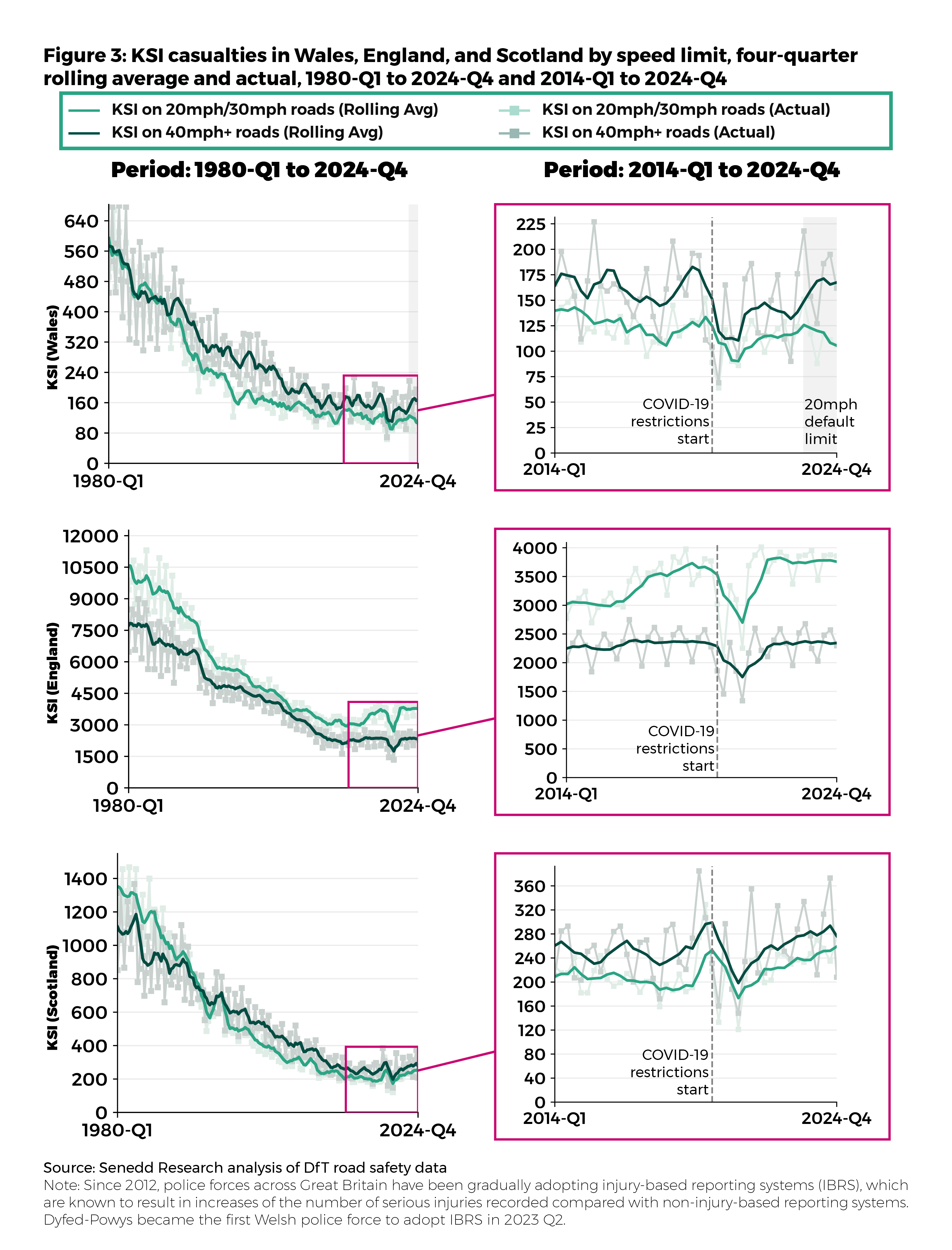
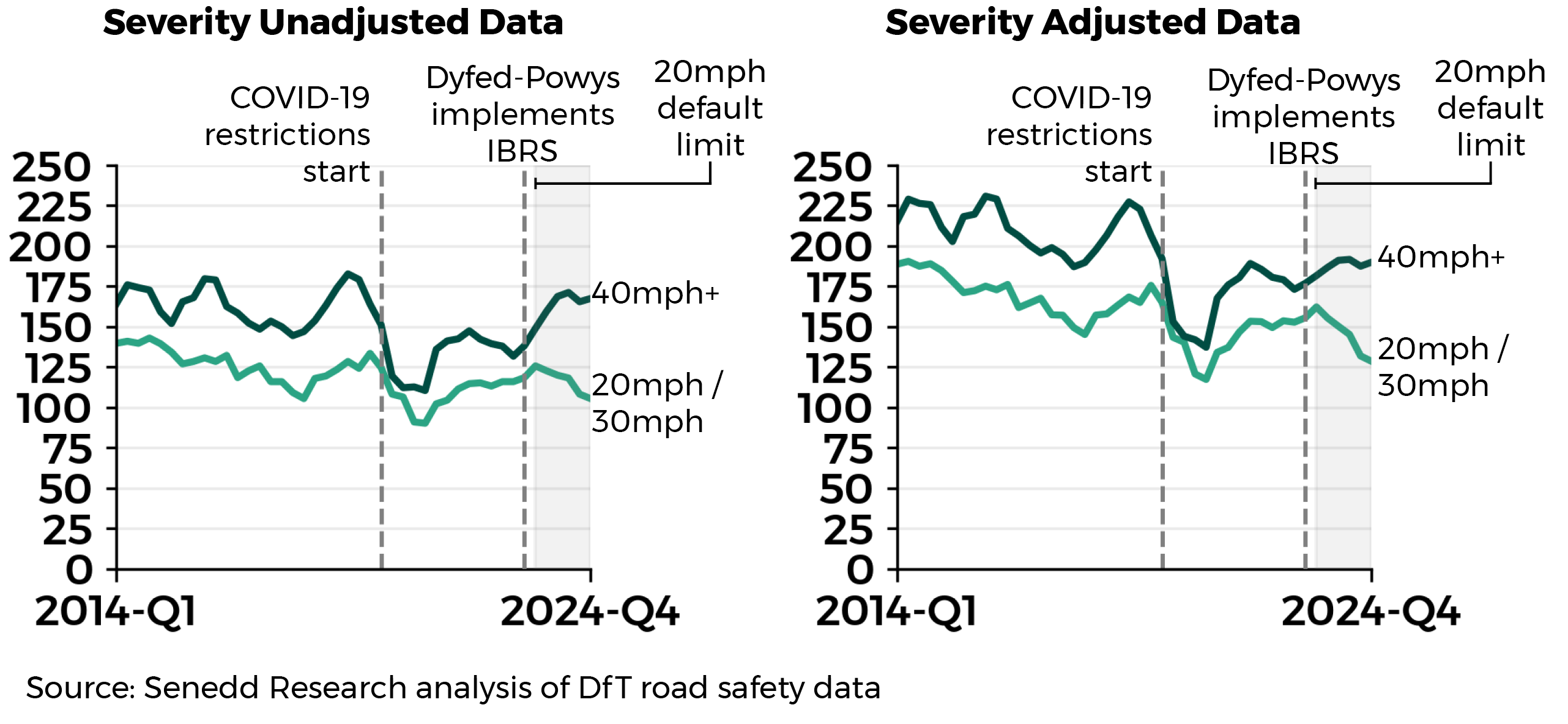
KSI casualties on 20/30mph roads in Wales have fallen, whilst there has been an increase on other roads. One reason for this increase appears to be linked to a change in reporting methodology in Dyfed-Powys, the impact of which is discussed in the next section.
From 2023 Q2 to 2024 Q4, Welsh 20mph/30mph roads saw an 11.0% decrease in the number of KSI casualties, whilst KSI casualties on 40mph+ roads in Wales increased by 21.2% from 2023 Q2 to 2024 Q4, beginning prior to the implementation of the 20mph default limit. There was relatively little change in England in comparison across the same period, with a 0.3% increase on 20mph/30mph roads and a 0.3% decrease in other roads. Scotland saw increases of 8.0% on 20mph/30mph roads and 0.2% on other roads.
Why have other Welsh roads seen an increase in KSI casualties around the implementation of the 20mph default limit?
The increase appears to be associated with greater numbers of KSI casualties recorded by Dyfed-Powys Police, following its change to the injury-based reporting system CRASH.
There is a known under recording of serious injuries for police forces using non-injury-based recording systems (NIBRS). Dyfed-Powys became the first Welsh police force to implement the CRASH system for reporting road collisions during 2023 Q2.
Police forces using CRASH have been found to report a greater proportion of serious injuries than those using NIBRS. DfT provides adjusted figures which estimate the number of serious and slight injuries that would have been reported had the police force been using IBRS.
Figure 4: KSI casualties on 40mph+ roads in Wales by Police Force, four-quarter rolling average, severity unadjusted and adjusted data, 2014 Q1 to 2024 Q4
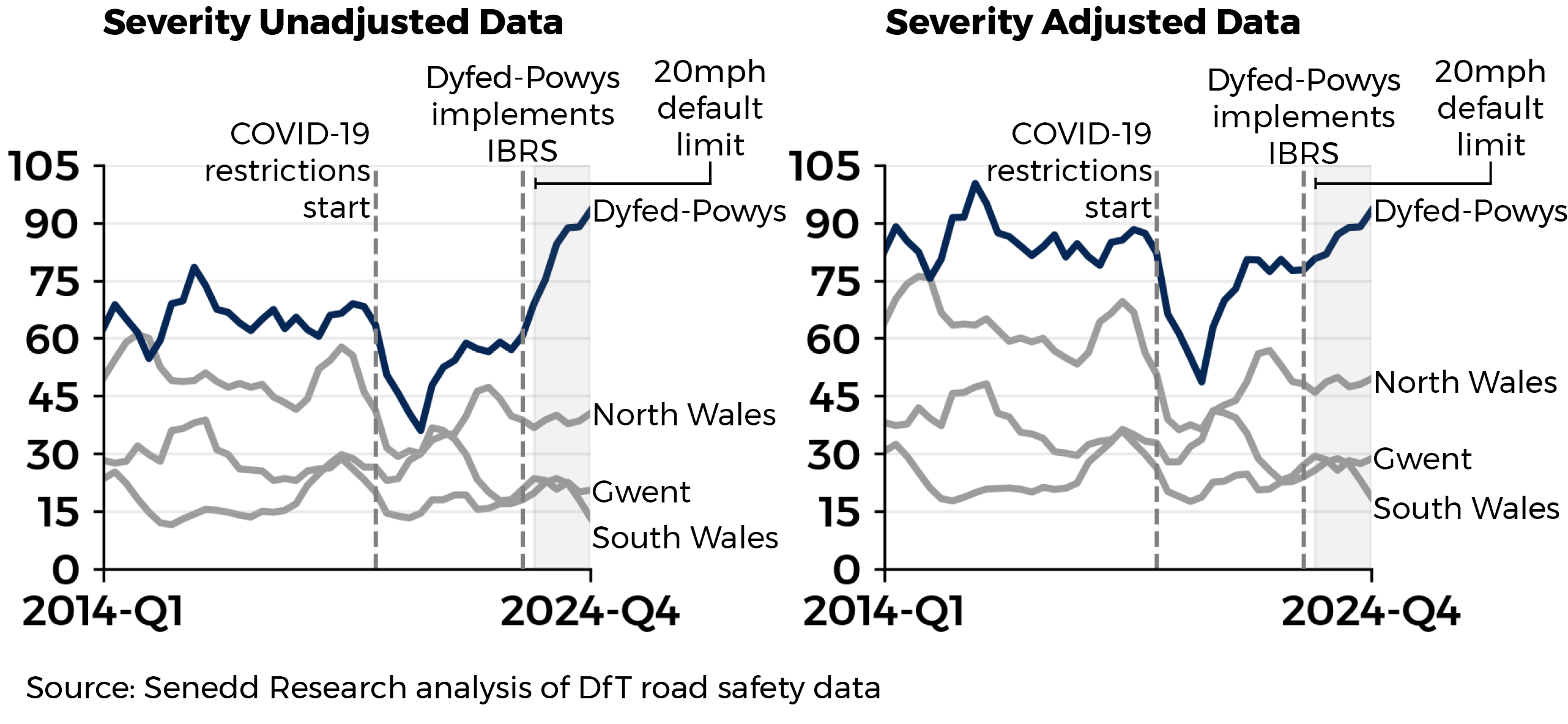
Using these adjusted figures, the number of KSI casualties on 40mph+ roads in Wales increased by 7.4% from 2023 Q2 to 2024 Q4, with the majority of this remaining increase also being seen in Dyfed-Powys. This suggests that much of the increase in unadjusted KSI casualties on Welsh 40mph+ roads during this period can be attributed to Dyfed-Powys switching to IBRS, although there may be other contributing factors. Using the same adjusted figures for 20mph/30mph roads shows a greater reduction of 17.4% in KSI casualties.
Figure 5: KSI casualties on 20mph/30mph roads and other roads in Wales, four-quarter rolling average, severity adjusted and severity unadjusted, 2014 Q1 to 2024 Q1
The story so far on 20mph suggests the policy has reduced both collisions and casualties on Welsh roads, with greater reductions in Wales than elsewhere in Great Britain.
However, it is still early days for this evaluation, and the impact of the policy extends beyond road safety alone. Given the high profile of this policy, the Welsh public will no doubt follow the evaluation process with great interest.
Article by Senedd Research, Welsh Parliament