







New nuclear is coming to Wales. In November 2025, the UK Government announced that Wylfa, Anglesey, will host a new power station containing the UK’s first small modular reactors (SMRs) – a new type of nuclear technology. This will be the first new nuclear plant in Wales for over half a century.
The UK Government’s ambition is for Wylfa’s SMRs to connect to the grid by the mid-2030s. This article reflects on Wylfa’s recent past, looks at the implications of the new announcement, and explores what might happen next.
Old Wylfa and Wylfa Newydd
The original Wylfa nuclear power station generated electricity from 1971 until its closure in 2015.
In 2012, Hitachi bought the Wylfa site and proposed constructing a new power station, called ‘Wylfa Newydd’, on adjacent land. Hitachi scrapped these plans in 2020 after failing to reach an agreement with the UK Government over upfront construction costs.
The last UK Government purchased the Wylfa site in 2024, later earmarking it as the “first choice site for [a] large-scale gigawatt nuclear power plant”.
Timeline of past and future nuclear developments at Wylfa
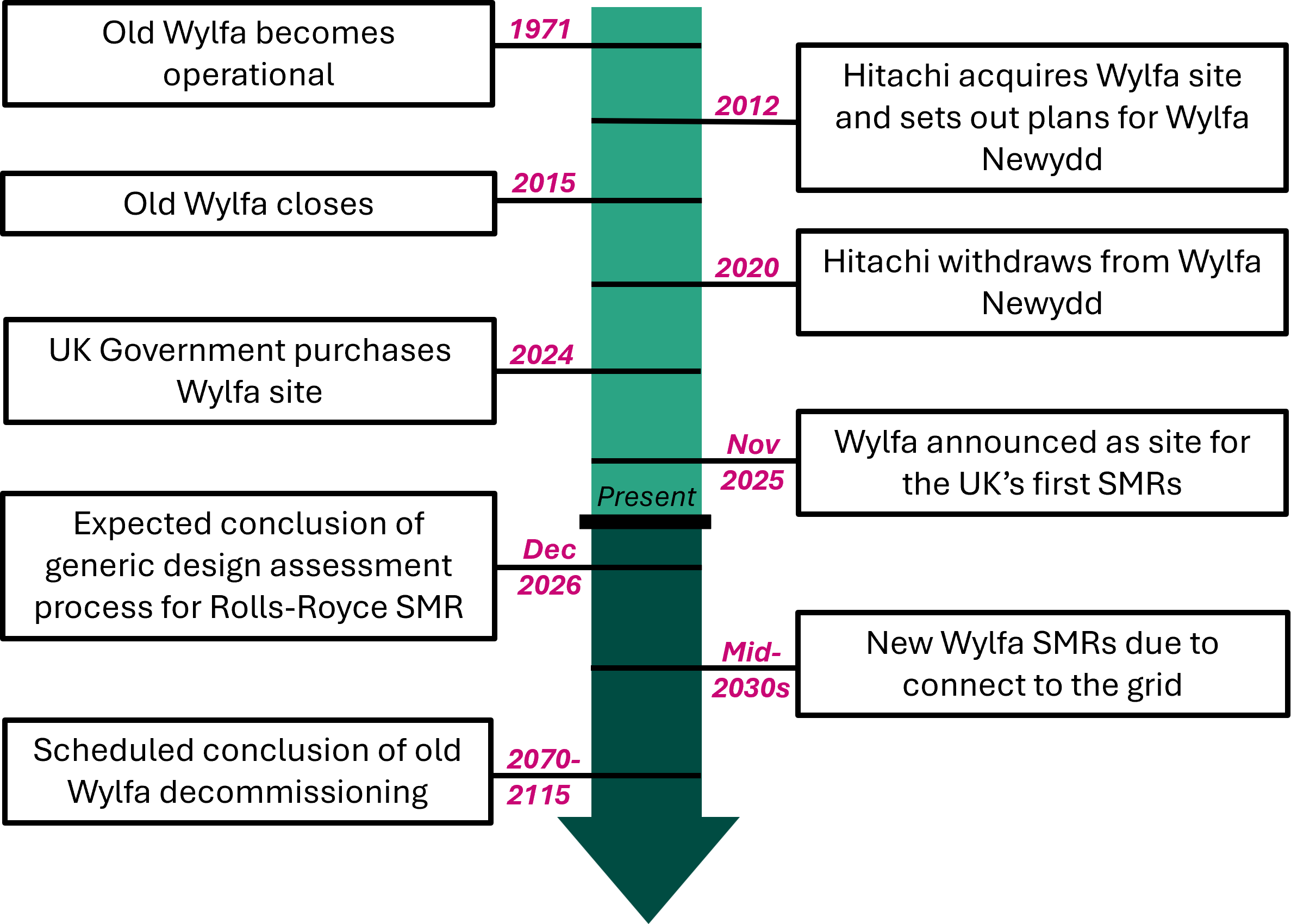
Source: Senedd Research
Nuclear in a low-carbon grid
Although no new UK nuclear power stations have come online since 1995, the UK Government sees nuclear energy as a low-carbon option for providing baseload power in a renewables-dominated electricity grid.
The Welsh Government has also previously expressed its support for new nuclear projects at Wales’ two existing (and currently inactive) nuclear sites – Wylfa and Trawsfynydd. It had promoted Trawsfynydd’s redevelopment through Cwmni Egino, but recently announced the company would be dissolved by April 2026.
In 2024, the Senedd passed a motion supporting:
…the role that nuclear power plays alongside renewables in the Welsh Government’s plans for a green and fair transition to a low-carbon economy, ensuring all new power generated in Wales is zero emission.
Small Modular Reactors (SMRs)
SMRs are a novel technology – so far only operational in Russia and China. All five of the currently operational civil nuclear sites in the UK are large-scale ‘gigawatt’ plants, as are two projects in development: Hinkley Point C and Sizewell C. However, delays and cost overruns on new large-scale nuclear projects have focussed governments’ attention on SMRs as a potentially more flexible nuclear option.
SMRs are intended to be mass-produced in factories, assembled to a standard design, and shipped to deployment locations. They have a smaller footprint than large-scale reactors and use more highly-enriched fuel than conventional reactors, to increase nuclear reaction efficiency.
In its 2025 Spending Review, the UK Government announced a £2.5bn investment into SMR development. In June, it selected Rolls-Royce as its preferred bidder to build the UK’s first SMRs.
Wylfa to host up to eight SMRs
On 13 November 2025, UK Energy Minister Michael Shanks MP announced Wylfa as the UK’s first SMR deployment site, saying:
The initial project will see the construction of up to three Rolls-Royce SMR units, with GBE-N [Great British Energy – Nuclear] assessing the site to have the potential to host up to 8 units, although this would be subject to future policy and funding decisions.
He said work at Wylfa “will create up to 3,000 new high skilled jobs at peak construction”. The Welsh Government said the project “represents an initial investment of £2.5bn” in north-west Wales.
If built to Rolls-Royce’s stated capacity (470MWe), each SMR would generate enough electricity to supply the equivalent of around 1 million homes. A Wylfa plant with three SMRs would be the second largest power station in Wales, behind only Pembroke gas power plant. A plant with eight SMRs would be by far the largest power station in Wales. The table below compares the scale of existing and proposed large energy projects in Wales.
Table: Comparison of capacity of major energy projects in Wales
|
Project |
Capacity (MWe) |
Notes |
|
Up to 3,760 |
Up to eight 470MW Rolls Ro yce SMRs |
|
|
At least 3,100 |
Two Advanced Boiling Water Reactors |
|
|
2,181 |
Wales' largest gas-fired power station |
|
|
Up to 1,410 |
Up to three 470MW Rolls Royce SMRs |
|
|
1,000 |
Two Magnox reactors |
|
|
576 |
Wales' largest operational wind farm |
The day before Wylfa was officially announced, Warren Stephens, US Ambassador to the UK, criticised the decision to progress SMRs rather than a new large-scale nuclear plant. The UK Energy Minister told the House of Commons that SMRs were chosen over a large-scale plant due to funding availability and timing.
Regulation, permitting, and planning permission
Currently, new nuclear power stations in Wales require three key approvals before any building can begin:
- site licensing and relevant consent from the Office for Nuclear Regulation (ONR);
- environmental permits from Natural Resources Wales (NRW); and
- planning permission from the relevant authority, which depends on project size.
Optionally, companies can also submit their reactor designs to the ONR’s Generic Design Assessment (GDA) process, which allows an upfront assessment of safety, security, and environmental impacts. Rolls-Royce’s SMR design is currently at the final stage of the GDA process, which is expected to conclude by December 2026.
Wylfa already has a nuclear site licence, because the old power station’s final decommissioning isn’t expected until 2070-2115. However, the ONR says new installations and site expansion will likely require relicensing – it says relicensing decisions can take “from a few months… to well over a year” depending on project complexity.
NRW, as Wales’ environmental regulator, is responsible for licensing of activities that could impact the environment. This includes any pollution to water, land, or air; and abstraction of groundwater. NRW’s dedicated webpage addresses its role in nuclear regulation, including its involvement in the GDA process and nuclear waste disposal.
The new Wylfa power station is likely to have a capacity above 350MW, meaning planning consent for the project would be determined through the UK Government’s Nationally Significant Infrastructure Project (NSIP) process, rather than being decided by the Welsh Government.
Regulatory changes may be on the horizon
It is likely that the existing regulatory framework for nuclear may change – a UK Government-commissioned review published in November 2025 said there is “systematic failure” within it. The review’s 47 recommendations included establishing a single decision-making regulatory body; a government-defined ‘tolerability of risk’ standard’; and streamlining of the UK Government’s NSIP consenting process. At the time of writing, the UK Government has not yet responded to these recommendations.
The recently agreed UK-US ’Atlantic Partnership for Advanced Nuclear Energy’ may also impact future regulation. It aims to speed up the building of nuclear plants by increasing mutual recognition between the countries’ nuclear regulators.
How will Wylfa be funded?
Following a 2022 legislative change, nuclear projects such as the Wylfa SMRs may use a Regulated Asset Base (RAB) funding model. The RAB model allows companies to charge all energy customers a regulated price on energy bills to support the capital costs of nuclear project construction. Such a charge would be managed by the energy regulator Ofgem.
Next steps
Although Wylfa has been approved, there is a long path ahead before its SMRs generate any power. For further information on nuclear energy in Wales, including developments at Trawsfynydd and Llynfi; the unresolved issue of hazardous waste storage; and relevant devolved powers around skills and education; see our 2025 briefing on nuclear energy.
Article by Dr Matthew Sutton, Senedd Research, Welsh Parliament