







Over the course of the Sixth Senedd, there has been a substantial increase in the amount of law being made by the UK Parliament in devolved areas compared to previous Senedd terms.
As this term comes to an end, this article looks at the emergence of this issue and the increased use of the legislative consent process. The process used to ask the Senedd to give its consent to the UK Parliament to making law in devolved areas. It considers the implications of these changes, when consent for Bills has been refused and what is left unresolved at the end of this term.
When does consent need to be sought?
Despite the devolution of law-making powers to the Senedd, the UK Parliament retains its right to make law for Wales on any matter. A convention was agreed to ensure that the views of devolved parliaments, including the Senedd, were taken into account if the UK Parliament was making a law that relates to a devolved area.
The Sewel Convention says that the UK Parliament will not normally legislate with regard to devolved matters without the consent of the Senedd. However, the Supreme Court has ruled that this is only a political convention and is not legally enforceable if the UK Parliament was to breach it.
The Senedd has processes in place to consider UK Parliament Bills that require consent. Memoranda are laid on each Bill for example that explains what parts of a Bill relate to a devolved area. The Senedd hold votes on whether or not to give consent to a Bill. You can read more about the background to the process in this article.
An increasing issue in the Sixth Senedd
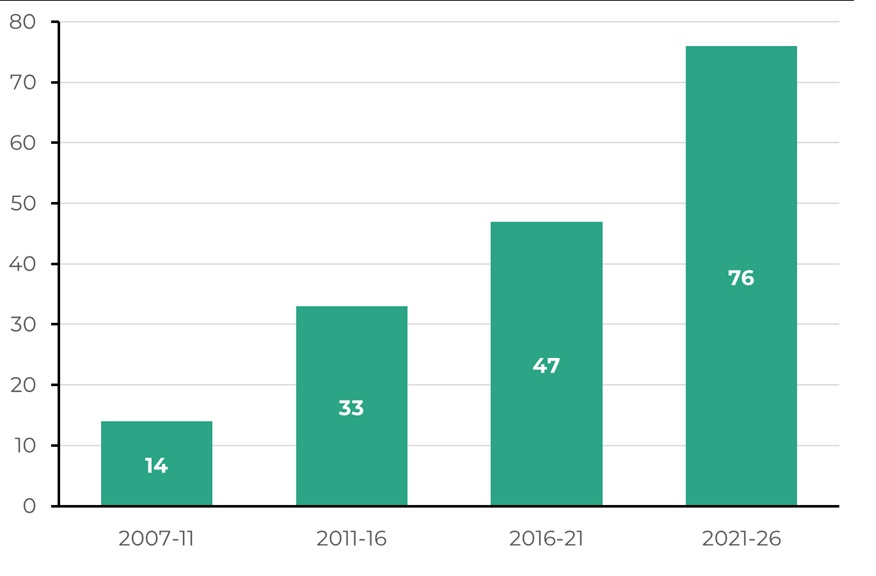
During this Senedd term, there has been a substantial increase in the number of UK Parliament Bills that have required consent. The chart below shows the number of UK Parliament Bills that had legislative consent memoranda laid for them in each of the last four Senedd terms. There has been a more than 60% increase in the number of Bills considered in the Sixth Senedd (2021-26), compared to the Fifth Senedd term (2016-21). The use of UK Bills in this way has been consistent under both the current (July 2024-) and previous (May 2021-June 2024) UK Government.
Chart 1: The number of UK Parliament Bills that had legislative consent memoranda laid for them in each of the last four Senedd terms
Source: Senedd Research analysis of legislative consent
In addition to this increase in the number of Bills the Sixth Senedd has also seen substantial increase in the number of clauses that consent is being sought for. This means that rather than there being a small number of clauses in each Bill that require consent, there are instead examples of Bills where entire Parts or the majority of the Bill have regard to devolved matters.
During the Sixth Senedd, legislative consent memoranda have been laid in relation to 1,718 clauses in UK Parliament Bills. This compares with fewer than 500 clauses in the Fifth Senedd (2016-21).
The Sixth Senedd has also seen a large increase in the number of supplementary legislative consent memoranda being laid. These memoranda are required if the Bill is amended by the UK Parliament to make further changes to the Bill when these amendments have regard to devolved matters.
This term has seen some Bills have as many as seven memoranda laid for them. There were 202 memoranda laid in the Sixth Senedd relating to 76 UK Parliament Bills. This compares with only 67 memoranda laid relating to 47 Bills in the Fifth Senedd (2016-21).
Why does this matter?
These increases mean that there is a growing body of devolved law being made in the UK Parliament, rather than by the Senedd. The Legislation, Justice and Constitution Committee has warned that the extensive use of such Bills has created a "democratic deficit" , which denies Members of the Senedd, stakeholder and the public a voice in shaping the law that impacts the daily lives of Welsh citizens. The Committee has raised concerns about the Welsh Government’s capacity being a factor in the use of UK Bills to legislate in this way. Its legacy report notes that the Welsh Government’s response to these concerns has been “mixed”, with some responses acknowledging capacity issues, while others suggest that capacity is not an issue and that it is more pragmatic to use UK Bills.
The amount of clauses being included in UK Bills also adds to the complexity of the law in Wales, as there are increased provisions in devolved areas split between amongst Acts passed by the Senedd and the UK Parliament. The Committee highlights building safety as an area that saw both a UK Parliament Act and a Senedd Act make changes to devolved law in a similar time period, with some responses acknowledging capacity issues, while others suggest that capacity is not an issue and that it is more pragmatic to use UK Bills.
A large number of supplementary consent memoranda and amendments to UK Bills very late on in their passage through the UK Parliament can also make it challenging to understand which clauses consent is being sought for and to track changes made to the Bill as it progresses. For example, the Water (Special Measures) Bill had seven memoranda laid relating to it.
When has consent not been given during the Sixth Senedd?
The first three years of this Senedd term saw a large number of UK Parliament Bills refused consent by the Senedd. Between May 2021 and June 2024, there were 14 UK Parliament Bills where consent was refused for some or all of the clauses in the Bills. This number is particularly stark when you consider that before 2021, consent had only previously been refused on nine occasions.
In the vast majority of these occasions, the UK Parliament agreed the Bill anyway, which the Welsh Government described as a “fundamentally disrespectful and destructive approach”. The Legislation, Justice and Constitution Committee agreed with calls from the Welsh Government to “codify” the Sewel Convention to enable it to be enforced when there is a risk of a breach.
Following the election of the current UK Government in July 2024, consent refusals have declined again. While the volume of UK Parliament Bills requiring consent continued to be high, consent was not refused at all until the Senedd voted on the legislative consent motion in relation to the Crime and Policing Bill on 17 March 2026.
On this occasion, the Senedd voted to refuse consent, despite the Welsh Government recommending that consent should be given. This has created a challenging situation for the Welsh and UK governments, who must now consider the Senedd’s consent refusal at the very end of the Bill’s progress through the UK Parliament.
A number of Bills remain unresolved
In addition to the situation regarding the Crime and Policing Bill, there are a number of other Bills where the dissolution of the Senedd on 8 April means that they haven’t been voted on by this Senedd. These Bills are:
- Public Office (Accountability) Bill (consent given in regard to memoranda 1-3 but further amendments are expected)
- Representation of the People Bill
- Railways Bill
- Armed Forces Bill
- Cyber Security and Resilience (Network and Information Systems) Bill
This will likely mean that the Seventh Senedd will need to consider these Bills early in the new term.
Given the concerns raised by the Legislation, Justice and Constitution Committee about the extensive use of the legislative consent process to make laws in relation to devolved matters, the approach of the new Welsh Government will be an important issue for the Seventh Senedd to consider.
Article by Josh Hayman, Senedd Research, Welsh Parliament