







On Wednesday 18 March, the Senedd will debate a new report calling on future governments to adopt Mission Cymru – a set of new principles to guide Wales’ international relations. It is the last report on the topic from the Culture, Communications, Welsh Language, Sport and International Relations Committee.
The report is aimed at future governments but the Committee’s asked the current government to respond on what it says is the “most consequential” of tasks: presenting Wales to the world.
This article explains Mission Cymru’s twelve principles and why the Committee believes they’d enable Wales to realise its international potential.
Isn’t the UK Government responsible for international relations?
As with many areas of devolution, it’s not clear cut.
‘International relations’ and ‘international development assistance and cooperation’ are reserved matters. However, this leaves scope for the Welsh Government to act in an international capacity. For example, it can:
- conclude non-binding agreements with other governments in devolved areas;
- have overseas offices; and
- make representations about any matter affecting Wales.
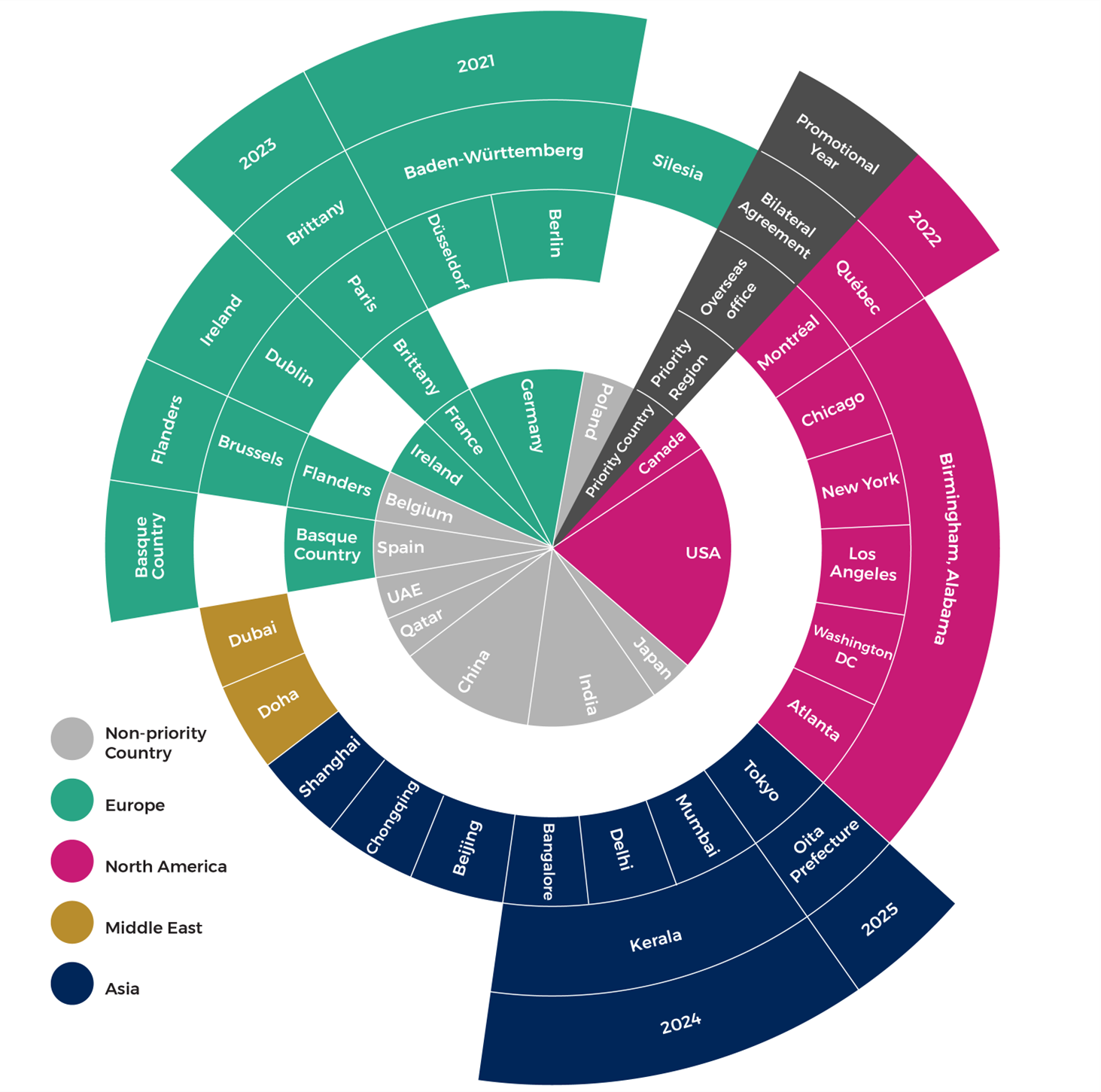
Many of the devolved nations’ international connections predate the formation of the United Kingdom by centuries, such as Wales’ close relationship to Ireland, and their modern-day arrangements reflect this. These are shown on the infographic below.
In practice, the four UK governments work together on the UK’s international relations. Mission Cymru’s Principle 3 says that future governments should adopt a proactive and constructive approach to this joint working.
Welsh Government international arrangements
Cabinet responsibility
The First Minister has always been responsible for Wales’ international relations, with the exception of a dedicated cabinet post held by the current First Minister between December 2018 – October 2020.
The report describes as “highly unsatisfactory” the decision of First Ministers in the Sixth Senedd not to attend Committee outside of one annual session.This, it says, “contrasts starkly” with other cabinet members who regularly appear before Senedd committees to cover international affairs in their portfolios.
In the Sixth Senedd, the Committee has been unhappy that all three First Ministers have declined to appear in person for budget scrutiny. According to the report, this decision, coupled with poor written information, meant that Members couldn’t confidently scrutinise around £58 million allocated to international activity since 2021.
To address this, Principle 2 says that the same scrutiny arrangements should apply to future Ministers with responsibility for international relations as they do to other members of the cabinet. The report also says that financial information on international activity “must improve”, which is covered by Principle 10.
Multiple plans have caused “uncertainty and confusion”
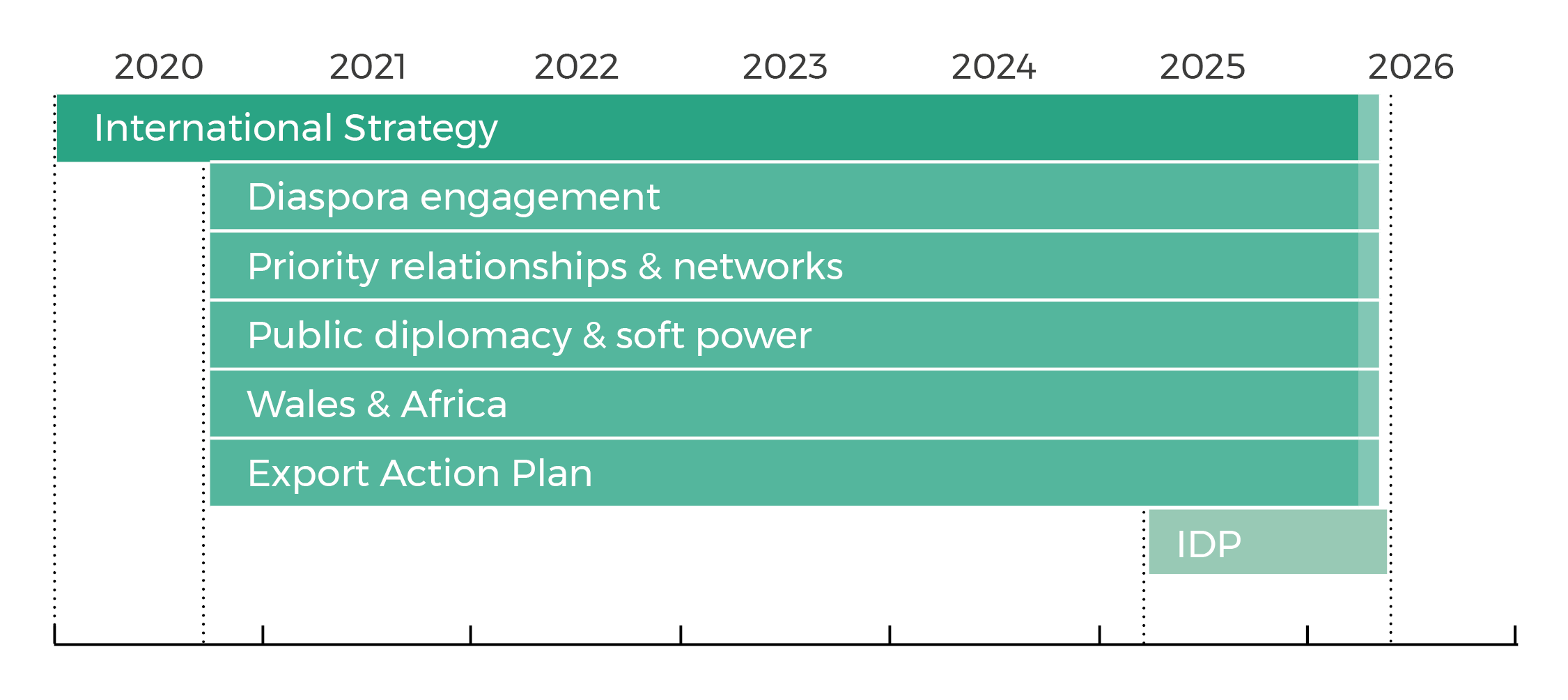
Since 2020, the Welsh Government has introduced six international relations plans. They have been in place concurrently but have different lifespans, as the infographic below shows.
The International Strategy has five action plans. Together, they contain three overarching aims and 278 actions for delivery until the end of 2025. The International Delivery Plan (IDP)(April 2025) set out “top priorities for delivery over the next year” and contains 15 aims. The First Minister later said that all six plans would expire in March 2026.
Welsh Government international relations strategies and plans (2020-2026)
The Committee said that the number of plans “is unhelpful and has introduced uncertainty and confusion”. It agreed with witnesses like the British Council who spoke of the benefits of a more focused approach. Principle 4 says that future governments should have a concise, focused and clear strategy, guided by high-level ambition and a small number of overarching aims.
Shortfalls in reporting
The Committee describes the Welsh Government’s information on delivering international priorities as “too often inexplicably, and frustratingly poor.” Gaps in reporting and low awareness “were illustrated time and again” by witnesses to the inquiry, many of whom said they rely on social media, like LinkedIn, for updates.
Highlighting that Welsh Government reports do not reference the aims and actions contained in its plans, the Committee said that the Welsh Government is “doing itself a disservice by not capturing and communicating its work in a coherent way”. This meant the Committee had not only been “denied the ability to make informed decisions”, but also to celebrate key milestones in Wales’ international journey. It supported evidence explaining the importance of reporting in combatting misunderstanding and fostering public confidence and support.
The Committee said that the First Minister has accelerated information sharing since she took office but “a degree of uncertainty remains on what has and has not been delivered.”
To address these issues, the Committee said improved reporting arrangements should be in place at the start of a future strategy. It set out minimum requirements, like reports should cover all international activity and the level of information to be provided to the Senedd (covered by Principles 5,6,8 and 9).
Resources should realise ambition
The Committee acknowledges the Welsh Government has a “relatively small budget underpinning international activity” which is “limited and finite”. Around £58 million has been allocated by the Welsh Government to international relations and international development in the Sixth Senedd. Based on evidence of the variety and range of activity delivered, the Committee concluded that “there is a clear risk that the Welsh Government’s sprawling collection of strategies stretches it too thinly”.
Principle 11 therefore says that future governments should ensure that resource is sufficient to realise their strategic ambition. The view that collaboration maximises opportunities was widespread amongst witnesses, including Size of Wales, and some offered to pool resources with the Welsh Government. Principles 7 and 12 endorse a Team Wales approach to utilising the sector’s resource, capacity and expertise.
Will the next government adopt Mission Cymru?
The Committee highlights that, since taking office, the First Minister hasn’t attended any of its debates to respond to international relations reports. Whether the First Minister will do so next week remains to be seen.
The debate marks an important moment in Wales’ international relations. The Committee says that it took a different approach to reporting to “make a positive and constructive contribution to our international story.” Perhaps most importantly, it believes that future governments could avoid the shortfalls it has identified by adopting Mission Cymru’s twelve new principles.
After five years of scrutiny, it has brought its evidence, expertise and experience to bear and has thrown down the gauntlet.
The question now is, will the next government accept?
Article by Sara Moran, Senedd Research, Welsh Parliament