







|
This is a guest article authored by the Equality and Human Rights Commission. The views expressed are those of the author, and do not represent Senedd Research or the Senedd. |
Today (10 December) marks Human Rights Day, which commemorates the UN General Assembly adopting the Universal Declaration of Human Rights in 1948. There has been significant progress towards guaranteeing human rights over the past, almost, 80 years. But it is the author’s view that there is more work to do – especially as we continue to see increasingly polarised debates and challenges to equality and human rights across the world.
In this guest article, Elinor Puzey from the Equality and Human Rights Commission (EHRC) - an independent statutory body and A-status National Human Rights Institution (NHRI) - explores what progress has been made in Wales on meeting international human rights standards.
Human rights in Wales
Human rights are universal and provide all of us with protections regardless of who we are. They are often seen as abstract concepts, but they apply to all our lives, every day. They are not ‘gifted’ to us by governments but are inherent to us all. As the United Nations notes
They range from the most fundamental - the right to life - to those that make life worth living, such as the rights to food, education, work, health, and liberty.
The Welsh Government has an obligation to meet certain international human rights standards, and has taken a number of steps to embed these through policy and legislation, including:
- Partially incorporating the UN Convention on the Rights of the Child (UNCRC) into Welsh law, via the Rights of Children and Young Persons (Wales) Measure 2011 (“the Measure”), which requires Welsh Ministers to have ‘due regard’ to the UNCRC when making decisions. The EHRC’s own research on the Measure showed the introduction of the due regard duty 'establishes attention to children’s rights’. The duty also means Members and other stakeholders can advocate for policies which are consistent with the articles in the UNCRC.
- The introduction of the Social Services and Wellbeing (Wales) Act 2014 marked progress in line with the Convention on the Rights of Persons with Disabilities (CRPD). Its due regard measure ensures the right to independent living is considered, as expressed in the CRPD.
- The Anti-racist Wales Action Plan includes a specific goal to embed human rights as part of its ambition for Wales to be an anti-racist nation.
- The LGBTQ+ Action Plan includes an action on strengthening understanding of human rights for LGBTQ+ people.
- In 2025, the Welsh Government published its Strategic Equality and Human Rights Plan 2025 – 2029, which reinforces its commitment to human rights.
However, despite a commitment by the Welsh Government to incorporate two (Convention on the Elimination of Discrimination Against Women (CEDAW) and Convention on the Rights of Persons with Disabilities (CRPD)) human rights treaties in Wales, we have seen little progress. This remains vital to address persistent human rights challenges in Wales.
The UNCRC has raised concerns about children living in poverty, food insecurity and homelessness in Wales.
Meanwhile, the concluding observations from the 2024 International Convention on the Elimination of All Forms of Racial Discrimination (CERD) show slow progress towards culturally appropriate accommodation for Gypsy, Roma and Traveller Communities in Wales.
Launch of the EHRC Universal Periodic Review report
The EHRC’s report on the UK’s progress against recommendations made during the 2022 Universal Periodic Review (UPR) is launched today (10 December). The UPR (a UN process where every member state’s human rights record is reviewed regularly by other states) found access to health services for disabled people still needed improvement. In the report, the EHRC encourages all governments and bodies in the UK, including the Welsh Government, to use the report’s findings to make further progress to protect, promote and fulfil human rights.
Monitoring human rights in Wales
As a National Human Rights Institution (NHRI), the EHRC monitors government compliance with international human rights treaties. One way this is done is through a Human Rights Tracker - an online tool that assesses how well the UK and Welsh governments are putting their international human rights obligations into practice. It includes over 70 assessments of Welsh Government actions in line with specific UN recommendations to improve compliance with the 7 ‘core’ UN human rights treaties the UK has ratified.
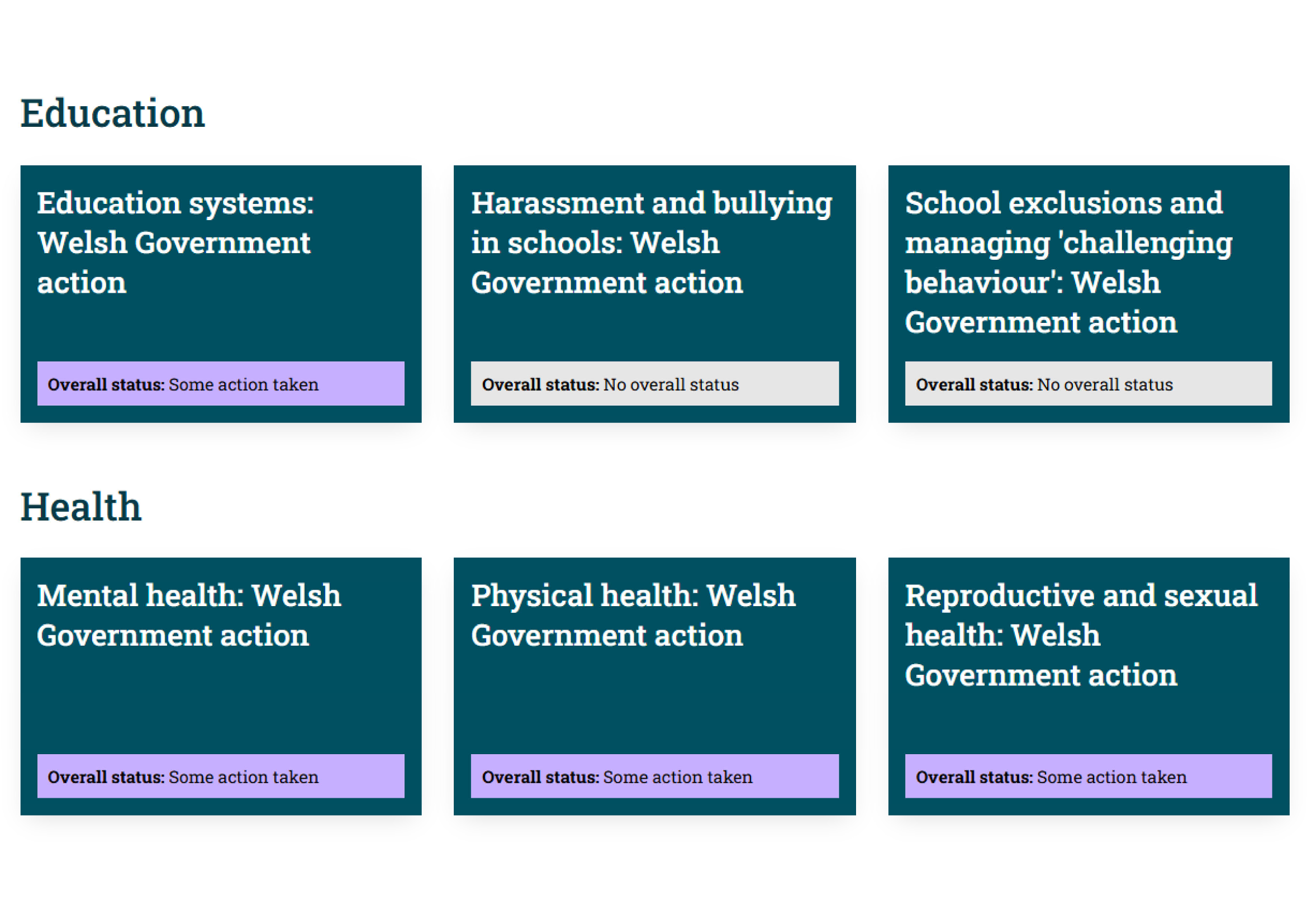
Source: Equality and Human Rights Commission
Unlike some other countries, the UK does not have a formal National Mechanism for Implementation, Reporting and Follow-up (NMIRF), as recommended by the UN, to help track government progress against UN recommendations. The EHRC launched the Human Rights Tracker in 2019 to help fill this gap. The Tracker reviewed the extent to which the UK and Welsh governments were meeting their international human rights obligations, and promoted understanding of and engagement with the UN human rights monitoring system.
The Tracker was re-launched in January 2025 with a new approach: assessing only government action on UN recommendations. This makes it clear where the Welsh Government has—or has not—taken steps towards its human rights obligations.
Senedd Members and civil society can check what’s been done across various thematic areas that impact people’s daily lives. They can also see all the recommendations made to the UK during UN treaty reviews since 2016 – available in Welsh too - and find out how to input to future review processes.
New Tracker assessments added
In November 2025, the EHRC added new assessments of the UK and Welsh governments’ action to implement recommendations made by the UN Committee on the Elimination of All Forms of Racial Discrimination in 2024.
The EHRC’s assessments suggest that, overall, there has been some progress by the Welsh Government. It notes the Welsh Government’s Anti-racist Wales Action Plan reaffirmed its commitment to be an anti-racist nation by 2030.
The EHRC saw significant action towards improving diversity in public life through updates to the Elections and Elected Bodies (Wales) Act 2024, promoting diversity in those seeking public office. However, it saw limited action to tackle racist bullying in schools, by not taking action to make reporting and recording such bullying a statutory requirement for schools.
Work continues to deliver human rights in Wales
Human Rights Day provides an opportunity to examine the progress made towards international human rights commitments. The Welsh Government, along with governments around the world, must continue to uphold its international obligations, for the enjoyment of human rights for the people of Wales.
The Human Rights Tracker is one way of monitoring how well the Welsh Government is doing this.
If you would like to find out more about the Human Rights Tracker please contact EHRCWales@equalityhumanrights.com
Article by Elinor Puzey, Senior Associate, the Equality and Human Rights Commission