







The Senedd election in May will be the first to be held under its new electoral system. This will mark the culmination of a process of institutional reform that can be traced back to the Expert Panel of Assembly Election Reform in 2017 and even further back to the Richard Commission in 2004 (this story is well-summarised here). The new Senedd electoral system is a ‘closed list proportional representation’ (closed list PR) system. We begin by exploring the concept of proportional representation (PR) and set out how the new Senedd system is designed to achieve this. We then explain how the system’s closed list determines which individual candidates are elected to the Senedd.
‘Proportional representation’
The term ‘proportionality’ when discussing electoral systems captures the degree of correspondence between the percentage of votes that parties receives and their share of seats. The new system achieves PR via a combination of two factors: district magnitude and electoral formula.
District magnitude is a technical term for the number of seats being contested in each constituency, or put differently, the number of representatives elected in each constituency. The new Senedd electoral system establishes a district magnitude of 6 seats across 16 constituencies.
The term electoral formula captures the formal mechanism through which votes are translated into seats in each constituency. In the Senedd elections, this will be achieved via the D’Hondt formula. Gallagher points out that the D’Hondt formula is the most used PR electoral formula for national elections, and that it is more generous to larger parties in comparison to alternative formulae.
How proportional is the electoral system?
While district magnitude and electoral formula interact to determine how proportional an electoral system is, it is the district magnitude that plays the more important role. Rein Taagepera developed a rule of thumb formula (75%/(district magnitude + 1) to determine ‘the vote level at which parties have a 50–50 chance to win their first seat’. The number generated for Wales’s six-seat system is 10.7%. Wales’s electoral system doesn’t set a formal national threshold for parties to be eligible for seats in a given constituency.
More generally, there is an element of randomness and unpredictability when it comes to the fine details of how national vote distributions will play out in each constituency. Dr Jac Larner at Cardiff University has developed a Senedd election simulator that lets you play out different potential electoral scenarios.
‘Closed List’
The term ‘closed list’ refers to the fact that individual candidates are elected according to their position on an ordered list. So, a party winning two seats would elect candidates in positions #1 and #2 on their list and candidates lower down the list would therefore be unsuccessful. Independent candidates can stand under this system and effectively present as single-person lists.
This way of determining which candidates on a list are elected means that the system is very straightforward from the voter’s perspective. The closed list system simply requires voters to mark an ‘X’ next to the party or independent candidate they wish to vote for. In the image below, you can see a mocked-up ballot paper:
Image: Mocked-up image of Senedd election ballot paper
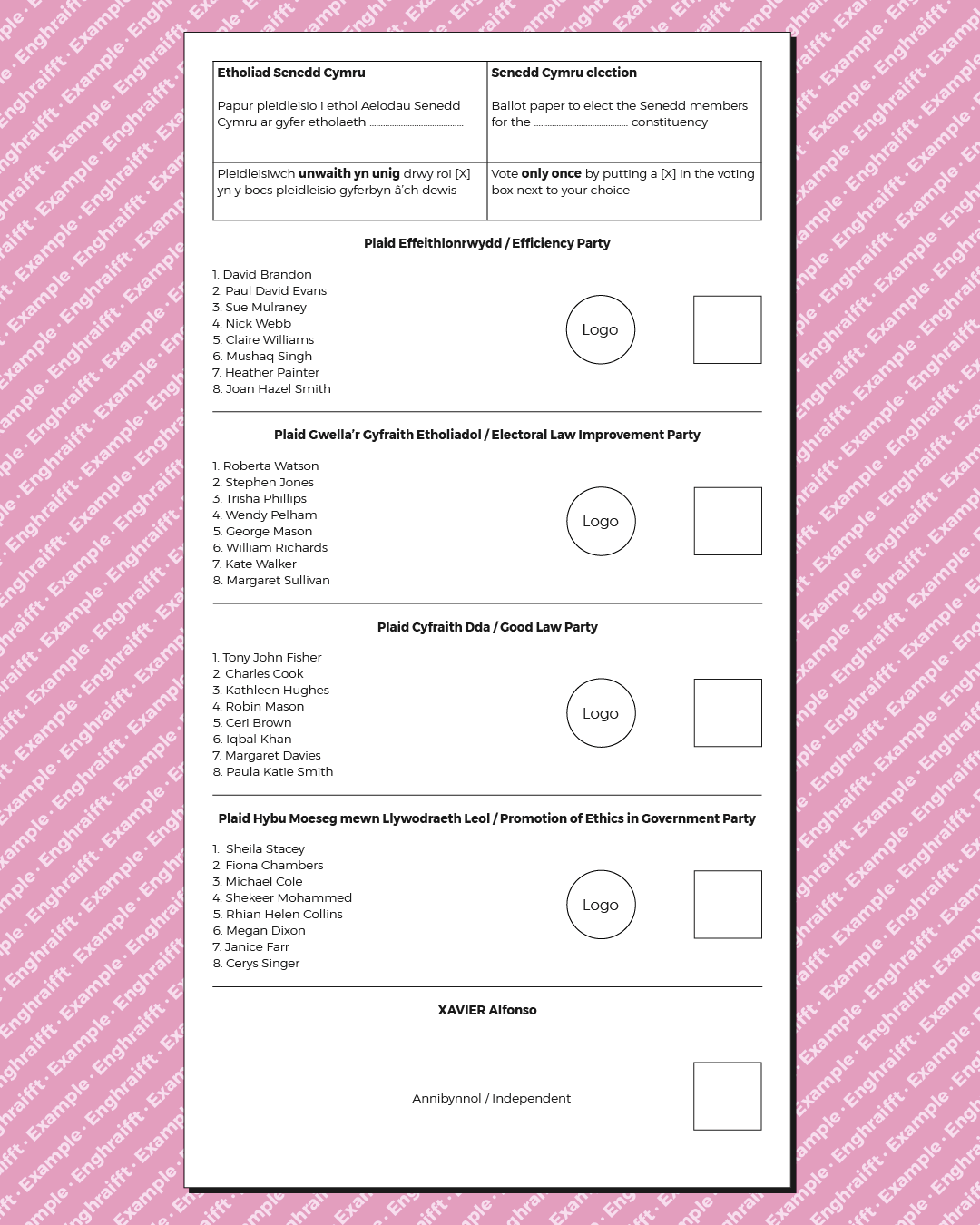
Source: Senedd Cymru
As such, the closed list PR system makes the voting process simpler in comparison to the Senedd’s former electoral system (the Additional Member System) that asked voters to cast two votes: one for a constituency candidate and one for a political party or independent candidate as regional representatives.
How do you decide what the best system is?
When it comes to the implications or consequences of electoral systems, there is no single ‘best’ system – instead there are trade-offs across the different objectives that you may want an electoral system to fulfil.
If you have a preference for a simple voting process resulting in clear majorities and single party government, you are likely to choose an electoral system relying on a plurality or majoritarian principle and a district magnitude of one. The first-past-the-post electoral system used for the UK Parliament is a clear example of this.
In contrast, somebody who wants voters to be able to signal their preferences in detail and have those preferences translated proportionally into seats, would be better advised to choose a PR electoral system with an open or flexible list that allows voters to influence the ranking of candidates on those lists.
The choice of an electoral system therefore is not neutral and comes with trade-offs, in particular between the proportionality of parliaments and the accountability of governments. John Carey and Simon Hix propose that PR systems with relatively small district magnitudes, such as the Welsh system, strike a balance between proportional representation and the ability of voters to process the party choices on offer as well as attribute political responsibility to the correct actors.
While the combination of electoral formula and district magnitude of six place the Welsh electoral system within the mainstream of modern democratic instances of PR, the use of a closed list is more contentious. Other varieties of ‘open or flexible list’ proportional systems allow voters to influence the ranking of candidates on the list. This gives the electorate a greater say over who represents them and means that parties have to forego some of their control over candidates’ chances of winning seats.
For instance, the Electoral Reform Society argue that ‘in terms of democratic legitimacy, open lists clearly trump closed lists’. While this is not a universally held position, it was the view taken by the Expert Panel Assembly Electoral Reform, which recommended the adoption of either a flexible list or Single-Transferable Vote electoral system.
However, the Special Purpose Committee on Senedd Reform, which published its report in 2022, recommended that the Senedd be elected using closed list PR. One of the main reasons for this decision was that closed list systems work well with integrated gender quotas, which can deliver more equal gender representation. This logic could also potentially apply to other under-represented groups. However, legislation to introduce a system of gender quotas for the Senedd elections was withdrawn by the Welsh Government in November 2024.
Is the system here to stay?
As we approach the Senedd election in May, it is difficult to predict how the electoral system will work in practice. However, it is possible that after the election, there could be a further change to the system. The Senedd Cymru (Members and Elections) Act 2024 requires the Presiding Officer of the newly elected Senedd to propose a motion to establish a committee to review the operation of the electoral system and produce a report. It will be for the newly elected Senedd to decide whether to agree to this motion. Depending on the experience of the system, and the evaluation of other key actors including the Electoral Commission, this may lead to further change in subsequent elections.
This guest article has been prepared for Senedd Research by Dr Anwen Elias, Dr Bettina Petersohn & Professor Matthew Wall.
Dr Anwen Elias (Aberystwyth University), Dr Bettina Petersohn and Professor Matthew Wall (both at Swansea University) are the academic team leading the 2026 Welsh Election Study.