








On 28 February, Israel and the US launched attacks on Iran, which retaliated with attacks across the region, including United Arab Emirates (UAE), Qatar, Kuwait, Bahrain, Saudi Arabia, Oman, Jordan and Lebanon.
The Welsh Government’s Middle East and North Africa (MENA) team is based across two offices in Dubai (UAE), and Doha (Qatar). Both offices are located inside British Embassies.
The Foreign, Commonwealth and Development Office (FCDO) has set up a webpage with the latest travel advice and is encouraging those affected to register to receive direct updates.
Reports say that the UK Government is preparing plans to evacuate “at least 200,000” British nationals from the region if commercial flights aren’t available.
This article highlights the Welsh and UK governments’ responses to the situation, Wales’ international obligations and trade.
First Minister responds
On 28 February, the First Minister responded to the situation on X:
The ongoing situation in Iran is deeply concerning.
The people of Iran have long endured a repressive regime - I’m clear that it must never gain nuclear weapons.
Our immediate international priority must be de-escalation, the protection of civilian life, and renewed diplomacy.
Instability in the region inevitably has a ripple effect here in Wales. I support the UK Government’s work to seek a path toward peace. Upholding international law remains fundamental.
The First Minister told BBC Wales’ Sunday Supplement on 1 March that:
The situation in Iran is deeply concerning, there will be people across Wales today who are following events really closely and some will have links with the region, some may even be visiting the region as we speak […]
It's clear that the people in Iran have endured a oppressive regime for several decades and I'm very clear that they should never be able to develop a nuclear weapon. But I think our priority now should be to deescalate. We need to protect civilian life andI think we've got to be clear that instability in the Middle East will have an impact here in Wales. I'm very clear that upholding international law should remain a red line for us. […]
There will certainly be an economic impact if you think about the Strait of Hormuz and the fact that there may be a blockage in terms of trade and the price of oil and things and that obviously will have a knock on effect. But I’m very clear that that is not the responsibility of the Welsh Government […]
The First Minister added that she is “very concerned about community cohesion” and that:
I want to make sure that there is protection for all our communities and we will all have a role in playing to make sure that we don't see those kind of tensions arise within our communities in Wales.
In addition to reports of rising oil prices, reports of disruption to Liquid Natural Gas (LNG) supply at Milford Haven port are also emerging.
UK Government publishes summary of legal advice
On 2 March, the Prime Minister published this summary of the UK Government’s legal position on ‘the legality of defensive action in respect of Iranian regional attacks’:
The UK condemns in the strongest terms the Iranian regime’s reckless and ongoing indiscriminate attacks against countries in the region. Such actions demand a united response to restore peace and security and prevent further escalation of the conflict.
As well as defending itself and its position in the region, the UK is acting in the collective self-defence of regional allies who have requested support. The UK and its allies are permitted under international law to use or support force in such circumstances where acting in self-defence is the only feasible means to deal with an ongoing armed attack and where the force used is necessary and proportionate.
Accordingly, the UK has military assets flying in the region to intercept drones or missiles targeting countries not previously involved in the conflict. In addition, the UK has responded to a US request which will facilitate specific and limited defensive action against missile facilities in Iran which were involved in launching strikes at regional allies.
The UK’s actions and related support to its allies is solely focussed on ending the threat of air and missile attacks against regional allies unlawfully attacked by Iran and who have not been involved in hostilities from the outset. It does not signal the UK having any wider involvement in the broader ongoing conflict between the US, Israel and Iran.
The UK remains of the view that a negotiated solution should be supported, and that further escalation into a wider regional conflict should be avoided.
The Government will notify the United Nations Security Council of relevant actions taken under Article 51 of the United Nations Charter.
Article 51 of the UN Charter requires states to notify the Security Council when exercising the right of individual or collective self-defence before it has taken measures necessary to maintain international peace and security.
Devolution and international obligations
While international relations is a reserved matter, there is scope for the Welsh Government to act in an international capacity. For example, it can conclude non-binding agreements with other governments in devolved areas, have international offices and hold meetings with counterparts from other countries.
Another article explains this part of devolution and why devolved governments can carry out international activity.
Welsh Ministers must observe and implement international obligations. International obligations cover legal duties and commitments the UK has agreed to, or universal rules of international law.
And although not a legal duty, the Welsh Government’s Ministerial Code also places a specific duty on Welsh Ministers to comply with international law and treaty obligations.
Trade
The Welsh Government’s priority markets, in the MENA region are UAE, Qatar, Saudi Arabia, Kuwait, Oman, and Bahrain. These states make up a trade bloc, the Gulf Cooperation Council (GCC) which is currently in trade negotiations with the UK. The Cabinet Secretary for Economy, Energy and Planning, Rebecca Evans MS is due to attend the next meeting of UK Ministers on trade with the US and the GCC on 4 March. She will also attend the Economy, Trade and Rural Affairs Committee for trade scrutiny on 5 March alongside the Deputy First Minister, Huw Irranca-Davies MS.
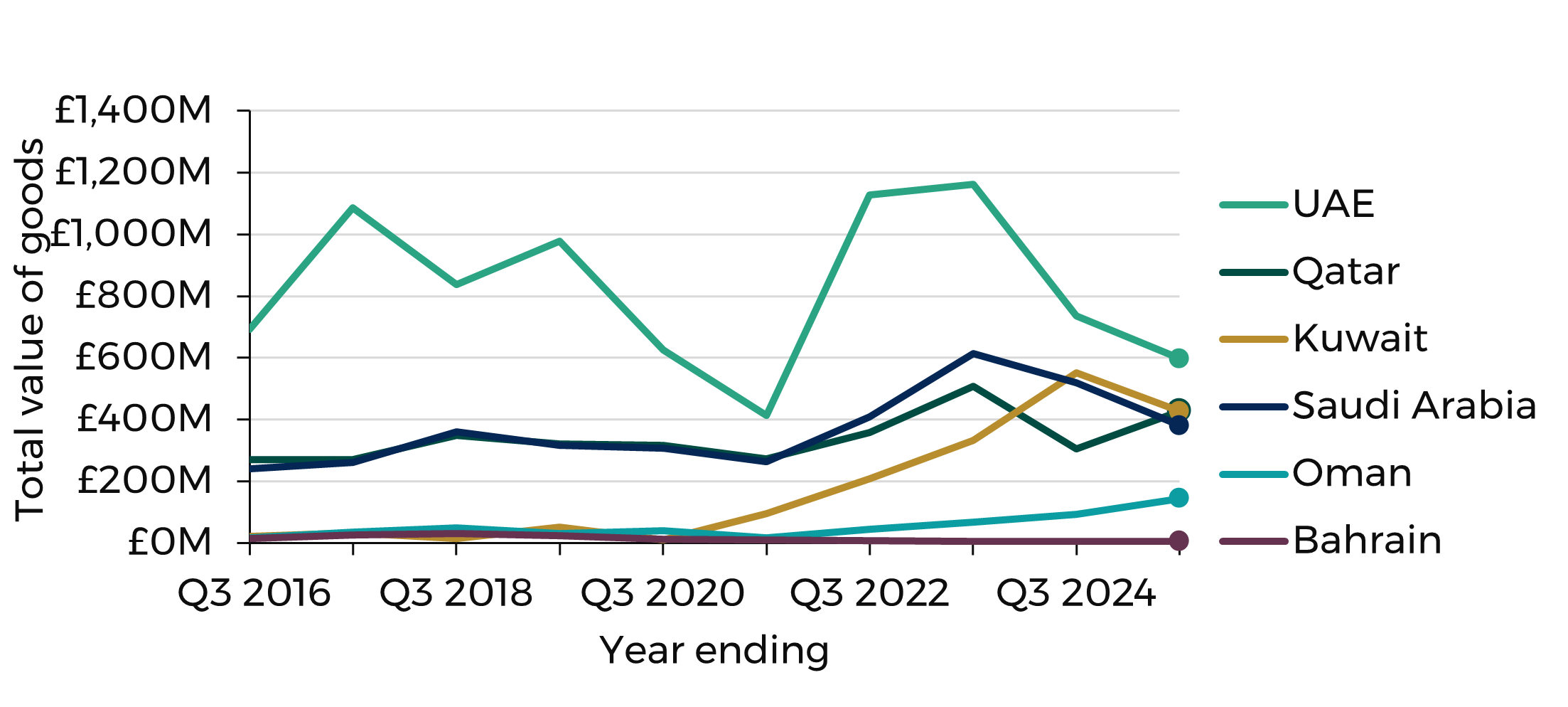
UAE, Qatar and Saudi Arabia make up the majority of Welsh trade with the region. The latest trade in goods statistics, year ending September 2025, show that Wales’ greatest value export to GCC states was power generating machinery and equipment. Petroleum, petroleum products and related materials were its greatest value import.
The table below shows how each GCC state ranks amongst Wales’ trading partners.
Wales’ trading partners: GCC state rankings (by export/import and value)
|
Trading partner |
Ranking: exports |
Ranking: imports |
|
UAE |
12th |
17th |
|
Qatar |
13th |
25th |
|
Saudi Arabia |
16th |
30th |
|
Kuwait |
63rd |
14th |
|
Oman |
37th |
36th |
|
Bahrain |
84th |
99th |
Source: Welsh Government statistics: International goods trade: interactive dashboard
The graph below compares the latest value in trade between Wales and each individual GCC state, with previous periods.
Trade with GCC states: total value of goods by year
Wales’ trade with Israel, Jordan and Lebanon is much smaller. In the year ending September 2025, the total value of goods traded with Israel was £87.5m. With Jordan, it was £40.8m and with Lebanon it was £7.0m. Wales does not trade with Iran, which is subject to over 600 UK sanctions.
Of the states involved in the conflict, the US is Wales’ largest trading partner by far. Total Wales-USA goods trade in the year ending September 2025 was worth £5.9bn. Of individual countries who import into Wales, the US is the largest by value with a sizeable lead over China.
This article will continue to be updated as the conflict develops.
Article by Sara Moran, Madelaine Phillips and Josh Jenkins, Senedd Research, Welsh Parliament
