






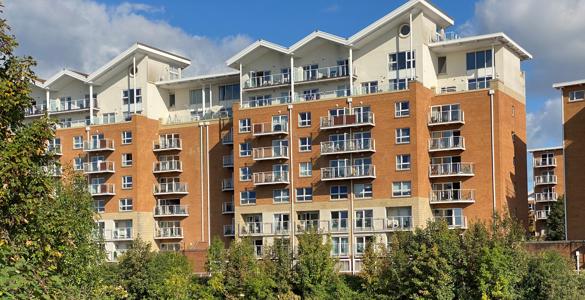
The Welsh Government’s Building Safety (Wales) Bill sets out a new approach to managing safety risks in multi-occupied buildings, seeking to address systemic failures that led to the Grenfell fire more than eight years ago.
Focusing on fire and structural safety while a building is lived in (the “occupation phase”), the proposed new regime includes all buildings with two or more residential units.
By contrast England’s new regime applies only to “higher-risk buildings”, meaning those at least 18 metres in height or with at least seven storeys. The regime, contained in the Building Safety Act 2022, has been in force since January 2024.
The Local Government and Housing Committee’s Stage 1 report on the Bill warned that resource pressures and workforce gaps mean the Welsh Government’s decision to include smaller and lower-risk buildings needs a rethink.
Another of the Committee’s concerns is that the Bill doesn’t include measures to speed up remediation of existing safety problems identified in the wake of Grenfell, particularly those that major developers are responsible for remediating.
Ahead of the Stage 1 plenary debate on 9 December 2025, this article looks at what scrutiny of the Bill has found so far.
What does the Bill do?
The Bill divides buildings within scope of the new regime into three categories:
- Category 1 – at least 18 metres or 7 storeys high. There are around 180 of these in Wales, mainly concentrated in Cardiff and Swansea;
- Category 2 – between 11-18 metres or 5-7 storeys high. There are around 449 of these; and
- Category 3 – less than 11 metres or 5 storeys high. There are more than 51,000 of these.
The regime also includes certain houses in multiple occupation (“relevant HMOs”).
Every building in the three categories will have:
- a person with lead responsibility for safety, known as the “accountable person” (or “principal accountable person” if there’s more than one);
- a record of building safety information (known as the “golden thread”); and
- a fire safety risk assessment carried out by a “competent person”, who must review it annually (or redo it in certain circumstances).
Other requirements are weighted towards higher buildings. The requirements for category 1 buildings include having a residents’ engagement strategy, a system for investigating residents’ complaints, a building safety certificate, and a safety case report.
For buildings in categories 1 and 2, the regime doesn’t just cover fire safety risk but also structural safety risk. Buildings in these two categories will have to register with the Building Safety Authority (discussed below) for their area.
Who is going to regulate?
Two types of body will oversee the regime: Fire Safety Authorities and Building Safety Authorities.
The Welsh Government intends Wales’s three fire and rescue services to act as Fire Safety Authorities. The question of who should act as Building Safety Authorities has been less clear.
The Welsh Government said it intends these functions to be delivered by local authorities, but admitted that having 22 Building Safety Authorities wouldn’t be practical.
Despite this, the Bill as introduced creates 22 Building Safety Authorities. The Cabinet Secretary subsequently told the Committee that work had taken place over the summer to identify a preferred model, and confirmed that this would be for three Building Safety Authorities, mirroring the footprint of the fire and rescue services.
The Committee regretted that this approach was announced too late to be subject to Stage 1 scrutiny.
Overstretching?
A key concern of many witnesses was that local authority regulatory functions are already significantly overstretched.
There was widespread support for bringing category 1 and 2 buildings into the regime as soon as possible. But some said the case for change is less clear for category 3, arguing that this will be a ‘big ask’ due to the high numbers. Some also doubted bringing in relevant HMOs, saying they are already well regulated.
The Committee concluded that the Welsh Government hasn’t proven that there’s enough safety risk in category 3s and relevant HMOs to justify their inclusion. It called for the Welsh Government to provide evidence to show that the additional workload of including these buildings will be proportionate to the safety benefits.
This is all the more important, said the Committee, in light of evidence suggesting that the Bill could reduce housing supply by increasing the cumulative burden of regulation on private and social landlords.
The Committee suggested that, if necessary, category 3s and relevant HMOs should be stratified by risk, with higher-risk buildings prioritised first.
What about remediation?
In oral evidence the campaign group Welsh Cladiators called on the Welsh Government to take urgent action:
For the thousands of unheard people trapped in unsafe flats, paying extortionate service charges, unable to either start families or downsize as they age, many struggling with their mental health, others simply wanting to just move on, I'm asking on their behalf: please get this mess fixed, not over another five years, but right now.
Many witnesses told the Committee it would be ‘a missed opportunity’ not to include powers in the Bill to force developers to speed up remediation.
The Cabinet Secretary for Housing and Local Government Jayne Bryant MS said that while ‘we do want to see the remediation programme move as quickly as possible’, the Bill doesn’t include legal measures because none had been included in the White Paper consultation.
The Committee said it is ‘deeply concerned’ at a lack of progress by developers. It recommended that the Bill is amended to include legally enforceable completion deadlines, with penalties for failing to address deficiencies in time.
Next steps
On Tuesday 9 December, the Senedd will vote on whether to support the general principles of the Bill. If passed, it will be subject to amendments at Stage 2.
You can watch the debate live on Senedd TV or read the transcript shortly afterwards.
Article by Jennie Bibbings, Senedd Research, Welsh Parliament
