






On 20 January the Welsh Government laid its Final Budget 2026-27. Alongside it, the Final Local Government Settlement 2026-27 sets out an increase in the overall core funding for local authorities of 4.5% compared to 2025-26, up from the 2.7% originally proposed in November.
In this article we consider the funding across local authorities, which will be debated alongside the Final Budget on Tuesday 27 January.
Budget agreement leads to an extra £112.8m for local authorities
The Welsh Government’s Draft Budget 2026-27 was presented as taking a ‘business-as-usual’ approach to allocations, with increases proposed in line with inflation. The Provisional Local Government Settlement for 2026-27, published in November, included an increase in core funding for local authorities of 2.7% (or £169.5m).
Following the budget agreement reached between the Welsh Government and Plaid Cymru, an extra £112.8m was announced for local government. This was alongside extra funding for health.
Core funding for local authorities to increase by 4.5%
Core revenue funding for local authorities comprises the Revenue Support Grant (RSG) and Redistributed Non-Domestic Rates (NDR), and is also referred to as Aggregate External Finance (AEF). AEF makes up the bulk of the Welsh Government’s funding to local authorities and will be £6.6bn next year. After adjusting the figures to make them comparable, that’s an increase of £282.3m or 4.5%, compared to 2025-26. In 2025-26, funding increased by 4.5%.
The largest percentage increase in funding for an individual local authority is for Newport (6.1%). Newport also had the highest percentage increase last year.
Figure 1: Change in AEF (adjusted) by local authority (2025-26 to 2026-27)
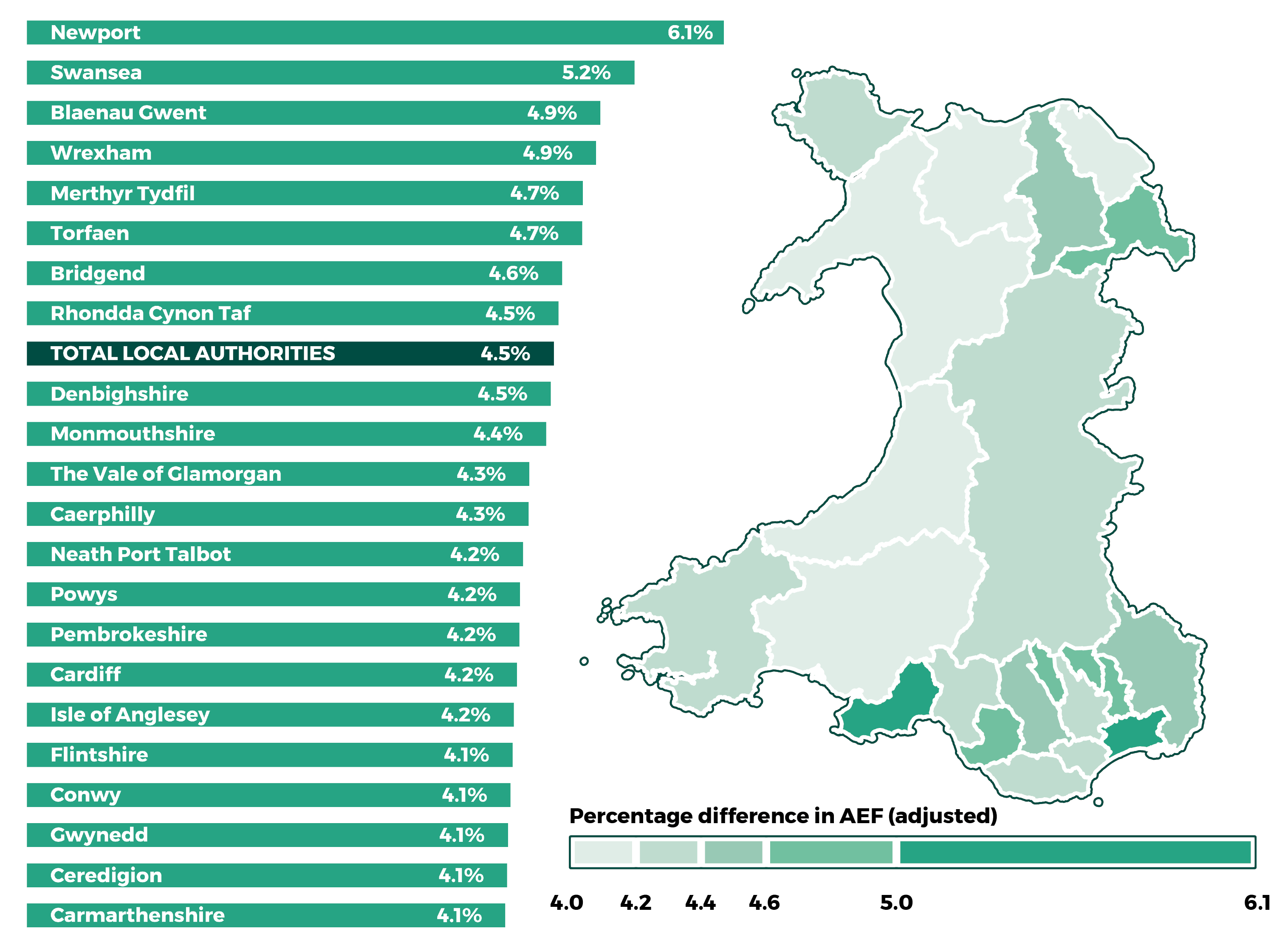
Source: Senedd Research and Welsh Government – Final Local Government Settlement 2026-27 (tables)
As well as the increase to core revenue funding, the Settlement outlines revenue grants of £1.3bn for 2026-27 and capital grants of £1.1bn, which includes general capital funding of £204m.
No authority gets less than a 4% increase
The Welsh Government again planned to implement a funding floor for 2026-27. This originally meant no authority would get less than a 2.3% increase, with top-up funding provided to 10 local authorities to ensure they didn’t fall below this level. However, the increase in funding at the Final Settlement now means no authority will get less than a 4% increase. The top-up funding allocated at the Provisional Settlement also appears to still be allocated to the 10 authorities at the same level in the Final Settlement. For 2025-26, the Welsh Government implemented a funding floor which meant no local authority got less than a 3.8% increase.
Following scrutiny of the Draft Budget and Provisional Settlement, the Local Government and Housing Committee voiced concerns that the repeated use of a funding floor indicated structural problems with the funding formula. It also highlighted the age of some of the data used to allocate funding, noting some indicators used data from the 1991 census. The Committee recommended the Welsh Government prioritise a review of the data and indicators that underpin the funding formula.
Estimated pressures of £1.6bn over the next three years
While the extra funding has been welcomed by the WLGA, it also estimated in September the financial pressure facing local authorities over the next three years is £1.6bn. For 2026-27, the WLGA estimated local authorities face budget pressures of £560m.
Demand for services is one of the areas the WLGA highlights as a significant element of pressure, noting specifically children’s social care and Additional Learning Needs within education. Acknowledging the pressures on local authorities, the Cabinet Secretary for Housing and Local Government says the “rise in school deficits cannot be overlooked”, going on to say the Settlement “offers a valuable opportunity for local authorities to allocate significant resources to their schools”.
Pressures in the current financial year are also estimated to be “large by historical standards”. In September, the WLGA said across local authorities there’s £184.3m of pressures being projected in-year. Around £70.8m of that relates to schools, closely followed by social care pressures of £69.3m. Prior to the announcement of additional funding in December, the Auditor General suggested to the BBC “one or two local authorities are very, very close to the edge in terms of their financial sustainability”, going on to say “It wouldn't take very much to push them over that edge”.
Council tax levels for 2026-27 to be determined
The Welsh Government isn’t the only source of funding for local authorities. Discussions around council tax will be ongoing as local authority budgets are proposed and agreed in the coming months. Analysis from Cardiff University shows council tax bills have “effectively tripled” since 1999, with “notably faster” increases in Wales than England and Scotland since 2010. The WLGA notes a similar trend, describing increases in council tax over the last three years as “unpalatable and unsustainable for hard-working families”.
The Leader of the WLGA told the BBC in December increases were likely to be less than they could have been prior to the budget agreement. However, he stopped short of making the commitment that council tax bills wouldn’t go up, and noted demand for services was still "outstripping" funding.
What next for local government?
While the Cabinet Secretary for Finance and Welsh Language, Mark Drakeford MS, says the Final Budget provides certainty for public services, he notes it also “provides the next government with the platform to set its own priorities for the future”. The 2026-27 budget, including the Final Local Government Settlement, allocates funding for a financial year that falls mainly after the election on 7 May.
While the Final Settlement provides funding clarity in the short term, it won’t be until after the election that local government gets an indication of what things might look like over the next Senedd term. In the meantime, you can watch the debate on the Final Budget and Final Local Government Settlement on SeneddTV on 27 January 2026. A transcript will be available shortly afterwards.
Article by Owen Holzinger, Senedd Research, Welsh Parliament